Showing posts with label Fox Cinema Archives. Show all posts

6/26/2014

Fox Cinema Archives DVD Review: Kentucky (1938)


Now Available to Own   


He may have been typecast and he was definitely too young for most of the roles he was offered but when it came right down to it, nobody played an old man better than Walter Brennan.

A character actor before there ever was such a term, although he played old men nearly his entire career, there was never anything caricature-based or disingenuous about Brennan's portrayals (whether he was cantankerous, charming or a curmudgeon) and he never played the exact same man twice.

In 1938, Brennan was only 44 years old when he portrayed a character roughly double his age in a performance that would garner him an Academy Award and help inspire the Walter Brennan "type" he was sought to inhabit again and again.


Yet Brennan’s ferociously lively and powerful turn in Kentucky is so good that even though he was a mere supporting player, his presence loomed large over not only the main romantic star-crossed lovers plotline at its core but Brennan also dominated scenes in which he didn’t even appear.

The best of his early state-name horse pictures including Home in Indiana and Maryland, White Fang and Calamity Jane filmmaker David Butler’s winning drama has been brought back to digital life thanks to a lush DVD transfer as part of Fox Cinema Archives’ latest wave of manufactured-on-demand classic films.

Released this past spring, Fox’s debut of Kentucky (which was based on John Taintor Foote’s story The Look of Eagles) as part of the Archive series was well-timed to coincide not only with the recent Oscars telecast but also the Kentucky Derby.


It's a compelling work that grabs you from its remarkable period prologue. The film revolves around a Romeo and Juliet or – to use a more American reference – Hatfield and McCoy style feud between two Kentucky families that began when being on opposite sides of the Civil War resulted in Goodwin blood being spilled by a member of the Dillon family.

Seventy-five years after he saw his father gunned down during a disagreement over letting Union soldiers take their champion thoroughbred horses, Brennan’s Peter Goodwin has vowed never to have anything to do with the Dillons.

But when the youngest member of the Dillon tree (played by Richard Greene) falls for Loretta Young’s beautiful Goodwin lass from afar, he vows to put aside the bad blood between them in order to follow his heart.

Yet when history repeats itself in the form of more deadly betrayal, gossip and lies, the feud is forced back onto the front burner as the Kentucky Derby draws nearer, predictably pitting the two families against each other.


Admittedly, it’s hard to watch the cringe-inducing, degrading way that African-American actors are used in the movie as essentially cartoonish buffoons. However, if you’re able to look past it and keep the film’s time period in mind (given our contemporary era of political correctness, which was sadly, regrettably nonexistent in 1938), then you’ll appreciate the rest of the picture as a richly made, thoroughly engrossing piece of pre-WWII entertainment.

A beautifully lensed Technicolor horse epic from cinematographers Ernest Palmer and Ray Rennahan, this Daryl F. Zanuck production may show its age with regard to the aforementioned racial insensitivities and a few clunky edits that don’t flow smoothly by waiting a long while to follow up on gaps in logic.

Nonetheless, it’s buoyed by its convincing cast and the timeless tale of lovers whose romance thrives despite which side of the horsetrack they’re from.

Likewise, Kentucky’s strongest asset is in the always timeless Walter Brennan who, despite mastering the art of defying time on and offscreen always made us think of his age as an afterthought when contrasted with the larger-than-life personalities of the characters he embodied throughout his enviable career... starting with his Oscar wining turn as a Kentucky horseman.


Bookmark and Share

Text ©2014, Film Intuition, LLC; All Rights Reserved. http://www.filmintuition.com Unauthorized Reproduction or Publication Elsewhere is Strictly Prohibited and in violation of the Digital Millennium Copyright Act.  FTC Disclosure: Per standard professional practice, I may have received a review copy of this title in order to evaluate it for my readers, which had no impact whatsoever on whether or not it received a favorable or unfavorable critique.

6/23/2014

Fox Cinema Archives DVD Review: Forever Amber (1947)


Now Available to Own   


Like the hand-painted pages in an old-fashioned storybook, Forever Amber is a lush Technicolor adaptation of Kathleen Winsor’s eponymous, scandalously sexual 972 paged epic.

Obviously inspired by Scarlett O’Hara, Amber concerns a willful social climber in 17th century England who escapes what she perceives will be a dull life as a farm wife for the first of many affairs and men until she reaches a higher status and title as part of the royal entourage.


Given the sudsy potential of Winsor’s rabid bestseller that in all actuality boasts too much plot to easily capture in a little over two hours, Twentieth Century Fox wasted no time in snapping up the rights of what they hoped would be the next Gone With the Wind.

Replacing not only its original lead (with a sensational Linda Darnell filling in for young inexperienced newcomer Peggy Cummins) but the film’s director as well, Fox pulled out all the stops to ensure that their adaptation of the book that had been banned by the Catholic Church and condemned by the Hay’s Code would be worthy of the public’s adoration.

Giving the work a whopping estimated budget of six million dollars, studio bosses kept a close eye on production. Needing to substitute Leave Her to Heaven helmer John M. Stahl (after thirty-nine days and three hundred thousand dollars worth of funds had been spent), they chose Otto Preminger, who not only had a history with Fox but with each successive film had begun branching out to different genres.


Following his work on early screwball comedies (like Danger – Love at Work) to Broadway adaptations (Margin for Error) and Film Noir (Laura), Preminger proved adept at period productions, tackling A Royal Scandal and Centennial Summer for Fox.

He banded together with an impressive group of behind-the-scenes collaborators including the man who’d lensed Stahl’s gorgeous Leave Her to Heaven and would go on to film South Pacific, The King and I, and Cleopatra in the form of Leon Shamroy. And together, Preminger and Shamroy made a staggeringly ambitious, sophisticated sudsy epic that painted Amber in Scarlett O’Hara light, complete with a heartbreaking final shot.

Reuniting with composer David Raskin who’d scored Laura with what is now considered a definitive Noir genre soundtrack, Preminger and Shamroy’s frames inspired Raskin to new heights as his lively, romantic Amber score garnered the musical virtuoso an Oscar nomination.


An easily compelling period work — while admittedly daring in its frank depiction of a morally loose woman — Amber also managed to make us empathize and identify with the self-sufficient and at times coldly ambitious (anti)heroine against the odds.

Given Amber’s multifaceted characterizations that are much more fascinating when viewed through the lens of a different time period, credit is due to its three talented screenwriters who’ve managed to address certain double standards about gender in a surprisingly daring work for its 1947 release date (not to mention its 17th century setting).

Hardly an era of women’s lib, nonetheless Amber’s struggle to reconcile her own needs and wants with her role as a single mother — while the father of her son lives a carefree life free from responsibilities — is touched upon in intriguing ways throughout the film.


While we can’t abide her more manipulative side, all in all, Amber is damned if she does and damned if she doesn’t while trying to find her way in a time period where women are defined by their associations with men.

Released during the height of the post-Casablanca/post-WWII women’s weepie subgenre, the film helped foreshadow the popular theme of ‘50s melodramas in which sometimes people don’t live happily ever after. Likewise arguing that there are different societal roles and expectations for each gender, Amber’s rich subtext makes Preminger’s long out-of-print, engrossing epic such a tantalizing find today.

A conflicted, complicated movie with its fair share of conflicted, complicated three dimensional characters, Forever Amber has been given a beautiful high gloss polish to the old Technicolor negatives for this Fox Cinema Archives release.

The latest entry in the studio’s collection of manufactured on demand Preminger titles (following the recent slate of his earliest directorial efforts released at the start of the year), Forever Amber will also be forever remembered for helping give birth to the popularity of its heroine’s name in post-WWII newborns of the baby-boomer generation.


Bookmark and Share

Text ©2014, Film Intuition, LLC; All Rights Reserved. http://www.filmintuition.com Unauthorized Reproduction or Publication Elsewhere is Strictly Prohibited and in violation of the Digital Millennium Copyright Act.  FTC Disclosure: Per standard professional practice, I may have received a review copy of this title in order to evaluate it for my readers, which had no impact whatsoever on whether or not it received a favorable or unfavorable critique.

6/05/2014

Fox Cinema Archives DVD Review: Footlight Serenade (1942)

 
Now Available to Own   


Fox Cinema Archives Photo Slideshow


“That’s the trouble with this business. They’ll never give a new face a chance,” a backstage hand sweeping floors complains in Footlight Serenade while at that very moment, one new face belonging to Betty Grable’s Pat Lambert is being given her big break.

Chosen out of sixty chorus girls not only for her ability to dance and chew gum at the same time but also her easy on the eyes beauty, Pat discovers she’s caught the eye of pompous boxer turned Broadway headliner, Tommy Lundy (Victor Mature).


Yet unfortunately for Tommy, the man no one dares to say no to in a sea of yes men has just picked a woman who’s recently said yes to another man down at city hall (in the form of John Payne’s fellow dance man, Bill).

Pushed into keeping their vows a secret from the lovesick brawler just to ensure the show will go on, when eventually the two men begin to battle over Grable, the onstage choreographed bouts take a threatening turn for realism after Tommy vows to knock out his romantic rival for good.

The last fully black and white filmed musical for Fox’s rising box office superstar Grable, while she was billed after Payne in director Gregory Ratoff’s fast-moving yet predictably formulaic “let’s put on a show” subgenre offering, it’s Grable’s show from start to finish.


And as Footlight’s hardworking hoofer/secret bride, the dancer dazzles in a role that seems tailor-made for the star as alter-ego Pat Lambert’s onscreen big break coincided with Grable’s offscreen break into films built around her as the overall lead in her own right.

Rounding out an excellent cast with affable turns by the charismatic Mature who makes Payne’s underwritten Bill that much duller by comparison, Footlight Serenade packed the screen with future TV stars and A-listers alike including Jane Wyman, James Gleason and Phil Silvers.

Aside from her likable girl-next-door approachable blend of carefree charm with capable moves (hoofing it up in the crop top clad bubblegum number with Payne), Serenade really gets going in a boxing Betty Grable led chorus girl showpiece to “I Heard the Birdies Sing.”


Although forgettable by today’s standards due to its generic plot, this B-musical helped foreshadow the big breakout to come for new(er) face Betty Grable in future Fox Cinema Archive hits like their recent DVD release of Mother Wore Tights which was one of the star’s personal favorites. 

Bookmark and Share

Text ©2014, Film Intuition, LLC; All Rights Reserved. http://www.filmintuition.com Unauthorized Reproduction or Publication Elsewhere is Strictly Prohibited and in violation of the Digital Millennium Copyright Act.  FTC Disclosure: Per standard professional practice, I may have received a review copy of this title in order to evaluate it for my readers, which had no impact whatsoever on whether or not it received a favorable or unfavorable critique.

5/16/2014

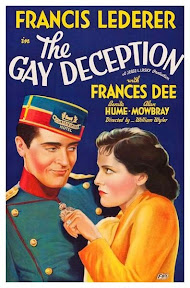
Fox Cinema Archives DVD Review: The Gay Deception (1935)


Now Available to Own   


Fox Cinema Archives Collection: 
Photo Slideshow   


A long out-of-print classic from director William Wyler, 1935’s The Gay Deception was one of the Oscar winner’s earliest successes.

A gender flipped version of the same mistaken identity premise he would bring to life once again in his 1953 masterpiece Roman Holiday, Deception derived its comedic plotline from the idea of a royal subject pretending to be an average Joe.

And while it pales in comparison to the film that introduced the world to Audrey Hepburn, it’s still a charming example of the type of wish-fulfillment movie-making that was especially popular as a source of escapism during the Great Depression.


Centered on a hardworking secretary who wins a five thousand dollar sweepstakes out of the blue, while Mirabelle (Frances Dee) is advised to put the money in the bank to enjoy a lifetime of accrued interest – long-tired of office life and in desperate need of a break, Mirabelle ventures to New York to live like the characters in her favorite films.

Told the most she can hope for is a month of pampering before her money runs out, Mirabelle is stunned to discover that the difference between the reality of high society is nowhere near as exciting as the stuff of celluloid fantasy as she spends most of her evenings going to the movies alone.

While some of the hotel’s other rich and powerful guests treat her with the icy reception of your typical high school clique, Mirabelle finds that she can’t escape the attention of a persistent yet suspiciously overconfident bellboy (played by Francis Lederer).

Really a prince in disguise, the two start off on the wrong foot as (not understanding the value of money or the effect of unsolicited negative opinions) he destroys her expensive yet overly decorated hat that he feels takes away from her looks.

But after he gets continuously fired and rehired (courtesy of calls from a conspirator at the consulate), the two feisty, fast-talking leads fight and flirt their way into the obligatory big reveal.

Even though it follows the genre conventions (which admittedly were fairly new at the time) to the retroactive letter, it’s a classy picture the whole way.


Foreshadowing the success that Wyler would have throughout his prolific career, Deception’s success as a fine film in its own right owed much to the involvement of those working on both sides of the lens from its Oscar nominated writers Stephen Avery and Don Hartman as well as a young Preston Sturges (who wrote a song for the picture) to its energetic cast.

While unfortunately the hero’s conceited personality grows old fairly fast, you have to applaud the boldness of Twentieth Century Fox to serve up a flawed lead, which in retrospect is quite refreshing given the interchangeably bland pretty boy archetypes that currently populate contemporary romantic comedies.

Still, fortunately for the audience, The Gay Deception nonetheless improves as it continues and with it so does the male lead’s characterization as Lederer begins to change once he’s called out on his arrogance by Dee.

Ultimately forgettable yet frothy and fun, the film (which was revived by the studio in time for its Fox Cinema Archives DVD release last month) is a wholly enjoyable find for film buffs and Wyler fans alike who are eager to seek out more hidden gems from the noted perfectionist’s five-decade spanning career.


Bookmark and Share

Text ©2014, Film Intuition, LLC; All Rights Reserved. http://www.filmintuition.com Unauthorized Reproduction or Publication Elsewhere is Strictly Prohibited and in violation of the Digital Millennium Copyright Act.  FTC Disclosure: Per standard professional practice, I may have received a review copy of this title in order to evaluate it for my readers, which had no impact whatsoever on whether or not it received a favorable or unfavorable critique.

3/26/2014

Fox Cinema Archives DVD Review: Margin for Error (1943)


Now Available to Own


  Fox Cinema Archives Photo Slideshow


Bookmark and Share

AKA Clare Booth Luce’s Margin For Error 

Directed by Otto Preminger, who also starred as the villainous Nazi during the Broadway run of Clare Booth Luce’s flag-waving ode to democracy, when Twentieth Century Fox brought the play, they wanted Preminger to reprise his role for a different director altogether.

Purchased as a hot property for Ernst Lubitsch, Preminger stuck to his guns, bargaining hard with the studio he’d already helmed a screwball comedy for years earlier with Danger – Love at Work.

Offering to act for free if they didn’t like the dailies he presented after a week on the job, Fox gave him the opportunity to act and direct which Preminger vowed to make the most of by reworking the wooden, speech-filled script adapted by Lillie Hayward. To give it the right edge, Preminger employed a newcomer fresh from the army in the form of an uncredited Samuel Fuller who helped load every scene with the utmost potential for suspenseful double-cross.


As this film finds him working in the mystery thriller genre that would become his wheelhouse, Margin for Error is bogged down less by Preminger the director than by Preminger the over-actor.

Failing to adapt his stage performance adequately for the small screen, Preminger comes off far too broadly and boldly in the process, emoting to the cheap seats and shouting to the rafters forgetting that he only needed to play to the camera in what is ultimately a B-movie thriller.


Though of course the art form was still evolving and this was made a good ten years before more naturalistic performances became the norm with the popularity of Lee Strasberg’s Method and The Actors Studio, Preminger’s hammy, campy Nazi turn fit right in with what Fox was hoping to achieve in translating the stage show to the screen. In fact, the executives were so impressed that they signed him to a seven year deal as both an actor and a director for the studio.

While Luce’s original plotline about a Jewish policeman assigned to protect the life of a Nazi German Consulate member had its roots in history as a FDR inspired plan to make an Anti-Semitic speaker look even more ridiculous when given a Jewish police protection detail, unfortunately the usually comedic Milton Berle is well out of place in his film role as the NYPD’s “most promising cop.”


Although the infinitely clever ending recalls the set-up that helped construct the murder mystery in Robert Altman’s Gosford Park as we’re given a death that plays out multiple ways, overall it’s an uneven B-movie.

Despite this, it’s perhaps best appreciated by Preminger fans hoping to see one of the filmmaker’s earliest achievements of merit before he would go on to helm the definitive Film Noir just one year later with the divine Laura.


An interesting example of a filmmaker finally starting to grow confident about the right material and the right collaborator in terms of thrillers and Samuel Fuller, Error brings film buffs back in time with this Fox Cinema Archives release.

A lost look at a director we’ve come to know well, Margin shows us a Preminger who wasn’t afraid to work for free to show those studio heads what he could do, knowing he could leave no margin for error if he ever wanted to work behind the camera as well as in front of it to release the films that would become synonymous with his name.


Text ©2014, Film Intuition, LLC; All Rights Reserved. http://www.filmintuition.com Unauthorized Reproduction or Publication Elsewhere is Strictly Prohibited and in violation of the Digital Millennium Copyright Act.  FTC Disclosure: Per standard professional practice, I may have received a review copy of this title in order to evaluate it for my readers, which had no impact whatsoever on whether or not it received a favorable or unfavorable critique.

3/21/2014

Fox Cinema Archives DVD Review: 5 Fingers (1952)


Now Available to Own  
Bookmark and Share

AKA: Five Fingers
Long Title: The Story of the Highest Paid Spy in History 

From the days of Jane Austen all the way up through the smash success of the Upstairs Downstairs inspired Downtown Abbey, for centuries the world has been entertained with tales of British society.

And while they’ve been the home to many talented writers, one of the most popular themes that’s been milked again and again for our amusement centers on the way that their class system nearly rivals that of the Caste system of the far East … at least, as it’s portrayed in period productions and sudsy corset-clad costume dramas on screens both big and small.


While there are always exceptions to the rules, stereotypes are sometimes so entrenched in the mindset of individuals that it clouds their judgment, even when they’re being shown something contradictory right before their very eyes.

And as chronicled in director Joseph L. Mankiewicz’s riveting biographical thriller 5 Fingers, perhaps it’s this built in sense of class prejudice at play that prevented Britain from discovering the identity of the highest paid spy in history.

For as it turned out, the culprit in question was none other than an opportunistic valet (as played by James Mason) who snapped photos of confidential World War II military documents belonging to his employer (the British ambassador to Turkey) and sold them to the Nazis for a full year.


A tale that has to be seen to be believed with so many twists, turns, double-crosses and moments of unspeakable incredulity that they could only occur in an adaptation of a true story, Fingers is based on the autobiography of L.C. Moyzisch, the ambitious, social-climbing spy known as Cicero whose motive was money versus political ideology.

An overlooked classic that’s been long out of print, All About Eve helmer Mankiewicz’s stellar suspsenser gets new life on disc thanks to this superb release from Fox Cinema Archives.


Though he was ignored come Oscar time, Fingers features one of James Mason’s career-best performances roughly a decade before – for better or worse – he would go onto be forever ingrained in the mind of filmgoers as the man who fell in love with Nabokov’s underage nymphet Lolita in Stanley Kubrick’s shocking adaptation of the novel.

Despite Mason’s snub, Mankiewicz’s work received two nods for direction and screenplay alike, also garnering a richly deserved Edgar Award for Best Motion Picture Mystery Screenplay for Michael Wilson’s adaptation, which was also co-written by an uncredited Mankiewicz.

A remarkable achievement in screenwriting  – the script is filled with crackling one-liners that insert some surprising bursts of humor as well as a sardonic, wistful multifaceted romantic subplot that helps illustrate the reason Mason's lead spy desires wealth.

While money itself too often serves as a motivating factor on film, once again Fingers never lets you forget the class focused society in which the characters live as we discover that Mason’s been in love from afar for years with the widow of the man he used to serve as a valet.


Longing to get on equal footing with the woman (played by Danielle Darrieux), the quick-thinking spy may be two steps ahead of everyone when it comes to making connections and gaining access to documents, but he doesn’t realize how deeply societal prejudices about old money vs. new money and class as something to be born with vs. obtained run. Needless to say, he may be far ahead on one level but that's a different one altogether that he'll never able to catch up with when it comes to his love.

And in some ways, he’s fighting a battle that’s as timeless and topical as any in a David O. Russell feature and watching this within a week of American Hustle was a fascinating experience to behold.


Featuring a pre-Psycho, pre-Vertigo pulsating Bernard Herrmann score and a thrilling denouement that made this film impossible to forget despite the fact that this was the first time I’d seen it in over twenty years since I’d first rented it on VHS as a kid, 5 Fingers is not only one of Mason’s charismatic showcases but it's also strong enough to stand behind All About Eve and Sleuth as one of the filmmaker’s most underrated, yet ingeniously crafted efforts.

Briskly paced and intriguing while exploring both sides of the character’s plight in a way that makes it clear that Fingers helped inspire John Schlesinger when he pieced together his own biographical espionage dramatic mystery The Falcon and the Snowman in 1985, six decades after it was first released, 5 Fingers remains just as entertaining, infuriating, unforgettable and topical as ever before. In other words, while the characters may question each other's backgrounds, it's never a question for a moment that this film is anything other than first class. 


Text ©2014, Film Intuition, LLC; All Rights Reserved. http://www.filmintuition.com Unauthorized Reproduction or Publication Elsewhere is Strictly Prohibited and in violation of the Digital Millennium Copyright Act.  FTC Disclosure: Per standard professional practice, I may have received a review copy of this title in order to evaluate it for my readers, which had no impact whatsoever on whether or not it received a favorable or unfavorable critique.

3/13/2014

Fox Cinema Archives DVD Review: Home in Indiana (1944)


Now Available to Own
   

  Fox Cinema Archives Photo Slideshow 


Bookmark and Share

Trying to recapture the success of earlier Walter Brennan horse centered vehicles such as Maryland and Kentucky by teaming up with celebrated cowboy picture helmer Henry Hathaway (who’s perhaps best known for directing the original True Grit), Home in Indiana delivered on its ambitions with a likable coming-of-age, fish-out-of-water approach that finds Lon McCallister in his first major role.

As a male version of what today’s audiences would most likely recognize as the Flicka storyline, McCallister is excellent as big city troublemaker Sparke Thornton who’s taken in by relatives in Indiana.


Sneaking off to the stables next door instead of going to school, Sparke leads a double life, learning how to handle horses alongside his beautiful neighbors played by fellow breakout stars Jeanne Crain and June Haver (nicknamed “The Pocket Grable” after fellow Fox star Betty Grable) by day and pretending he’s tired from days filled with reading, writing and arithmetic by night.


Nominated for an Academy Award for its rich Technicolor cinematography, the warmly made, wholesome family film which has been given new cinematic life on DVD thanks to this Fox Cinema Archives release rivals contemporary fare in terms of quality and has hardly aged a day in this gorgeous presentation, except perhaps in terms of its admittedly broad portrayals of African-American stable hands.

Although at the same time, you must give Twentieth Century Fox credit for being ahead of its time in depicting an interracial friendship between Sparke and another horse enthusiast.

Best viewed in the spirit of lighthearted entertainment with which it was made, Home in Indiana plays exceptionally well to the nostalgia-inclined viewers or for families with tweens eager to expose their children to something that isn’t filled with product placements and/or manufactured gimmicks.

A terrific re-release of the picture which was based on the Saturday Evening Post story “The Phantom Filly” by George Agnew Chamberlain that was remade as the movie musical April Love in 1957, Home in Indiana is now available as part of Fox Cinema Archive’s newest wave of stellar DVD debuts of long out-of-print works which have hit stores online over the past few months.


Text ©2014, Film Intuition, LLC; All Rights Reserved. http://www.filmintuition.com Unauthorized Reproduction or Publication Elsewhere is Strictly Prohibited and in violation of the Digital Millennium Copyright Act.  FTC Disclosure: Per standard professional practice, I may have received a review copy of this title in order to evaluate it for my readers, which had no impact whatsoever on whether or not it received a favorable or unfavorable critique.

3/06/2014

Fox Cinema Archives DVD Review: Danger - Love at Work (1937)


Now Available to Own   


 Fox Cinema Archives Photo Slideshow 


Bookmark and Share

Remakes and hybrids held together by the spliced together storylines of past smash successes in the literary, film or stage worlds are nothing new. No, as it turns out, the practice of striking while the iron (er, film fodder) is hot has been around as long as we’ve had a studio system.

It’s this realism that explains this subpar cinematic rip-off of the Pulitzer Prize winning play You Can’t Take It With You that would go on to garner two Oscars two years later for Best Picture and Best Director when it was helmed as a superior, straightforward adaptation by American dream specialist Frank Capra, who turned it into a screwball classic.


Using the 1936 play by George S. Kaufman and Moses Hart to influence the overall structure, style and main storyline in a loose reimagining of the source material that celebrated unconditional love of family and the gift that is freedom, James Edward Grant also drew from another screwball classic of ’36 to infuse the muddled script for Danger – Love at Work with a romantic comedy arc.

Although he hoped to employ the same male/female banter of one-upmanship as evidenced in filmmaker Gregory La Cava’s still fresh, fiercely funny and influential My Man Godfrey, unfortunately Grant’s overwrought repetitive script, co-written by Ben Markson is all over-the-place in its tale of a lackadaisical lawyer who is offered one last chance to prove himself.

Given an assignment that’s driven his coworker batty, he’s sent to track down the signatures of eight South Carolina property heirs in order to transfer the land to a hunting club eager to purchase it for one hundred thousand dollars.


Predictably, things go wrong from the start as he makes a bad impression on one of the relatives on the train coming down from New York. Our hero meets his match in the form of a ten year old Harvard bound brat eager to put him through the wringer when he’s unknowingly experimented on in a series of anger inducing escapades to test a theory about the correlation between hair color and temper. And after he sinks to the boy’s level, it’s up to the kid’s older sister (gamely played by Anne Southern) to flirt and fight with the lead on the family’s behalf.

Replaced just days before the shoot to make up for the thick accent of French lead Simone Simon in the role that was then given to Southern, while she does her best, her chemistry with Jack Haley’s Henry MacMorrow feels more forced than free-flowing.

And that’s actually the greatest problem of the movie given the speed and strength with which everyone reads their lines, hits their marks and lands their pratfalls and physical gags that renders Danger an overly wooden, stagey production. In other words, there’s too much work on display in Work.


Completely out of his element as a director for hire on a mediocre comedy, future dramatic movie ace Otto Preminger is an odd fit for this little seen, often out-of-print rarity. Recently released to film buffs as part of the most recent wave of Fox Cinema Archive classics of overlooked discs made direct-to-order on DVD demand, Danger pales in comparison to the two classics it was trying to copy a la You Can’t Take It With You and Godfrey.

Nonetheless for Preminger fans eager to see where the director of the quintessential Film Noir Laura began with this – his third picture at the helm – it’s well worth a look. In doing so, you’ll discover that Preminger was always drawn to outsiders who stole scenes from the leads and delivered the most quotable lines – even if most of the time we can’t imagine ever wanting to willingly be in the same room with any of them for more than a scene or two – before the camera zeroes in on someone else.


Text ©2014, Film Intuition, LLC; All Rights Reserved. http://www.filmintuition.com Unauthorized Reproduction or Publication Elsewhere is Strictly Prohibited and in violation of the Digital Millennium Copyright Act.  FTC Disclosure: Per standard professional practice, I may have received a review copy of this title in order to evaluate it for my readers, which had no impact whatsoever on whether or not it received a favorable or unfavorable critique.

3/05/2014

Fox Cinema Archives DVD Review: Mother Wore Tights (1947)


Now Available to Own 


   Fox Cinema Archives Photo Slideshow  


Bookmark and Share

If I were a fashion designer, I would watch Turner Classic Movies 24/7 for inspiration. And seeing this recent gorgeous Technicolor release from Fox Cinema Archives just one day after the Oscars confirmed for me once again that the most beautiful fashion is straight out of the past.

More specifically, I couldn’t help but realize that a gown worn by Betty Grable during the onscreen performance of the Oscar nominated love song “You Do” not only manages to steal the focus from the tune itself but also looked like it could’ve easily walked the red carpet and made the best dressed list the night before. Of course, as gorgeous as it is, there’s no upstaging Grable in Mother Wore Tights, which is her own personal favorite out of all her pictures.


The film, based on Miriam Young’s book by the same name about her song and dance team parents who were vaudeville headliners became not only Grable’s most successful movie to date but also Fox’s highest grosser of 1947, taking in more than five million dollars alone that year at the box office (which intriguingly, would’ve made it a flop today).

Directed by Walter Lang, who would go onto helm one of the studio’s strongest Hepburn and Tracy productions with the underrated Desk Set a decade later along with creating movie musical history with the classic The King and I in 1956, Mother Wore Tights is noteworthy for kickstarting another screen pairing. As such, it’s the first feature with Grable and the man she called a friend for life offscreen – Dan Dailey – who would reunite with her three more times again onscreen throughout their careers.

And while it’s Grable – pregnant and hoofing up a storm regardless while even managing to do one of Dailey's numbers better than he did – that captures our hearts the most in a movie that wisely makes the most of her bubbly, All-American girl next door appeal, the film begins to run out of steam in the last act.


Narrated by an uncredited Anne Baxter as the screen version of the author Miriam Young, who wrote the book that Lamar Trotti’s screenplay is based on, Mother loses its momentum by unsuccessfully trying to shift its focus away from the tale of the headliners juggling the responsibilities of career and family with a sudden emphasis on their children.

Awkwardly trying to position the plight of the older daughter’s romantic coming-of-age to the forefront, Mother sacrifices the building blocks of the story it had been previously telling by pushing Grable’s eponymous mother further into the background. Needless to say, this is the last place we want her since (as portayed) the daughters aren’t nearly as interesting as our heroine from the first hour of the movie.

While the costume design by Orry-Kelly, which is showcased to glamorous effect by Harry Jackson’s Oscar nominated color cinematography keeps us dazzled, ultimately it’s Grable who shines brighter than any glittering gown and helps Tights hold up so well despite the 107 minute running time that begins to feel much, much longer in the final act. In other words, it’s a long Mother, but this musical about a vaudeville mother still knows how to deliver on the promise of entertainment more than sixty years later on Fox Cinema Archives DVD.


Text ©2014, Film Intuition, LLC; All Rights Reserved. http://www.filmintuition.com Unauthorized Reproduction or Publication Elsewhere is Strictly Prohibited and in violation of the Digital Millennium Copyright Act.  FTC Disclosure: Per standard professional practice, I may have received a review copy of this title in order to evaluate it for my readers, which had no impact whatsoever on whether or not it received a favorable or unfavorable critique.