Showing posts with label Stephen McHattie. Show all posts

6/29/2009

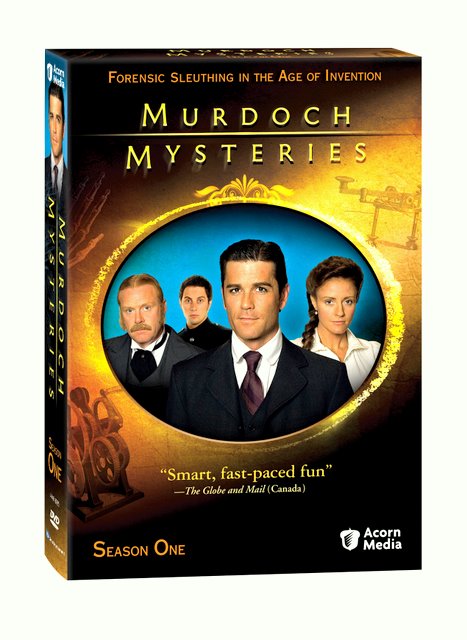
TV on DVD: Murdoch Mysteries: Season 1 (2008)


Now Available to Own on DVD


Previously Available


Photo Slideshow


Delicious
Bookmark this on Delicious
submit to reddit
Print Page

Digg!

MovieBlips: vote it up!

A major hit following its premiere in its Canadian homeland-- earning a whopping fourteen Gemini award nominations (our neighboring country's version of the Emmys), Murdoch Mysteries has been steadily building a fan-base in England as well as France where it began airing in syndication a few weeks ago.



And now the series-- which has actually wrapped and broadcast its second season in Canada-- has finally arrived for American audiences to savor both in this Acorn Media 4-disc slim-packaged DVD collection of the first season along with its scheduled run to debut on PBS on the thirtieth of June.
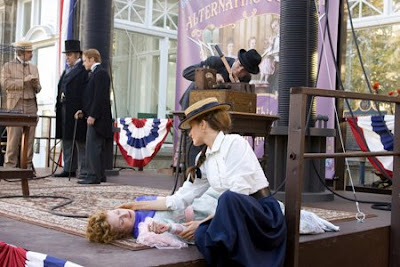


For devotees of author Maureen Jennings' Detective Murdoch series of novels which began back in 1997 with the title Except for Dying that has so far received six sequels in the collection as well as those who aren't fond of waiting for weekly installments of the series-- this beautifully transferred set is presented in its original 16x9 widescreen cinematic aspect ratio, with accompanying Dolby Digital surround, and contains subtitles for the deaf and/or hearing impaired.
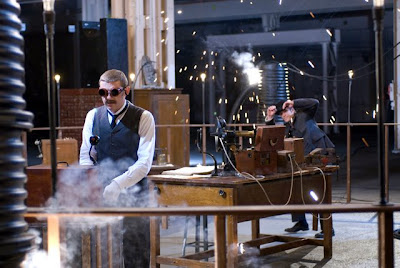


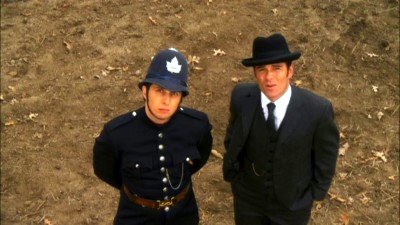
Also boasting episodic commentary by its handsome, naturally charming lead actor Yannick Bisson (who portrays the Toronto based Detective William Murdoch) and co-star Jonny Harris (who plays his eager, hardworking constable assistant and protege George Crabtree) along with the production designer and executive producer-- the set additionally features a photo gallery of the Victorian era series, interviews with Jennings and cast members, as well as cast and character filmographies and biographies respectively.


Smartly written and bolstered by the involvement of author Jennings who serves as a creative consultant on the Canadian series to ensure the novels are done justice, her work--which had actually been filmed previously as a series of mystery films called The Murdoch Mysteries-- makes for an intriguing blend of fantasy, historical fiction, police procedural, literary mystery, and period productions.
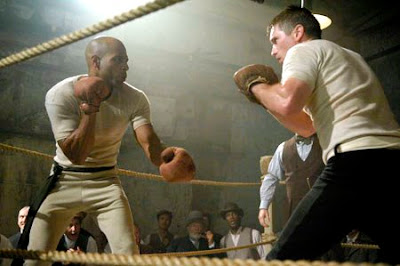


Set in 1895-- its titular character employs both newly discovered technologies such as early crime scene investigation methods and rudimentary forensic studies in his inventive and highly scientific pursuits to solve whatever crimes disturb his surroundings-- all the while rubbing elbows with individuals such as Nikola Tesla, Arthur Conan Doyle, and Prince Alfred.


What begins as an irresistibly clever gimmick of blending our popular whodunnit and penchant for Law and Order style crime scene series with the influence of Sherlock Holmes however soon gives way as the mysteries themselves become either fairly easy to solve or part of a predictable pattern where the inevitable "a ha" moment occurs in a rushed manner near the end of all thirteen episodes.


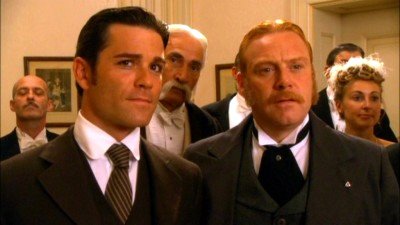
Our likable lead along with a terrific supporting cast such as the aforementioned Harris and Murdoch's obligatory tough-minded boss Inspector Brackenried (Thomas Craig) keeps things running smoothly but great credit for its success is due to the show's vintage Scully and Mulder dynamic. This is supplied in the form of the brainy, forward thinking, liberal and early feminist Dr. Julia Ogden (Helene Joy) whose knack for forensics makes her one of the area's top pathologists and a woman who shares a similar fascination for science, medical examination and experimentation to help rule in and out suspects and evidence as Murdoch's most trusted ally.


Although the involvement of a woman of her position in the time period seems a bit anachronistic-- Joy is a consistent bright spot in the series and along with Harris, helps sustain the sense of fun and excitement the opening episode promises before Murdoch's rather bland personality and over-abundance of Catholic guilt and ritual find you struggling not to hit the snooze button.


While budget does appear to be a problem in the filming of such a high concept period series as certain locations seem simply re-dressed throughout, the show hides this very well with a superlative usage of camera trickery by incorporating what the crew calls "Murdoch Vision" as we're given a doorway inside his overworked mind while he tries to use his own sense of logic blended with an overactive (yet always scientific) imagination to recreate crime scenes or explain things while we literally see what he's thinking.
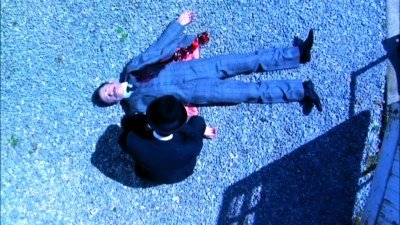


It's a cool style that adds much needed flavor to the show when it threatens to become far too gimmicky (for example when Doyle arrives to help with a seance mystery?) and Murdoch begins to wear on the nerves for his pretty bland personality as he seems about as fascinating as a doorway when next to the flirtatious and bold Ogden and constable version of the boy scout Crabtree.


Still, despite a few clunks and the fact that possibly like its ITV cousin, one where the decision to film even fewer episodes (maybe six or so as seems to be popular in England) would've resulted in less obvious repetition, production challenges, and an over reliance on gimmicks-- it's still an entertaining set sure to appeal to fans of literary and historical mysteries.
3/06/2009

Watchmen (2009)


View the Trailer & Photo Gallery


On DVD & Blu-ray
(7/21/09)


Delicious
Bookmark this on Delicious
submit to reddit
Print Page


Digg!

It's rare just to think of superheroes as people who simply play dress up like paper dolls donning capes or masks. For, instead of entertaining little girls, they decide to clean up the streets as efficiently and often as brutally as possible to begin where the thin blue line ends and go places the cops can't follow.


Although comic book (or graphic novel) mythology is filled with characters who were bit by radioactive spiders, born on distant planets, or find themselves gaining super powers when some sort of scientific or medical experiment goes wrong-- when you truly think about superheroes, you realize that essentially they're an existential breed altogether. After all, they are the ones who decide what's right and wrong for themselves, what they can live with, and what they're willing to do to make the world the way they'd like to see it.


While some refuse to kill and others exclusively assist the police, the self-proclaimed superheroes in director Zack Snyder's Watchmen all just donned the masks on their own and throughout the film, only one truly has super powers in the most classical sense-- namely via a radioactive accident gone horribly wrong. And because people come from all walks of life, we get quite the varied assortment in this extremely faithful adaptation of co-creator and illustrator Dave Gibbons' and writer Alan Moore's originally twelve part work published by DC Comics.

Simply put-- these aren't the superheroes championed in the previous generations who decorated themselves in the colors of the American flag and clearly understood right and wrong.


In the world of Watchmen-- we're shown a nightmarish dystopia of a New York City only a few minutes away from nuclear demise as the minute hand inches closer to the twelve of the doomsday clock. In a chaotic mid 1980s society where Richard Nixon has been president for five terms-- instead of traditional caped crusaders, we're presented with the remaining and/or second generation members of a group of crime fighters who began prior to the World War II era as the Minutemen. Following their initial fame, they've gone through several incarnations as they aided the government, halted the Vietnam war until eventually the world turned on the "Masks" and forced them into retirement.

While some ended up insane and/or dead-- just moments into the film, we're presented with the oldest original member, the Comedian (Jeffrey Dean Morgan) who is a bit of both. Morgan's Comedian is possibly only funny to the most twisted of souls. Unapologetic, vicious and coldblooded, his sociopath has been the go-to man to do our govermenment's dirty work (including being the true shooter of JFK) and personally not above attempting to rape his true love and shooting a pregnant girlfriend in the head.


Upon the film and graphic novel's opening, the Comedian is quickly forced out of a New York penthouse window and lands on the dark, slimy street, with a trickle of blood left on the yellow smiley face button he wore on his robe. Everything we need to know about the Comedian is given away pretty quickly as the film opens with him puffing on a phallic cigar and while it's hard to care about such a monster, his death nonetheless sets the chain of events that follow.


After we're given a brief overview of the history of the Watchmen during an extraordinary title sequence set to the music of Bob Dylan (just one of many phenomenal artists used throughout the soundtrack) that seems as though it was literally pulled right from the shiny pages of the original DC Comic, we encounter the remaining Watchmen including our film noir inspired psychopathic narrator Rorschach (a mind-bogglingly good Jackie Earle Haley).


Defying the bill that outlaws masked vigilantism, the unstable Rorschach-- convinced that Comedian's death is part of a larger conspiracy to kill off the superheroes-- checks in with all the rest. Dutifully keeping a journal of the events that reveals much more than his forever evolving ink blot filled mask does-- Haley's Rorschach is the most fully developed character of the lot and the one whose back-story not only hits us the hardest but helps provide a much clearer picture of the work.


As for the rest of the Watchmen-- only one has publicly revealed his identity in the form of the proclaimed "world's smartest man," and uber tycoon and entrepreneur Adrian Veidt (Matthew Goode). Veidt continues to work with the only one who truly possesses extraordinary powers-- the radioactive, forever nude, glowing blue man Dr. Manhattan (Billy Crudup)-- a former physicist who survived a freak accident that has now made him apathetic to people and obsessive about his scientific work in avoiding doomsday.


The superhero form of a shut-in whose very existence has scared nations into cooperating with the United States-- Manhattan's relationship with his younger, long-time live in girlfriend Laurie Jupiter (Malin Ackerman) is strained as he becomes much less focused on her and withdraws into his work.


Jupiter-- who had joined the Watchmen in order to please her glamorous pin-up mother Silk Spectre (Carla Gugino) as the second Spectre is still in close contact with her former colleague, Dan Dreiberg (Haley's Little Children co-star Patrick Wilson), in a role as dry as his name implies) as he now appears to be an aimless, impotent, over-the-hill boy scout who has succumbed to his retirement that consists of grabbing beers with his predecessor and reminiscing about the past.


Dan's crush on Laurie and her mutual flirtation seems obvious from the first time they're on-screen together but the film that celebrates the neuroses and deviance avoids the idea of a predictable courtship, reminding us that the only way they can be fully satisfied is to return once again to the masks in an exploitative, over-the-top sex scene that's only outdone by the gallons of blood and guts that spill out gleefully in this sadistic R rated comic come to life.


By squeezing in so many characters and a highly complex plot that takes a revisionist view of American history (yet one whose pessimism about the end of time seems sadly timely once again given the senseless wars and violence around the globe)-- Synder's production of Watchmen is a nearly three hour bloated mess that combines some truly spectacular visual tricks and musical cues and bogs it down with characters that never feel fully alive.


Far more interested in going for the same shock that Robert Rodriguez employed in adapting Frank Miller's Sin City in endless gore yet minus the ability Rodriguez had to tell a firmly cohesive story that would fully intrigue those who haven't read the graphic novel-- while it may be incredibly faithful to the work, the translation leaves us unmoved and uninspired by its unwillingness to engage us.


Dazzling with artistry as an attempt to keep us interested-- although more often that not via the wrong reasons with shocking outbursts of blood-- mostly I felt detached from a bulk of the film's characters who seemed less like the fully-formed psychologically challenging individuals promised and more like just shallow, one-dimensional cartoons come to life.


While of course, my reaction would probably have been different had I read the work beforehand, however, much like Catherine Hardwicke's tepid version of Twilight-- ultimately you have to separate the entities of the film from its source material and unless you've read the twelve part graphic novel, you're sure to feel like you're missing out on just what made the book so revered.

It has often been dubbed "the most celebrated graphic novel of all time" and one that was deemed so un-filmable that it took roughly fifteen years to get it made. Granted of course, Watchmen is sure to do great business opening tonight as both a regular theatrical feature and an IMAX experience on an unprecedented number of screens for an R-rated movie-- avid devotees will be able to fill in all the holes and under-developed characters based on their intricate knowledge of the comic.

However, the rest will probably do much better to pick up illustrator Gibbons' and author Moore's multiple-award winning graphic novel which became the first and only one to win not just a Hugo Award but also be included in "Time Magazine's 2005 list of 'the 100 best English-language novels from 1923 to the present.'"

The despite the potential dollar signs dancing before Warner Brothers' eyes and Billy Crudup's indication that he's contractually obligated to appear in a sequel should one be made-- despite Morgan's jokes that the fans would kill 'em-- director Snyder said he wouldn't be involved in another work be it a prequel or sequel since it goes against their intention for the film.

Furthermore Gibbons explains that it was never conceived as a film in the first place with a set-in-stone twelve issue series being his and Moore's intention. And by ultimately presenting audiences with an all-flash for cash work that lacks the requisite emotional arc-- perhaps maybe they would've been better off if they listened in the first place to the original author Alan Moore who publically stated he didn't want to be involved in a film.

To put the psychopaths onscreen without delving into exactly what makes them tick seemed excruciatingly sadistic at times and makes an ultimate payoff on Mars in the third act seem far less Earth-shattering than perhaps the filmmakers had hoped. And while I'd never suggest a sequel-- maybe the best thing for the series other than perhaps leaving it alone on the page, would've been presenting it in installments since it will take more than a simple cheat sheet or pre-film chat with a devotee to give the movie the same impact for one who's never flipped through the pages of the twelve-part book.

Thus in the end, ultimately, it answers its question of "who's watching the Watchmen," by keeping us watching for nearly three hours and hoping that somehow it will all gel together or we'll feel connected in some way but unfortunately, we leave the way we went in-- not entirely certain just who's underneath those masks but even worse-- not sure we actually care to find out in the first place.