Showing posts with label Katherine Heigl. Show all posts

4/22/2014

Blu-ray Review: The Nut Job (2014)


Now Available to Own


Photo Slideshow


What a difference a film’s length can make as we learn in director Peter Lepeniotis’s overlong (even at 86 minutes) feature length adaptation of his briskly paced 2005 roughly 10 minute animated short Surly Squirrel.

In The Nut Job Lepeniotis transfers the same unique premise which finds the aptly named, quick-thinking yet self-serving and quick to con squirrel Surly (Will Arnett) in the midst of a real live human bank robbery while planning the perfect heist in his eternal quest for food.

Whereas the short film kept its sights small, the feature length Universal Picture borrows the oft-utilized caper set-up derived from the classic Italian comedy Big Deal on Madonna Street (that’s been repurposed in dozens of pictures since) as Surly plots to steal the inventory of a nut store without realizing that the shop is a cover for crooks trying to tunnel into the nearby bank.


Simultaneously casing the job while also recruiting new allies to his side such as the crooks’ tough-looking but softhearted Pit bull (voiced by Maya Rudolph) Arnett’s Surly even finds himself working alongside his old forest friends who’d banished him from the park after being burned one too many times by the selfish squirrel.

Desperate for food to feed the entire park, Katherine Heigl’s brainy Andie is cautious about her new partnership from the start but finds her alliance tested even more when Surly and his sources discover that the real reason the park is having a food shortage is due to a furry friend that Andie’s trusted her entire life.


While there are some dynamic action sequences that are brought vividly to life in the warm-toned visually stunning CG animation from former Toy Story 2 animator turned director Lepeniotis (including an inventive opener and an interesting chase that uses birds as parachutes), compared to the overwhelming dull stretches, the diversions are few and far between.

Bogged down by a hero you can’t really root for until he inevitably and rather abruptly sees the error of his ways by the end, you can’t help but wonder how much better the film would’ve been if say, Andie had been bumped to the lead role and Surly had been turned into a supporting player.


For while Surly was ideal in a 10 minute classic Looney Tunes inspired production, he isn’t the best main character to build an entire plotline around. However, to be fair, Nut’s pretty unbalanced in the way it seasons its cast of characters as far too often the film relies on bodily function sidekick humor for cheap laughs rather than serving up solid roles.

One bright light in this lackluster Job is unexpected MVP Brendan Fraser’s spirited vocal performance as a dimwitted wannabe hero Grayson whose knack for failing his missions is nearly equal to the size of his own ego.


Completely wasting the talented Arnett on a character who loses his spunky personality in favor of a redemptive formulaic paradigm that rings false by coming completely out of left field (as never once were we led to believe earlier on that Surly even wanted to change), The Nut Job is a missed opportunity on a number of levels.

All in all, it’s a vital reminder that there is still a worthwhile market for high caliber short films as perhaps Surly would’ve entertained us better as part of an anthology film that introduced us to all the characters in a series of shorts that were each as unique and inventive as the filmmaker’s 2005 introduction to the squirrel.


While younger children may be more forgiving than older ones despite lulls that may make them restless in the film’s running time that feels nearly double its length, hopefully by stepping back to watch this full-bodied roast side-by-side with the shorter serving, the filmmakers will be able to reevaluate exactly where they went right and wrong while whipping up this batch for the big screen.

Though admittedly blandly appetizing, here’s to hoping that the next Nut they make will follow a less familiar recipe in order to deliver something to the audience that’s not only much more flavorful but filled with greater opportunities for its talented cast to crack us up in Universal's upcoming sequel to this forgettable first Job. 

Bookmark and Share

Text ©2014, Film Intuition, LLC; All Rights Reserved. http://www.filmintuition.com Unauthorized Reproduction or Publication Elsewhere is Strictly Prohibited and in violation of the Digital Millennium Copyright Act.  FTC Disclosure: Per standard professional practice, I may have received a review copy of this title in order to evaluate it for my readers, which had no impact whatsoever on whether or not it received a favorable or unfavorable critique.

3/11/2014

Criterion Collection Blu-ray Review: King of the Hill (1993) and The Underneath (1995)


Now Available


Bookmark and Share

Having recently announced his retirement from conventional film directing, it’s become almost irresistible to look at the varied oeuvre of filmmaker Steven Soderbergh’s past twenty-five plus years in the business and discover (there among the seemingly wide range of material) certain overlapping themes, unifying ideas that link one film to the next and offer even the tiniest window into the heart and soul of their enigmatic creator.

Soderbergh has called this tendency to seek out a universal thread a “parlor game” for journalists or critics as documented in a reprinted interview included in the Criterion Collection booklet for the long overdue induction of his often-out-of-print, overlooked third masterpiece King of the Hill on three-disc Blu-ray/DVD dual combo pack (that also features his fourth picture The Underneath).


Nonetheless, for film scholars interested in the subject, the beginning of an emerging area of interest for Soderbergh began to recur onscreen by the time of this ’93 work in the form of its young protagonist.

King centers on a natural born storyteller or youthful fabulist who lies to hide the pain and protect himself as opposed to seduce and deceive the way another charismatic Sodebergh liar did onscreen via James Spader’s breakthrough performance in the director’s semi-autobiographical Palme d’Or winner Sex, Lies and Videotape.

Like the subject of his second film Kafka or his last film Side Effects, manipulators hold cinematic sway over the population on and offscreen but their motives run the gamut and they’re always out-of-step with the rest of the characters.


Confessing that what drew him to A.E. Hotchner’s autobiographical depression era memoir was that he felt himself drawn to a hero “who feels at odds with everyone around him. And again is very interior,” Soderbegh acknowledges that “that’s my feeling in general. And I go toward that kind of material,” which he did for this film and would do countless times in the future from The Limey to Erin Brockovich and The Informant.

Yet there’s something about this film that, like the complex tapestry he wove in Traffic manages to take this basic idea, along with Hotchner’s coming-of-age template that chronicles that time of your life when you learn that your parents aren’t mythical beings but real life flesh and blood people that makes King of the Hill something different altogether.

Impossible to pin down into any specific genre despite its obvious episodic qualities and purported tale about a boy learning how to become a man when one by one due to illness, money and job opportunities he finds he’s left fending for himself during a pivotal summer in 1933 in a St. Louis hotel room, Hill defies expectations from start to finish.


Filling the picture with memorable characters that were brought to life by actors who would go onto become household names from Adrien Brody and Lauryn Hill to Katherine Heigl, Amber Benson and Jesse Bradford in a remarkable turn, Soderbergh walks that fine line between laughter and tears, melancholy and small victories by injecting the film with a surprising amount of warmth, humor and mischief.

While it is tonally similar to My Life as a Dog as well as Hope and Glory, it’s far more successful in my eyes because of the way it always remembers it’s being told through the eyes of a precocious child as opposed to a thirty year old filmmaker at the peak of his powers.


In King the genuine affection that Soderbergh has for all of his characters and the experiences that test his main character from reading a story he wrote in class to a story he tells the teacher to explain why he’s in the hotel shines through every frame.

Gorgeously lensed with strong art direction, Hill employs a rich Edward Hopper infused Americana color palette to convey the warm burgundy and mustard tinged loneliness of those paintings and the time period in which it takes place.

And by avoiding a glossier magazine style sheen straight out of Saturday Evening Post Norman Rockwell works or even a stark black and white meld of The Grapes of Wrath through the eyes of Shirley Temple, it has a rich sense of nostalgic reminiscence without the same clichéd gold filter that typically paints the cinematic past -- ensuring that we’re not so lost in the look of the film that it’s a barrier to the story he’s trying to tell.


From the charismatic presence of Adrien Brody to the devastating heartbreak felt when we were put into the shoes of Amber Benson's epileptic girl down the hall to the exuberance experienced when our hero pulls one over on a shady cop and landlord, it’s a testament to the strength of the movie that I could still vividly recall certain moments from my initial screening of it back in ‘93.

In fact, viewing King today for the first time since I was twelve years old (or roughly the same age as Bradford’s protagonist), I was amazed by how well the work held up. My first Soderbergh film that I’d rented due to a rave review from Siskel and Ebert, King of the Hill affected me so much as a budding film lover that I recommended it to my history teacher who tried (and failed) to get authorization to screen it for our middle school class.

While some scenes and characters (mostly the adults, I realized, as when you’re a child you mostly relate to your own) had completely vanished from my mind, I was amazed by how powerfully some sequences came flooding back to my mind. And this became most apparent during the film's most haunting scene as our creative yet starving young lead meticulously cuts out magazine photos of his dream meal and then devours them at a table before succumbing to stomach pains.


So deeply personal and powerful – rightfully filmed as though we were tiptoeing on something we were never meant to see – I realized upon watching it again as an adult how much of an impression the film had made on my life.

And honestly, moments like this one and others in deeply moving films viewed during my transformative years – nearly feel as though they were part of my own childhood. As such it was an absolute honor not only to revisit the same work again with the clearer understanding of an adult mind but also to take this opportunity to go back and screen it again through my own younger eyes.


And given the fact that the man who made one of so many profound films that impacted my moviegoing life has retired from filmmaking (at least for now), it offers us an even greater excuse to look back at all of these masterpieces that will hopefully continue to live on as they’re inducted in the Criterion Collection.

While I have yet to experience their edition of Traffic, this restoration of King of the Hill is absolutely stellar, arriving with bonus interviews, deleted scenes and more.

And although the clunkily crafted Noir throwback The Underneath which reunites Soderbergh with his Sex leading man Peter Gallagher is notable as his last big studio effort before he cut loose with his palette cleansing, Jackson Pollock painting version of a film in the form of Schizopolis it’s an interesting if only half-successful film.


For serious Soderbergh scholars only (as the man himself didn’t write the oddly plotted, logically challenged heist picture), The Underneath tries to build something new out of far too many superior somethings old from Out of the Past to The Asphalt Jungle but ends up settling for something we’ve seen too many times before.

And while it’s notable in the way that it kicked off the renaissance that inspired Soderbergh to take control of his career and came back in a big way with an unprecedented string of hits including Out of Sight, The Limey and others, it pales in comparison to King.

An underrated gem that’s at last given its Criterion due, unlike The Underneath, King of the Hill shows us that Soderbergh is best when he brings something new to something old in a tale of a fabulist instead of hoping to take a fabulist’s approach and convince us it’s the other way around by dressing up something old like something new.


Text ©2014, Film Intuition, LLC; All Rights Reserved. http://www.filmintuition.com Unauthorized Reproduction or Publication Elsewhere is Strictly Prohibited and in violation of the Digital Millennium Copyright Act.  FTC Disclosure: Per standard professional practice, I may have received a review copy of this title in order to evaluate it for my readers, which had no impact whatsoever on whether or not it received a favorable or unfavorable critique.

7/24/2009

Movie Review: The Ugly Truth (2009)


Now Available on DVD & Blu-ray


View a Slideshow


Pick a Side:

Katherine Heigl


Gerard Butler


Delicious
Bookmark this on Delicious
submit to reddit
Print Page

Digg!

MovieBlips: vote it up!

Whether they're deemed "chick flicks" or the now trendier "rom-coms," I think I understand one of the reasons that first men and now women have started to stay away from the genre in droves. And that is that aside from the smash success of Sandra Bullock and Ryan Reynolds' hit The Proposal-- it's because whether they're titled Bride Wars, He's Just Not That Into You, Ghosts of Girlfriends Past, or any number of variations, once you've seen one, you've usually seen 'em all.


And this is a shame since romantic comedies or in particular-- screwball romantic comedies-- where men and women speak a mile a minute equally matched in love and loathe throughout with fiery flirtation are one of my favorite genres and one of the most inspiring to me as a writer.


I catch glimpses of that wit now and again-- most recently evidenced in Magnolia's brilliant art-house festival favorite The Answer Man starring Jeff Daniels and Lauren Graham which is also opening this weekend following a video on demand presentation. Additionally it's also around in a few other comedies like Adrienne Shelley's Waitress that have also broken the mold but it's pretty rare.


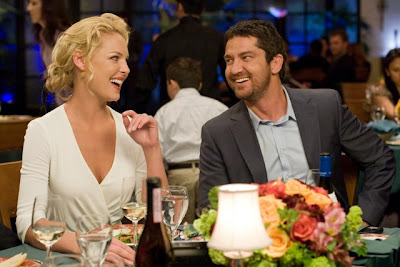
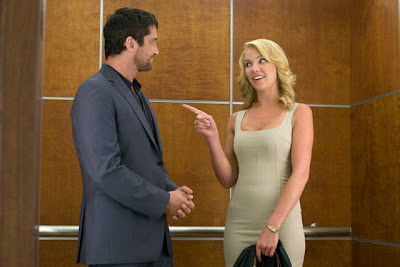
While The Ugly Truth doesn't even begin to break the mold or any new ground, what it does do is rework the same cardboard cut-outs or cliched male and female types we're typically presented with in these films. Namely in one corner we have the control-freak female looking for Mr. Right in a role beautifully played by the beaming yet guileless risk-taking girl-next-door Katherine Heigl. So out of necessity, in the other corner, there's the beyond stereotypical playboy cad who even Sean Connery's version of James Bond may have felt like punching in the face, nicely portrayed by Connery's fellow Scottish countrymen, Gerard Butler.


Thus these over-used characters from the-- "man, they hate each other so much that inevitably this passion will explode into red hot romantic lust" dynamic are used as a starting point. And it's achieved via Legally Blonde screenwriters Karen McCullah Lutz and Kirsten Smith (who owed us a good movie after last year's House Bunny debacle) by attempting to make Nicole Eastman's story idea and first draft much snappier by going for the same extremes we would've found in the screwball era and in doing so they're somewhat successful and somewhat completely off-the-mark.


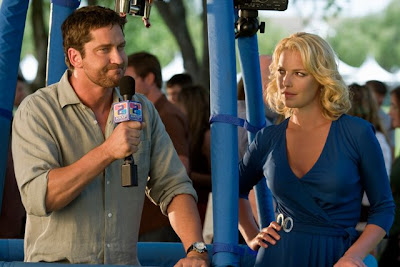
Of course, it does "screwball" without the class of an Irene Dunne and Cary Grant picture. For Grant would never have told Dunne that the only way to snare a man is with two particular body parts and by utilizing one act for which a certain former president almost received impeachment. And while you have no doubts you know exactly where it's headed as it spirals into a long conclusion that should've ended in a hotel instead of a CGI hot air balloon (don't ask), it's a damn sight more fun than most by-the-numbers studio genre pictures we've seen so far this year. Moreover, it's light-years better than the shudder-inducing Ghosts of Girlfriends Past which was so bad it actually disturbs me more than ads for the new movie Orphan.


Employing the requisite simple yet illogical premise of a rom-com, we're introduced to Heigl's award-winning Sacramento television morning show producer Abby Richter who explains that the secret to her success is "looking chaos right in the eye and telling it to 'eff' off," using her same ultra prepared manner at the workplace as in her dating life. This is evident from the start wherein she prints off a man's dating profile and runs a background check, further providing him with talking points and urging that they just go directly to number three after the conversation inevitably gets off to a shocked start.


Following the lackluster date, Heigl returns to her solo apartment to find that her cat has tuned into The Ugly Truth, the local public access show hosted by Butler's Mike Chadway where he spouts his own brand of misogynistic, chauvinistic logic that all women need to get a man is a StairMaster. One of those guys who shoots outward for humor-- Mike further philosophizes that women should burn their self-help books (however, I do agree with this one), and if they aren't seeing anyone... well, then, they're just plain ugly. And while admittedly that's lame, you can't exactly pretend you've never heard some men say this a million times before in their "it's all women's fault" rant.


Provoked by both a bad date and Chadway's insistence in the idea that his ridiculous shock-jock opinions should be held-up as facts (in a society where-- let's face it-- people do consider the opinions of people like Lou Dobbs, the nuts on Fox News Channel, Howard Stern and everyone in between as factual sources), Abby calls in to prove him wrong and defend her idea of the perfect guy who does believe in love. However, when he calls her bluff that he's imaginary, he calls her "Lassie" and ends the conversation.


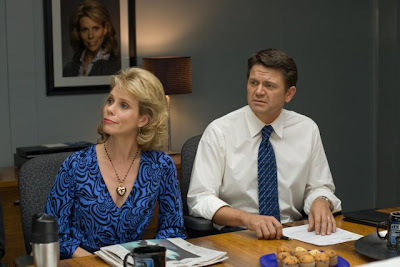
Obviously, in real life the exchange would've ended there since as a public access host, he's not on a network that can get sued... until Abby discovers that to boost her sagging ratings, they've decided to bring Chadway on board a few times a week as a commentator to spice things up. And horror of horrors, the audiences love the sensationalism-- especially when he turns his negative views on marriage directly on married co-anchors Cheryl Hines and John Michael Higgins (hilarious as always).


While inevitably, Mike realizes that Abby was the woman who phoned in and takes back his "ugly" comment when he harasses her in front of the rest of the station, the two get off on a bad start, only to discover that they have to work together despite their differences and move it into the personal arena when Abby does meet a new neighbor (Eric Winter) who may in fact be Mr. Right. In another illogical-- only in the movies turn of events-- she employs Mike's help as a sort of "deal" not to blow it the way she's ruined every other date.


Sure enough their animosity grows into friendship and attraction as we begin to see other sides to Mike including his unexpected (to anyone who hasn't seen a rom-com, that is) sensitive side where his nephew is concerned. And while they take some of the shocking antics of Mike's confrontational verbal style into the visual realm with women wrestling in jello and one hilarious if dubious technological update of Meg Ryan's Harry Met Sally restaurant orgasm scene featuring a helpless Heigl-- all in all, despite its contrivances there's still a lot to like about the film no matter how hard we want to resist.


Intriguingly though, it's only Mike who is at least given the opportunity to be at least a bit more unmasked as the movie goes on even though poor Butler slips in and out of his Scottish accent briefly throughout. To this end, there's still some lingering questions we have about Heigl's Abby and perhaps why her need to be perfect or in control reigns supreme that I felt were ignored in favor of just asking us to simply buy into the workaholic female stereotype as opposed to exploring her on the same level as Mike.


Still, in lieu of this flaw of managing to improve on one traditional cardboard cut-out at the sacrifice of another (more or less although Heigl's charm helps endear her to us)-- the script again is still far easier to accept and root for than other recent works. Namely, the more serious offenders would be the women written into Bride Wars as well as the passive heroine of Ghosts of Girlfriends Past who would've been much better off solo than with a leading man so unlikable I wouldn't have cared whether or not his character had been hit by a bus.


Following a reschedule from its previous April opening date and coming off the heels of the success of the more all-ages viewer friendly Proposal as well as hitting theatres post-Potter and coinciding with the expansion of the unorthodox romantic sleeper (500) Days of Summer, The Ugly Truth may well be affected attendance-wise. And while it isn't perfect, Ugly Truth at least will manage to keep men awake more them some of the recent studio made rom-coms that have come before it, if only because you'll be in constant shock at the ridiculous things Butler manages to say with a straight face.


Text ©2009, Film Intuition, LLC; All Rights Reserved. http://www.filmintuition.com

Unauthorized Reproduction or Publication Elsewhere is Strictly Prohibited.