
Now Available on DVD & Blu-ray as a
Remastered Deluxe Edition
With a New Commentary & Interview
Previously Available Edition
Remastered Deluxe Edition
With a New Commentary & Interview
Previously Available Edition


Bookmark this on Delicious

Print Page


In Fatal Attraction (also recently released on Blu-ray), Glenn Close's scorned one-night-stand warns Michael Douglas that she "is not going to be ignored.” Tired of being ignored himself in a world where as his Wall Street character Gordon Gecko proclaimed, “greed is good"-- a few years following the premieres of those '80s classics-- Douglas' character snaps in gridlock L.A. traffic on the hottest day of the year near the beginning of Joel Schumacher's psychological exploration of an urban nightmare.
Despite the 8 & ½ like opener and weather fueled short tempers a la Spike Lee's masterpiece Do the Right Thing-- Falling Down is incredibly straightforward from the start as a work of action driven suspense rather than a highbrow work of art.
The timeline plays out over the course of a deceptively sunny day that is in stark contrast to the tone of the piece which seems as though it's filled with as many ominous dangers as a long, dark night.

And in it, Douglas' angry, laid off former governmental cold war era defense employee does all the wrong things, changing from his tendency to implode everything--shoving it beneath the surface-- until he explodes all over the city in a series of escalating violent encounters and devastating acts.
The film Douglas notes in an all new interview would most likely have been made independently today. For by the time it was finally released in '93, Ebbe Roe Smith's screenplay (that later garnered him an Edgar Allen Poe award) had been circulating from studio to studio for years as each one passed on the piece.
However, the work found and an avid supporter in the continuously risk-taking Michael Douglas who consistently stands behind projects in which he wholeheartedly believes which is something he's done since producing Milos Forman's Oscar winner One Flew Over the Cuckoo's Nest starring his good friend and frequent collaborator Danny DeVito.
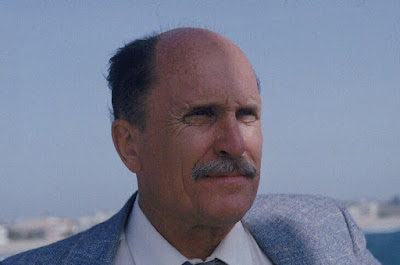
And in fact it was his commitment to the unique material in tandem with director Joel Schumacher's clear-cut vision as well as costar Robert Duvall who plays the ideal counterpoint to the madness as a good-natured, ready to retire police officer who pieces together the movements of Douglas that makes the film so successful. And still Douglas marvels at the brave boldness of Warner Brothers Studios to see it through as all of the aforementioned collaborators crafted one of the most provocative films of the '90s and likewise offered further proof of Douglas' acting versatility and command of character.
Daring, controversial and still potent sixteen years later especially to this reviewer who hadn't seen it since its original release-- upon further research I was fascinated to see all of the numerous interpretations. To say that reception to the film itself varied is a gross understatement as Falling Down runs the gamut of responses, thereby proving that-- like all effective works-- the fact that it draws a passionate response always makes it a success at least on the most important level of jolting audiences out of passivity and into conversation.

And surely it was seriously discussed as some audience members erroneously viewed it as a celebration of violence and anarchy. Moreover, others fervently dismissed Falling Down as merely racist. This is especially the case since the well-dressed yet crew cut sporting and briefcase carrying main character-- known for a majority of the picture as his license plate D-FENS (both a nod to the man's former employer and an ironic statement on his actions which move from offense to defense and back again depending on how you look at it)-- is first set off in a scene by a Korean grocer before getting into an altercation with Latin American gang members.
However the most obvious interpretations of the piece likened the film to a modern amalgam of Robert De Niro's turn as the loose cannon or “certain breed of white boy” that Paul Schrader warned of in his script for Martin Scorsese's Taxi Driver as well an action-packed version of Peter Finch's “I'm as mad as hell and I'm not going to take this anymore” mantra in Network.
Yet to me and right in line with the other work of Schumacher (especially as he later revisited with the near Colin Farrell one-man-show underrated effort Phone Booth), Falling Down seems to be a satirically exaggerated cautionary tale of the way that all of the little things we experience can multiply until it's too late.
For, in the case of D-FENS who flips out in the opening moments of the piece when his automobile's air conditioning fails and a fly buzzes as in a poem of Emily Dickinson-- it's all these little things like being overcharged at convenience stores and missing out on the breakfast menu at a fast food joint by minutes-- which propel him onward on his delusional yet determined journey to the home of his estranged wife (Barbara Hershey) and daughter.

And while it's not a journey we'll want to take very often as it's a painful yet poignant portrait of a heart heading directly into darkness, it's nonetheless a passionate piece as we chronicle one man's (possibly culturally symbolic?) loss of sanity to the point of literally falling down in the memorable finale wherein the "London Bridges" references that run throughout finally pay off.
Despite my admiration for the work which I was startled to realize how much of it I recalled verbatim as it was so shocking that it seared into my young mind in '93, I must admit that it's still incredibly hard to watch the disturbingly funny yet shockingly in-your-face film now in 2009. And the reason for this is simple as unfortunately the events in the film aren't that far-fetched today since we're bombarded much too often with horrific news reports of (usually) a nondescript man like D-FENS who snaps either at work, at home, or at a public place and kills everyone in sight including himself.

Of course, at the same time-- while it's especially hard given this state of affairs to view it objectively-- the fact that Schumacher, screenwriter Smith, Douglas and all involved had the foresight to try and address our increasingly hostile society sixteen years ago makes Falling Down even more significant and similarly much less exploitative in retrospect.
Remastered to a sharper clarity for this deluxe edition release-- while I can't rate the Blu-ray technical aspects or what sounded like a truly incredible booklet that comes with the disc which lets you behind the scenes, offers a discussion of the movie and examines D-FENS to greater extent, this DVD will still be of particular interest.

Nicely tying in with this year's AFI Lifetime Achievement Award for Douglas, Falling Down's DVD benefits from the inclusion of a Schumacher and Douglas commentary track and a modern in-depth discussion by Douglas as he deconstructs D-FENS and articulates his take on the character, film, and his passionate wish that it would provoke discussion among those who saw it. I think it's safe to say that that goal was more than achieved since, much like Close noted in Fatal Attraction, Falling Down may do a lot of things but it will definitely not "be ignored."





