Showing posts with label Rose Byrne. Show all posts

8/27/2018

Movie Review: Juliet, Naked (2018)


Now Available


Bookmark and Share

High Fidelity, About a Boy, and Juliet, Naked author Nick Hornby's characters have always been my kind of people.

Like looking in the mirror, whenever I read his books, in the sentences on the pages staring back at me I see not just myself but my friends, family, crushes, and loves – passionate people Jack Kerouac might've called "the mad ones" – who can talk books, movies, music, art, and life for hours.

And that's exactly what Duncan (Chris O'Dowd) was like when Annie (Rose Byrne) first met him in Jesse Peretz's big screen adaptation of Juliet, Naked.


Arriving in her small English seaside community full of ideas from the outside world – the exact same way she had when she returned from university in London to take her dad’s post at a small history museum and care for her younger sister after he grew ill and died – Duncan's passion mirrored her own.

But although the film and media studies professor swept her off her feet early on, now fifteen years later, Annie has started to realize that just like film, she is her boyfriend's second love.

Still hopelessly devoted to early '90s alternative singer/songwriter Tucker Crowe (Ethan Hawke), whose Jeff Buckley meets Jeff Tweedyish breakout breakup album "Juliet" he considers a masterpiece, in his spare time, Duncan has created a shrine to the singer in the couple’s basement as well as a website dedicated to the man and his work.


The ringleader of roughly two hundred middle aged men (as Annie describes in her witty offscreen voice-over), Duncan and his fellow fanatics obsess over Crowe's words and music, while sharing their theories as to where they think he is today after mysteriously walking out of a Minneapolis club two decades earlier in the middle of a set without looking back.

The source of a number of fights between the couple including yet another disagreement when she opens and listens to an obscure cut of the album called "Juliet, Naked" that had been sent to her boyfriend, Annie finally has enough and posts a negative review of "Naked" on his website.


And while it helps precipitate their breakup, ironically this action also winds up causing her to obsess over Tucker as well when the musician sends her an email agreeing with her critique, leading to a back-and-forth correspondence between the two that grows more revealing and flirtatious over time. Fortunately for viewers, gradually life and fate intervenes and the two finally come face-to-face.

Adapted by screenwriters Jim Taylor (Sideways), Tamara Jenkins (The Savages), and Evgenia Peretz (Our Idiot Brother), despite the plot similarities, the utterly charming Juliet, Naked has less in common with the delightfully old-fashioned Pride and Prejudice infused Shop Around the Corner update You've Got Mail and more with both Notting Hill and the two most famous big screen Hornby translations of High Fidelity and About a Boy.


Though obviously a romance in spirit (and just one of several recent releases breathing fresh new life into one of film's very first genres), similar to Marc Turtletaub's 2018 American remake of the Argentine film Puzzle, at its heart, Juliet, Naked is the story of a woman who falls in love and sees herself a bit more clearly when mirrored back in her lover's eyes.

With the Duncan sized obstacle out of her way once and for all, Annie realizes just what it is she does and does not want out of life.

A love letter to Rose Byrne, in Peretz's Juliet, the actress steals the viewer's heart as easily as she always does.


While the passionate dialogue that fills the film's first half drops off a bit in its understandably awkward second half as it's always harder to communicate in person as freely as you had in print, Juliet's vulnerabilities admirably wind up taking us in a direction we did not expect.

Following in the footsteps of other British romantic comedies that fill your screen with irresistibly offbeat characters, Juliet boasts a fine, understated turn from a more laid back than usual Ethan Hawke as well as a terrifically funny O'Dowd, whom, much like Annie is a Hornby character you immediately feel like you know.


As breezy and warm as the nearby seashore, Peretz's Sundance favorite is the film you didn't know you needed to make summer last a little longer.

Explore the Book & Soundtrack


Text ©2018, Film Intuition, LLC; All Rights Reserved. http://www.filmintuition.com Unauthorized Reproduction or Publication Elsewhere is Strictly Prohibited and in violation of the Digital Millennium Copyright Act.  FTC Disclosure: Per standard professional practice, I may have received a review copy or screener link of this title in order to voluntarily decide to evaluate it for my readers, which had no impact whatsoever on whether or not it received a favorable or unfavorable critique. Cookies Notice: This site incorporates tools (including advertiser partners and widgets) that use cookies and may collect some personal information in order to display ads tailored to you etc. Please be advised that neither Film Intuition nor its site owner has any access to this data beyond general site statistics (geographical region etc.) as your privacy is our main concern.

8/21/2009

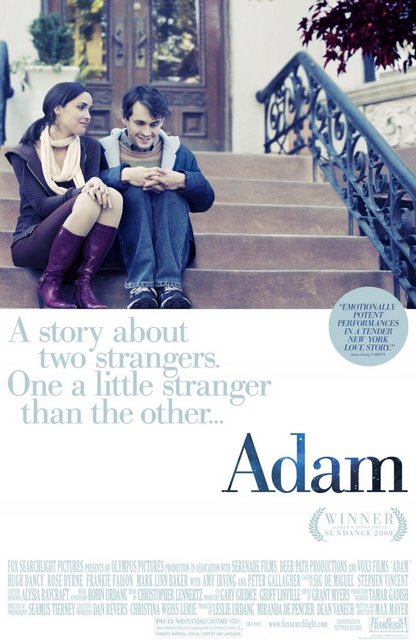
Movie Review: Adam (2009)


Now Available


Delicious
Bookmark this on Delicious
submit to reddit
Print Page

Digg!

MovieBlips: vote it up!

Due to the fun yet admittedly self-conscious trailer that features our eponymous lead character
uttering an obligatory Forrest Gump joke, I think that most people going to see writer/director Max Mayer's Adam will assume it will be a lighthearted romantic comedy with a little Asperger's Syndrome awareness on the side.


However, those expecting to be spoon-fed the same cinematic set-up of boy meets girl that we usually encounter will be quite surprised by the work that begins with both very little dialogue and also the sight of Hugh Dancy's Adam at the burial of his father.

Still inevitably Mayer does go for some rom-com conventions when the gifted genius meets cute with his new neighbor Beth (Rose Byrne) as we realize literally that if A (for Adam) and B (for Beth) share enough screen time then C (a romantic crush) will develop. Yet, it's nonetheless a remarkably brave decision to open the Sundance Film Festival award-winning work in a way that places visuals over dialogue.


As such, with an offscreen death and
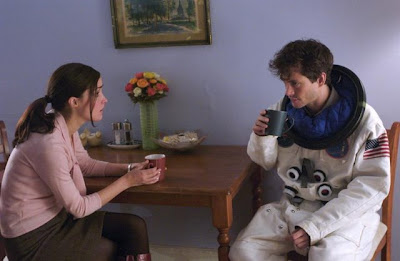
acquainting us with the man who takes part in an evening ritual alongside laptop to offer him company and distraction, initially Adam is reminiscent of the start of Hal Ashby's Being There which also focused on a character who most likely suffered from some type of autism and engaged in repetitive distraction in the form of television instead of computers.

However, by choosing to convey a great deal of information visually instead of employing narration a la Fox Searchlight's other romantic themed film (500) Days of Summer or inventing a cliched character to offer us a back-story in the form of a monologue, Mayer's Adam therefore invites audiences to engage with the work on an intellectual level.


And while this is refreshing to say the least, fortunately for us, we're never required to possess the same technologically advanced knowledge that our main character uses to create expensive computer chip based toys until eventually he's let go because he can't make them cheap enough.


Obsessed with physics and the infinite nature of the universe which seems as infinite and unexplainable as our main character himself-- Adam is awe-struck when his beautiful neighbor Beth (Rose Byrne) seems to show more than just a polite interest in the cosmos.


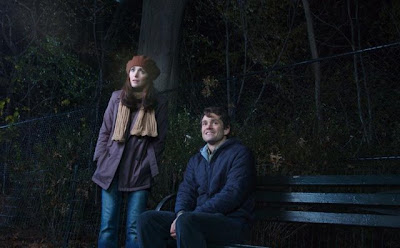
A schoolteacher who aspires to become a children's book author, Beth is attracted to Adam from the start and finds his ideas of impressing her with an interior planetarium in his apartment and raccoon watching in Central Park charming... until that is, his bluntness goes a little too far. And soon he ultimately has to reveal that he lives with Asperger's Syndrome which prevents him from reading between the lines of the emotions, body language and internal process of others.


Uncomfortable in crowds, Adam is likewise unsure how to react when her parents (Amy Irving and Peter Gallagher) ask a halfhearted question about a historic theatre which results in Adam rattling off more facts than could fit into an entire encyclopedia. Still aside from their differences in social behavior, somehow the two fall into what could most likely be construed as love until you realize that "love" as an abstract, indefinable concept is something as hard to pinpoint for Adam as the data of other galaxies.

Exceedingly well acted by the entire ensemble cast-- in the film this is evident most importantly by Dancy who can bring tears to your eyes within seconds before he makes another startling remark unsure just why he's nearly arrested for simply watching the children on the playground at Beth's school.

And thankfully the film avoids the temptation to sugarcoat Asperger's Syndrome as well as the challenges faced by those living with and those who love individuals with disabilities. Additionally, while Mayer's film succeeds on a purely word-of-mouth, intimate charming level that like The Station Agent as the type of movie you want to hug and recommend to others-- sadly it suffers a bit when it hits a few unnecessarily protracted and predictable plot points.

Unfortunately, the delicate balance of the film is nearly lost as too much time is dedicated to the indictment and trial of Beth's smooth-talking yuppie father in a one-note role and subplot we couldn't be less interested in for the film other than-- like Adam's loss of a job-- having a timely Enron-esque significance. For, despite being well played by Peter Gallagher who's been typecast in these roles ever since Sex, Lies and Videotape and While You Were Sleeping, he's given nothing to work with and just hits his marks in a few contrived sequences that won't surprise anyone who's seen a romantic dramedy before as he tries to encourage Beth to date someone without a disability.

As the movie evolves and his character begins to devour the screen time, I began realizing that Adam was revealing yet another significant influence via the film's similarity to another Fox '80s classic-- Cameron Crowe's Say Anything. Although while the end of Say Anything was slightly vague yet far more optimistic about the characters' future together than The Graduate-- I think the way that Adam evolves and ultimately concludes will probably come as something of an unusual surprise for those fooled by the ads into believing the picture was going to be just a slight deviation of the rom-com genre.

While I hesitate to reveal anything other than to say that once again, the movie seems to appeal more to one's intellectual side by going for a natural progression of events as the two begin to grow and change thanks to one another in a way that relies on viewers to interpret, overall I have to share how pleased I was by the filmmaker's decision to avoid the trappings of the genre.


Although he nearly sabotaged his own cleverly devised picture with the uninteresting and unappealing plot surrounding Beth's parents that makes the Beth and Adam relationship suffer from stale predictability for a short period of time, in the end it's redeemed by the strength of it as a whole. Moreover by placing creativity at the forefront of Adam from the unique opener to the similarly intriguing conclusion, Mayer's infinitely likable work is a nice, old-fashioned and offbeat change of pace to the standard "boy meets girl" formula. And as such, it marks the best film of this type since Fox Searchlight's previous but superior sleeper hit (500) Days of Summer released just a few months ago.


Text ©2009, Film Intuition, LLC; All Rights Reserved. http://www.filmintuition.com

Unauthorized Reproduction or Publication Elsewhere is Strictly Prohibited.

7/10/2009

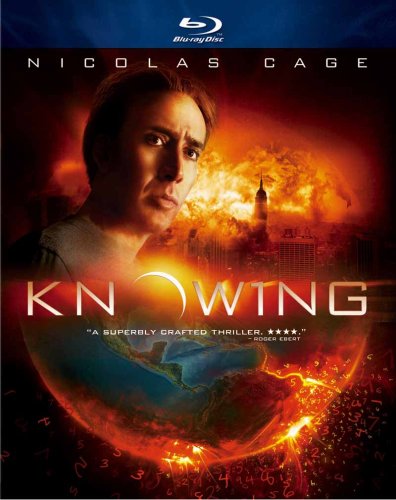
Blu-ray Review: Knowing (2009)


Now Available on DVD, Blu-ray & On Demand


Download on iTunes

Knowing (2009)

Movie Still Slideshow


Original Theatrical Review

Also New from Summit Entertainment

Apple iTunes


Delicious
Bookmark this on Delicious
submit to reddit
Print Page

Digg!

MovieBlips: vote it up!

Blu-ray Critique

While the greatest critic of my generation, Mr. Roger Ebert-- not only gave filmmaker Alex Proyas' most recent effort Knowing four stars but also stated that it was "among the best science-fiction films I've seen" as the Summit Entertainment press release proudly proclaims-- admittedly I was less than thrilled when I screened it in time for its March 20th release.

Bolstered by the always charismatic charm of Nicolas Cage who can even make flawed films like Next, Kiss of Death or Snake Eyes watchable just by being the same Wild at Heart, Moonstruck Cage we remember along with the film's dynamite premise-- the movie had everything going for it until it suddenly took one of several wrong turns in the final hour to oddly giggle inducing faux New Age effect.


However, Proyas is a master showman and visually the film is stunning with its usage of the Red One Digital Camera that completely overwhelmed the senses with its unparalleled clarity along with the other standouts of his signature style and Marco Beltrami's underrated score (still one of the best of '09) which made it a feast for the senses indeed.


While the technical aspects of the film given its Red One Camera naturally transfer superbly to Blu-ray to make the sights and sound of the impending apocalypse come alive and fans are sure to love the commentary with the director along with two making-of featurettes, I was stunned to realize how great of a loss of impact the movie had on the small screen.


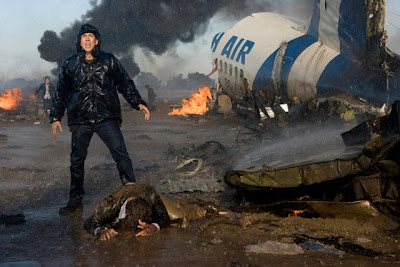
The film's most mesmerizing and intense set-pieces and action sequences involving a plane and a train (amidst a few automobiles naturally for good measure) didn't hold the same sense of overwhelm, heart-racing, palms-sweating, goose-bump inducing excitement of the theatre even in Summit's uniformly excellent high-definition transfer.


For, even though I had problems with the way the movie itself structurally careened out of control and become so devoid of the science it pretended to be steeped in from the start-- at least in the theatre, I was still given a genuine thrill in two action sequences that were worth the price of admission alone so it's a shame to discover that even given the greatest technological presentation, in the end sadly "there's no there, there," to quote Gertrude Stein.

Yet, hopefully if you didn't have the experience with which to compare the theatrical screening of Knowing, you'll still get an ample kick out of the action in the film, before-- that is-- it goes from "knowing" to nonsense.


“The great thing about Knowing is that… it has this bedrock of emotions and human interaction. Reality is what this story is all about… We don't ask you to suspend disbelief. Everything that we've addressed in this could possibly happen.”
Director Alex Proyas;
(As Quoted in Summit Entertainment's Production Notes)

Now maybe it's just missing from his IMDb page, but I wasn't aware that The Crow, Dark City and I, Robot director Alex Proyas held advanced degrees in cosmology, astrophysics, thermodynamics, and quantum mechanics.


Of course, you don't have to be Stephen Hawking to make a thought-provoking science-fiction movie as Steven Spielberg has proven numerous times over. However Proyas’ film Knowing-- which begins with an incredibly intense, pulse-pounding first hour, unfortunately hurdles towards one of the most ludicrous, unintentionally hilarious, and downright bizarre conclusions in recent cinematic memory.

In fact, it so derails its audience-- that had been previously and wholeheartedly committed to the far-fetched but fascinating storyline for a good majority of the picture-- with one of its roughly baker’s dozen silly finales which makes his announcement that he believes his film is completely steeped in reality all the more mind-boggling and a bit worrisome.

Uneasily venturing from its The Shining meets The Ring freaky little kid origins into a doomsday drama a la Deep Impact before it tries to weave in Mothman Prophecies and Dragonfly New Age spiritualism to the horror-lite psychological thriller Final Destination—Knowing leaves no genre or device behind sprinkling in some Close Encounters of the Third Kind in for good measure amidst a generous helping of The Twilight Zone.


And unfortunately, in hindsight, it definitely didn't need to be that way as the film begins with an eerie and ominous beginning going back in time to 1959 as we meet a young girl who participates in a grade school burial of a time capsule to be dug up 50 years later.


While the other students in Lucinda's class predictably draw pictures of spaceships in their foreshadowing of what life will be like in 2009, Lucinda obsessively puts pencil to paper and begins writing numbers in a frantic frenzy filling both sides of one single sheet before her teacher pulls it away from her. However, Lucinda hadn't finished her project as we quickly discover on the day of the time capsule burial when the peculiar girl disappears from the crowd and is later found scratching until her nails are bloody more numbers into the wood of a school closet door.


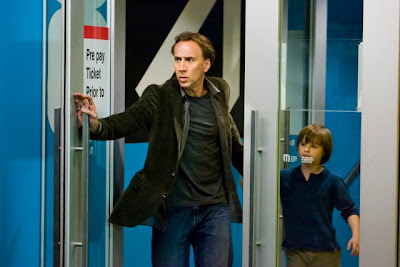
Fifty years later, Lucinda’s sealed, buried envelope is opened by Caleb (Chandler Canterbury)—conveniently the son of MIT astrophysicist John Koestler (Nicolas Cage). Although his son isn't supposed to bring the envelope home (following the ceremony that unearthed the time capsule), something about the numbers inspires Caleb to do the opposite as he later tells his father that the sheet could contain some sort of math puzzle.


As equally headstrong as his father-- the young hard of hearing Caleb comforts himself with Discovery Channel specials and old home movies of his deceased mother. Yet, fiercely devoted to protecting his son almost to the point of making Caleb a near shut-in when he isn’t in school since he can’t bear to lose the rest of the family either to death or disagreement as-- John copes with the absence of his wife with increasing amounts of Jack Daniels and classical music.

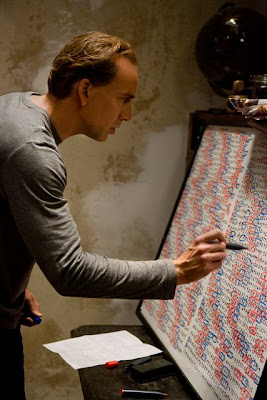
However, in a drunken whim, he becomes as equally intrigued as Caleb was by Lucinda's numbers. Ripping a white-board down off of his wall when he realizes that patterns have begun to emerge and after an insane amount of Google searches, Koestler realizes that what-- to an untrained eye would just seem to be the nonsensical automatic writing of a lunatic-- actually foretells the dates and casualties of ever major tragedy including the latitude and longitude of each event.

When he realizes that the Phoenix, AZ hotel fire which took his wife away is also included in the message, he takes his discovery to a colleague in the cosmology department who remains not only skeptical of the paper but fearful of his friend’s mental stability. However-- sticking to his guns (or rather brains)-- John remains increasingly convinced by its authenticity especially when he personally witnesses two upcoming disasters conveniently located within driving distance.


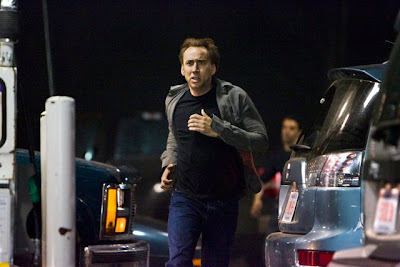
It's in these two horrific scenes of startling intensity and state-of-the-art special effects that Proyas shows that he is an incredibly stylish filmmaker with a noir flair, keen sense of the dramatic, and master at weaving all of the pre-production, on-set, and post-production elements together for the most incredible impact. Knowing's sequences are unbelievably dazzling to the senses.


Magnificently captured as one of the first feature productions to be lensed with the innovative Red One Camera that boasts “the latest in lightweight high resolution digital technology,” as cinematographer Simon Duggan notes-- the camera offers an extraordinary and previously untapped potential for digital cameras by producing, “skin tones [that] are soft and look fantastic,” with “hardly any noise or grain in the images,” which therefore help produce “a very immediate quality for [the]... picture...[that] is virtually identical to film.”


Freeing up the filmmakers to move much faster than the usual for a shoot, Duggan said that the new technology gave them “more confidence in pushing the limits of what we were doing,” by offering them the chance to do things formerly exclusive to post-production such as “tweaking color” as they were shooting directly on set.

Coupling Duggan’s amazingly fluid, hyper-real cinematography with Proyas’ trademark emphasis on natural, low-lit scenes filled with dark color schemes and wardrobe such as in a phenomenal subway chase and derailment in New York City—Knowing is heightened all the more with the score from the talented composer Marco Beltrami (Scream, 3:10 to Yuma).


It’s hands down the best original score I’ve heard so far in 2009. And moreover, it’s one that was so good at numerous moments-- and especially when the movie started to become increasingly nonsensical-- I found myself fixating on the work more as a moving piece of art with some truly dynamic music that managed to maximize every scene to the fullest, even when it didn’t deserve it along with the incredible photography. For example, we're soon distracted by some super lame special effects as it moves towards its laughable finale, we're distracted by a group of odd stereotypical Albino looking mystery men in long trench coats that seem to have wandered in from a 1980s music video shoot.

An admirable attempt that had so much potential given its terrific set-up and original source material, Knowing seemed to have been—at least when you read the press notes—destroyed over the reported “eight years [spent] developing the script,” which had begun with the initial gem of an idea from Ryne Douglas Pearson (Mercury Rising).


And accurately, Nicolas Cage compared the script to a teleplay for Rod Serling’s iconic “The Twilight Zone,” which made sense for a majority of the picture. Moreover, I felt that it would’ve been best if they would’ve stuck with that “what if?” simple yet fascinating idea of what would you do if you discovered you knew precisely when tragedy was to strike in the form of the apocalypse.


However, by trying to throw in a bizarre and uneven amount of New Age, spiritual, pseudo-scientific, religious, and philosophical theses together into one movie, it ultimately just resulted into a huge mess as opposed to their original intent which was to make something “people are going to want to talk about.” Going for a weird blend of I Am Legend with a musical motif pulled straight out of Barry Lyndon-- yet with all the "believability" of Eyes Wide Shut, you'll find yourself foolishly starting to stand up several times as the final moments of Knowing goes from one would-be tease of an ending to the next.


And while honestly, the timing couldn’t be worse for a movie about the end of the world given our gloomy global crises, economic situation, etc.—I’m sure it will fascinate for a good week or so at the box office especially considering the devoted fans of both Proyas and Cage until eventually word of mouth will bring it down, just as it did to those other watchers of doom-- in the recent Watchmen.(Updated Note as of 7/10: Sadly, this is another film to which my idol Ebert awarded four stars)


And although M. Night Shyamalan and Frank Darabont's 2008 works are far from perfect, I'd say-- save your dough and rent the underrated yet still superior The Happening and The Mist and instead.


Text ©2009, Film Intuition, LLC; All Rights Reserved. http://www.filmintuition.com

Unauthorized Reproduction or Publication Elsewhere is Strictly Prohibited.

3/20/2009

Movie Review: Knowing (2009)


Now Available on DVD, Blu-ray & On Demand


Download on iTunes

Knowing (2009)

Movie Still Slideshow


Also New from Summit Entertainment

Apple iTunes


Delicious
Bookmark this on Delicious
submit to reddit
Print Page

Digg!

MovieBlips: vote it up!

“The great thing about Knowing is that… it has this bedrock of emotions and human interaction. Reality is what this story is all about… We don't ask you to suspend disbelief. Everything that we've addressed in this could possibly happen.”
Director Alex Proyas;
As Quoted in Summit Entertainment's Production Notes


Now maybe it's just missing from his IMDb page, but I wasn't aware that The Crow, Dark City and I, Robot
director Alex Proyas held advanced degrees in cosmology, astrophysics, thermodynamics, and quantum mechanics.

Of course, you don't have to be Stephen Hawking to make a thought-provoking science-fiction movie as Steven Spielberg has proven numerous times over. However Proyas’ film Knowing-- which begins with an incredibly intense, pulse-pounding first hour, unfortunately hurdles towards one of the most ludicrous, unintentionally hilarious, and downright bizarre conclusions in recent cinematic memory.

In fact, it so derails its audience-- that had been previously and wholeheartedly committed to the far-fetched but fascinating storyline for a good majority of the picture-- with one of its roughly baker’s dozen silly finales which makes his announcement that he believes his film is completely steeped in reality all the more mind-boggling and a bit worrisome.

Uneasily venturing from its The Shining meets The Ring freaky little kid origins into a doomsday drama a la Deep Impact before it tries to weave in Mothman Prophecies and Dragonfly New Age spiritualism to the horror-lite psychological thriller Final Destination—Knowing leaves no genre or device behind sprinkling in some Close Encounters of the Third Kind in for good measure amidst a generous helping of The Twilight Zone.


And unfortunately, in hindsight, it definitely didn't need to be that way as the film begins with an eerie and ominous beginning going back in time to 1959 as we meet a young girl who participates in a grade school burial of a time capsule to be dug up 50 years later.

While the other students in Lucinda's class predictably draw pictures of spaceships in their foreshadowing of what life will be like in 2009, Lucinda obsessively puts pencil to paper and begins writing numbers in a frantic frenzy filling both sides of one single sheet before her teacher pulls it away from her. However, Lucinda hadn't finished her project as we quickly discover on the day of the time capsule burial when the peculiar girl disappears from the crowd and is later found scratching until her nails are bloody more numbers into the wood of a school closet door.

Fifty years later, Lucinda’s sealed, buried envelope is opened by Caleb (Chandler Canterbury)—conveniently the son of MIT astrophysicist John Koestler (Nicolas Cage). Although his son isn't supposed to bring the envelope home (following the ceremony that unearthed the time capsule), something about the numbers inspires Caleb to do the opposite as he later tells his father that the sheet could contain some sort of math puzzle.

As equally headstrong as his father-- the young hard of hearing Caleb comforts himself with Discovery Channel specials and old home movies of his deceased mother. Yet, fiercely devoted to protecting his son almost to the point of making Caleb a near shut-in when he isn’t in school since he can’t bear to lose the rest of the family either to death or disagreement as-- John copes with the absence of his wife with increasing amounts of Jack Daniels and classical music.

However, in a drunken whim, he becomes as equally intrigued as Caleb was by Lucinda's numbers. Ripping a white-board down off of his wall when he realizes that patterns have begun to emerge and after an insane amount of Google searches, Koestler realizes that what-- to an untrained eye would just seem to be the nonsensical automatic writing of a lunatic-- actually foretells the dates and casualties of ever major tragedy including the latitude and longitude of each event.

When he realizes that the Phoenix, AZ hotel fire which took his wife away is also included in the message, he takes his discovery to a colleague in the cosmology department who remains not only skeptical of the paper but fearful of his friend’s mental stability. However-- sticking to his guns (or rather brains)-- John remains increasingly convinced by its authenticity especially when he personally witnesses two upcoming disasters conveniently located within driving distance.

It's in these two horrific scenes of startling intensity and state-of-the-art special effects that Proyas shows that he is an incredibly stylish filmmaker with a noir flair, keen sense of the dramatic, and master at weaving all of the pre-production, on-set, and post-production elements together for the most incredible impact. Knowing's sequences are unbelievably dazzling to the senses.

Magnificently captured as one of the first feature productions to be lensed with the innovative Red One Camera that boasts “the latest in lightweight high resolution digital technology,” as cinematographer Simon Duggan notes-- the camera offers an extraordinary and previously untapped potential for digital cameras by producing, “skin tones [that] are soft and look fantastic,” with “hardly any noise or grain in the images,” which therefore help produce “a very immediate quality for [the]... picture...[that] is virtually identical to film.”

Freeing up the filmmakers to move much faster than the usual for a shoot, Duggan said that the new technology gave them “more confidence in pushing the limits of what we were doing,” by offering them the chance to do things formerly exclusive to post-production such as “tweaking color” as they were shooting directly on set.

Coupling Duggan’s amazingly fluid, hyper-real cinematography with Proyas’ trademark emphasis on natural, low-lit scenes filled with dark color schemes and wardrobe such as in a phenomenal subway chase and derailment in New York City—Knowing is heightened all the more with the score from the talented composer Marco Beltrami (Scream, 3:10 to Yuma).


It’s hands down the best original score I’ve heard so far in 2009. And moreover, it’s one that was so good at numerous moments-- and especially when the movie started to become increasingly nonsensical-- I found myself fixating on the work more as a moving piece of art with some truly dynamic music that managed to maximize every scene to the fullest, even when it didn’t deserve it along with the incredible photography. For example, we're soon distracted by some super lame special effects as it moves towards its laughable finale, we're distracted by a group of odd stereotypical Albino looking mystery men in long trench coats that seem to have wandered in from a 1980s music video shoot.

An admirable attempt that had so much potential given its terrific set-up and original source material, Knowing seemed to have been—at least when you read the press notes—destroyed over the reported “eight years [spent] developing the script,” which had begun with the initial gem of an idea from Ryne Douglas Pearson (Mercury Rising).


And accurately, Nicolas Cage compared the script to a teleplay for Rod Serling’s iconic “The Twilight Zone,” which made sense for a majority of the picture. Moreover, I felt that it would’ve been best if they would’ve stuck with that “what if?” simple yet fascinating idea of what would you do if you discovered you knew precisely when tragedy was to strike in the form of the apocalypse.

However, by trying to throw in a bizarre and uneven amount of New Age, spiritual, pseudo-scientific, religious, and philosophical theses together into one movie, it ultimately just resulted into a huge mess as opposed to their original intent which was to make something “people are going to want to talk about.” Going for a weird blend of I Am Legend with a musical motif pulled straight out of Barry Lyndon-- yet with all the "believability" of Eyes Wide Shut, you'll find yourself foolishly starting to stand up several times as the final moments of Knowing goes from one would-be tease of an ending to the next.


And while honestly, the timing couldn’t be worse for a movie about the end of the world given our gloomy global crises, economic situation, etc.—I’m sure it will fascinate for a good week or so at the box office especially considering the devoted fans of both Proyas and Cage until eventually word of mouth will bring it down, just as it did to those other watchers of doom-- in the recent Watchmen.

And although M. Night Shyamalan and Frank Darabont's 2008 works are far from perfect, I'd say-- save your dough and rent the underrated yet still superior The Happening and The Mist and instead.