Showing posts with label Israel. Show all posts

9/14/2018

Netflix Movie Review: The Angel (2018)


Now Streaming

Bookmark and Share

"When one man, for whatever reason, has the opportunity to lead an extraordinary life, he has no right to keep it to himself." - Jacques Yves Cousteau

For spies, access (to people as well as information) is everything. And as the son-in-law of Egyptian President Gamal Abdel Nasser who would – following Nasser's heart attack – quickly become the special adviser and Secretary General for Nasser's former Vice President and successor, Anwar Sadat, Ashraf Marwan's access to everything was extraordinary.

Inspired by (as the production notes describe) the "failed chicken farmer" Juan Pujol Garcia who became a British and German double agent to undermine the Nazis in World War II, Marwan initially reaches out to the Israeli intelligence organization, the Mossad when he's a husband, father, and university student in England.


Although he’s blown off at the first, eight months following Nasser's passing – just when he's begun to form a close alliance with Sadat – Marwan is startled when the Mossad follows up, tracking him down from England to Egypt.

Hoping to prevent another war, after Sadat and his advisers begin making plans to take back the land that Israel had claimed when they defeated "the combined forces of Egypt, Syria, and Jordan" in 1967’s Six Day War, Marwan begins selling secrets to his Israeli handler "Alex" aka Danny.


Fearing for his family's safety as well as his own, although he enlists the help of some friends, including beautiful British actress Diana Ellis to snap a photo or provide cover as a faux mistress, as Sadat's plans and war games escalate, so does the danger for the spy code named "The Angel."

Filled with as much plot and background data as one of Marwan's reports (including an opening voice-over that quickly sums up an entire war), while this approach does unfortunately hold us at an arm's length since we're never able to stop long enough to get a true sense of the people behind the pages handed from one man to the next, it's fascinating stuff regardless.


Anchored by the compelling Dutch actor Marwan Kenzari, who costarred with his Mossad handler played by Toby Kebbell in 2016's Ben Hur (which undoubtedly helped their chemistry), Kenzari's affecting, multilayered, largely internal portrayal helps add a deeper sense of struggle to the goings on.

Giving us an in depth look at the responsibilities faced by a man who has begun to excel at deception, even for the noblest of reasons, The Angel works as well as it does, in large part because we believe Kenzari – regardless of which role he's playing when and to whom – as a husband, spy, or adviser.


Alluding to a gambling habit, money problems, and trust issues with his wife, Marwan's love of western culture as a student in England seems clear early on. However the film's juxtaposition of his resentment at the way he's treated by Nasser with his subsequent call to Mossad leaves the viewer with more questions about Marwan as well as his initial impulse to pick up the phone.

Although he matures and changes before our eyes, we find ourselves wanting to know more about his thought processes beyond some of the film's key expository lines, penned by Spy Game and Children of Men screenwriter David Arata for The Iceman director Ariel Vromen.


Hoping to, as he revealed in the production notes, "try to make it as realistic and visceral as possible" in the way the we see "the journey of one man, where he starts, [and] where he's planning to go," Vromen drew upon Ben Affleck's Argo for inspiration, as well as Steven Spielberg's underrated Munich.

While prior to the film I was more familiar with the end of Marwan's story (which is still in need of investigation and has only become timelier and more suspicious over the last ten years), The Angel offers a fast-paced, exciting, well made depiction of everything he'd done decades earlier to lead to roughly forty years of peace.

And needless to say, with results like those, even if we occasionally find ourselves wanting to know more about not only our lead but also the people and places glossed over throughout, in the end – and like most spies – we're grateful to The Angel for the information as well as the access.


Text ©2018, Film Intuition, LLC; All Rights Reserved. http://www.filmintuition.com Unauthorized Reproduction or Publication Elsewhere is Strictly Prohibited and in violation of the Digital Millennium Copyright Act.  FTC Disclosure: Per standard professional practice, I may have received a review copy or screener link of this title in order to voluntarily decide to evaluate it for my readers, which had no impact whatsoever on whether or not it received a favorable or unfavorable critique. Cookies Notice: This site incorporates tools (including advertiser partners and widgets) that use cookies and may collect some personal information in order to display ads tailored to you etc. Please be advised that neither Film Intuition nor its site owner has any access to this data beyond general site statistics (geographical region etc.) as your privacy is our main concern.

3/31/2018

Film Movement Movie Review: In Between (2016)

Bookmark and Share

AKA: Bar Bahar

"Once you express your worldview and your manifest, there's no turning back. Either do something real or don't do it at all. At least that is the way I see things," writer/director Maysaloun Hamoud explains in an interview quoted in Film Movement's press notes for her passionate first full-length feature In Between.

Nominated for a dozen Israeli Oscars (and garnering two wins for her female-centric cast), it's safe to say that much like she believes her "heroines bring their dreams to the screen," she's doing the exact same thing as a filmmaker.

Eager "to bring more Palestinian female representations" to cinema's emerging Arab New Wave, Hamoud’s award-winning breakout festival hit In Between is the epitome of her desire to tell stories in which "a woman is staged in the center and not just behind the male characters."

Revolving around not one but three very different Palestinian women who come to share an apartment in the Yemeni Quarter neighborhood of Tel Aviv, the aptly named In Between illustrates their struggles to reconcile their personal, cultural, and religious beliefs in a city they mostly feel at home in at night while exploring the underground club scene.


Of course, that would be all except for the devout, younger Muslim university student Nour (an excellent Shaden Kanboura) who arrives out of the blue shortly into the film, having been invited to stay by Nour’s cousin – a former, unseen resident, whom we gather never shared those plans with her roommates.

Fortunately not the types to leave a woman in a lurch, while her dorm is being renovated Nour is given what we deduce is her cousin's old room to complete her computer science degree in peace, which is a welcome respite from an otherwise two hour commute from Jaffa.

Though hesitant at first, over the course of the film, Nour (and the audience) grows closer to her free-spirited new friends, Laila (played by scene-stealer Mouna Hawa) and Salma (the delightful Sana Jammelieh).

A criminal defense attorney by day turned queen of the club scene by night, Laila and Salma – a communist bartender and DJ who hides the fact that she’s a lesbian from her Christian family – soon become surrogate big sisters to the less worldly Nour. And nowhere is this relationship more evident than in a heartbreaking yet beautifully moving sequence when they try to help Nour on a night when things go very wrong.

Filmed in an intimate, small space while pulling back enough to offer the women privacy as if we're in the apartment as well, in this scene, Hamoud avoids the rookie mistake of telling us what we're seeing – wise enough to know that when it comes to raw emotion, actions speak so much louder than words.


Drawn to their strength and resolve to the point that we find ourselves wanting to know more about not only the enigmatic main characters but their fascinating friends as well, all in all, it’s a fast moving, powerful, feminist work about life as a modern Muslim or Christian Palestinian woman in a world that may not be ready for them. And sadly, this idea was carried offscreen as In Between earned its brave writer/director a Fatwa.

Obviously this isn't helped by the fact that some critics have foolishly dubbed the film Palestine's Sex and the City, more for the character setup (and in order to score easily accessible pop cultural clickbait points) than anything else. And while admittedly on paper, the character combination of the wild friend, the militant rebel, and the more modest one has been used repeatedly throughout film and television history, Maysaloun Hamoud is up to the creative challenge.

Managing to leave the archetypes behind, Hamoud crafts three largely believable, three-dimensional heroines within the universally relatable context of friendship and sisterhood in what the filmmaker told Vogue (in a fascinating, though spoiler heavy interview) is the first picture of a planned trilogy.

Putting women at the heart of the story in such a powerful way, now that she's shared her worldview with a film and characters that are very real and uniquely her own – just like she's said – there's no turning back.


Text ©2018, Film Intuition, LLC; All Rights Reserved. http://www.filmintuition.com Unauthorized Reproduction or Publication Elsewhere is Strictly Prohibited and in violation of the Digital Millennium Copyright Act.  FTC Disclosure: Per standard professional practice, I may have received a review copy or screening link of this title in order to voluntarily decide to evaluate it for my readers, which had no impact whatsoever on whether or not it received a favorable or unfavorable critique.

10/30/2014

Film Movement DVD Collection Review – Beyond Borders: Stories of Interfaith Friendship (Arranged; A Bottle in the Gaza Sea; Foreign Letters)


Now Available to Own:   
Beyond Borders
Faces of Israel

  Photo Slideshow


Released alongside Film Movement's Faces of Israel four-disc film collection of works which offer viewers a snapshot of the complexity and diversity of life in contemporary Israel, the companion box set Beyond Borders celebrates the differences that unite and divide us in a humanistic trio of titles set in the United States as well as the topical region.


But rather than take you through them alphabetically or chronologically, I'm taking a cue from the films included in Borders to go beyond the expected – serving up a review of the titles in the order I'd recommend watching them for the greatest cinematic impact.


Foreign Letters (2012)
Directed by Ela Thier

Although it’s included alongside A Bottle in the Gaza Sea, Ela Thier’s largely autobiographical effort Foreign Letters makes a first-rate companion film to the thematically similar, likewise female (co)directed tale Arranged which seems to continue on with the thesis of intercultural female friendship established in Letters.

Easily the best starting place in the Beyond Borders box set celebrating interfaith friendships from the Film Movement catalog, the work chronicles Thier’s own adolescent struggles to navigate life in a new nation where she could barely speak the language.

As the sweet, succinct, 1982-set story begins, the twelve-year-old Ellie (Noa Rotstein) writes what the audience quickly gathers is just the latest in an ongoing series of letters from America to her “best friend times infinity” back in her former Israeli home.

Charting the timeless struggle of not fitting in to not knowing where to sit at lunch, Thier takes a cue from the Peanuts specials of yesteryear by translating the English language instructions of Ellie’s everyday teacher (outside the ESL classroom) into veritable gibberish in her feature-length adaptation of her acclaimed short A Summer Rain (which is also included on the DVD).

Thier’s subtle portrait of coming-of-age in a brand new country slowly but steadily picks up momentum as Ellie finds a friend in a fellow outsider via the Vietnamese refugee Thuy (Dalena Le).


Shy and studious as well as just as self-conscious as Ellie, the two girls begin testing the waters of a fledgling friendship that was initially forged out of loneliness and necessity before they soon discover that their differences are nowhere near as important as their similarities.

Educating themselves about life in their new surroundings, the girls balance one another out while also giving each other the vital self-confidence they need to stop hiding in the shadows of a school that isn’t nearly as ready to accept them as they are ready to accept both each other as well as everyone else.

While it’s a bit structurally underwhelming as we get the feeling that Thier wasn’t entirely sure what to do with the production’s full ninety-nine minute running time (versus the original seventeen minute short which also utilized the same talented young leads), Letters nonetheless manages to overcome the bumps in the road to leave a lasting impression.

Furthermore, the film’s sheer authenticity elevates Thier's work as a timeless portrait of female adolescent existential angst that resonates as strongly today as we imagine it would've if released in its original 1982 time period.

Thus in spite of a floundering middle act that gets bogged down with somewhat episodic plotting, we're more than willing to take a cue from Ellie and give it some time to find its way.

A moving and sensitive salute to the importance of human connection as well as a completely preach-free reminder that we’re all humans with the same wants, needs, fears, laughter, and tears regardless of our language or homeland, Thier’s autobiographical cinematic journey results in one of the best family friendly offerings in the entire Film Movement catalog.

Reminding viewers of the rewards that await us when we dare to look past the popular lunch table of cliquish Twilight style commercial friendly studio fare, Foreign Letters serves as an excellent “starter” picture to introduce middle school students to the world of international filmmaking by way of characters they can relate to that likewise have something of quality to say.


A Bottle in the Gaza Sea (2011)
Directed by Thierry Binisti

Adapting a work from the “tell me” medium of literature to the “show me” medium of film is difficult enough as it is without even considering the fact that for the title in question, the story unfolds largely through the written word as the most pivotal sequences revolve around the sending and receipt of e-mail messages.

Of course, considering that the characters at the heart of A Bottle in the Gaza Sea are a French born seventeen-year-old Israeli girl (Agathe Bonitzer) and a twenty-year-old Palestinian boy (Mahmoud Shalabi) who found her cyber address included in the titular bottle, it’s safe to say that Gaza isn’t your typical pen pal saga.

Wanting to make sense of all of the suicide bombings that occur on her side of the water, the beautiful idealist Tal sends her query out to the unknown via her older brother who’s able to hurl the bottle into the Gaza Sea while carrying out his required military service.

What begins as a heated, blame-filled exchange of sarcasm and oft-heard clichéd generalizations gradually blossoms into something much more substantive as the two share their thoughts, typed snapshots of daily life, and later actual photographs that make them realize that if they’d met anywhere else under ordinary circumstances there’s a pretty strong likelihood that they would’ve become friends.

Part of the three disc Beyond Borders collection crafted to explore interfaith relationships, while Bottle might hold up well on its own, unfortunately when viewed alongside the other two vastly superior titles included in the set, it’s the weakest entry in an otherwise staggeringly impressive triple feature.

While the thematically similar Foreign Letters is much more natural in its approach, the admirable effort put forth by filmmaker Thierry Binisti to capture both points-of-view and likewise evoke empathy for each character (while simultaneously pulling you in two totally different directions) makes the film seem much better than it actually is in the end.


An unapologetically hopeful work that’s bogged down by awkward performances and emotionless English language line-reads by its young actors (which should've been subtitled along with its foreign dialogue), Bottle is an otherwise well-intentioned attempt to translate Valerie Zenatti’s award-winning novel to the screen.

Though you wish the final result would've been far more compelling, Bottle stays afloat – getting better as it continues – which results in a surprisingly moving final sequence that’s guaranteed to stay with you.

Largely wordless and therefore much more effective at conveying the real unspoken bond between the characters as two kids who connected (versus the filmic opportunities to take advantage of politically correct speechmaking), the gorgeous depiction of idealism and acceptance butting heads with bureaucracy conveys everything the filmmaker was trying to say in its memorable conclusion.

As it stands, it’s a lovely throwback to the same spirit of youthful rebellion tempered by the futility of circumstance found in the final frames of ‘50s and ‘60s French New Wave cinema (followed by the British and American pictures it influenced for a majority of the late '60s and '70s).

Moreover it’s further proof of not only Binisti’s artistry but another reminder to those adapting novels in the future that there is indeed a better way to tell the story than through too many voice-overs and shots of inboxes on computer screens.


Arranged (2007)
Directed by Diane Crespo and Stefan Schaefer

Review: (Originally Published 5/1/08)

"Someone should be shooting a commercial for world peace," fourth grade teacher Nasira Khaldi (Francis Benhamou) jokes to her coworker turned friend Rochel Meshenberg (Zoe Lister-Jones) when the two women bump into one another in a New York park and encourage their younger relatives to play together.

It’s a recurring joke throughout the inviting, original and warmhearted American independent film Arranged that focuses on two young women in their early twenties who, despite their religious differences as a Muslim (Nasira) and an Orthodox Jew (Rochel), are both dealing with similar issues of parental pressure and familial obligation in the quest to marry the two teachers off.

In Rochel's case, this tradition calls for utilizing the talents of a matchmaker who pitches men to her client as if she’s selling automobiles by evaluating their job performance, sustainability and prominence. However for Nasira, it’s a bit more laid back as their father invites over a much older family friend in the hopes that his young daughter will find love with an uncouth gentleman prone to chatting animatedly with food in his mouth.

Meanwhile Rochel contends with a series of disastrous matchups including a painfully awkward first encounter with a man who acts as though he’d rather voluntarily show up for a root canal than a date, along with one man who lets himself into the place and proceeds to snoop through everything while running at the mouth his own sales pitch covering his accomplishments.

Both targets from their female principal who, in trying to compliment their beauty patronizes their beliefs by offering them money to go out and buy designer clothes and have a drink to start taking advantage of the women’s movement, the two modestly dressed new teachers sit singularly at tables away from the more daring and cliquish women their age at the school.


However, the film's leads really hit it off when children question whether or not they hate one another because of what they’ve heard on the news.

In offering the students a unity circle exercise, Rochel and Nasira conduct their own diversity celebration that seems to be far more accessible than the perfunctory district mandated training shown at the start of the film. Sure enough as the women begin spending more time together away from work, they realize they have far more in common than they first assumed.

Touchingly authentic and believably executed, directors Diane Crespo and Stefan Schaefer’s appealing film was a hit in the film festival circuit.

An official selection at the South by Southwest Film Festival and the Miami Jewish Film Festival, Arranged earned the audience award at Berkshire International Film Festival as well as the Grand Chameleon Award for Best Narrative Feature at the 2007 Brooklyn International Film Festival before making its way to DVD from our friends at Film Movement.

Bookmark and Share

Text ©2014, Film Intuition, LLC; All Rights Reserved. http://www.filmintuition.com Unauthorized Reproduction or Publication Elsewhere is Strictly Prohibited and in violation of the Digital Millennium Copyright Act.  FTC Disclosure: Per standard professional practice, I may have received a review copy of this title in order to voluntarily decide to evaluate it for my readers, which had no impact whatsoever on whether or not it received a favorable or unfavorable critique.

8/17/2009

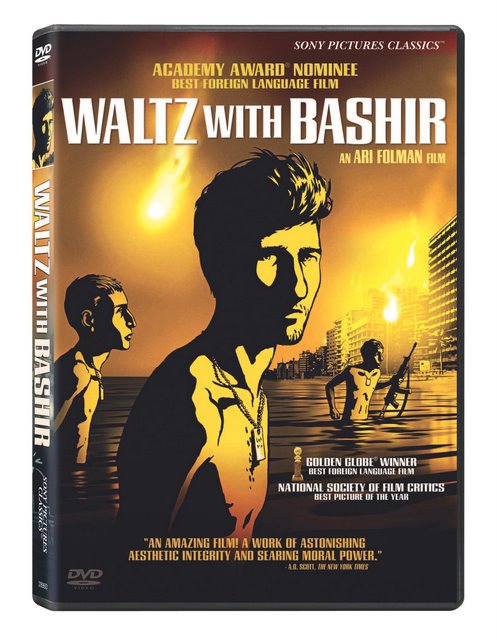
DVD Review: Waltz With Bashir (2008)


Now Available To Own


Alternately designed to protect us and to accept our own input as though it were a computer we were constantly updating-- the potential of the human mind and our memory in particular is an unfathomable and undeniable enigma.


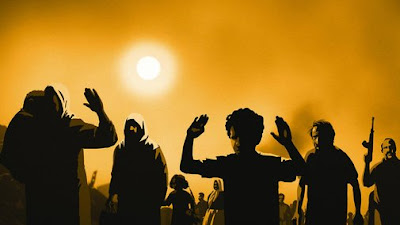
As filmmaker Ari Folman quickly discovers early on into his surreal, haunting and humanistic autobiographical animated documentary Waltz With Bashir, when we're faced with something so horrifically unbearable that we're not sure how to process it, we can disassociate ourselves from the experience. Thereby, we can then view stimuli we encounter as though it were projected via twenty-four flickering frames per second on a screen in a movie theatre.



Yet, when that camera breaks-- as one interviewee reveals to Folman later into this stunning achievement-- and we become self aware as though we've finally succeeding in breaking down that fourth wall to realize that we're actually experiencing the devastation firsthand, the results can be too much for us to accept.


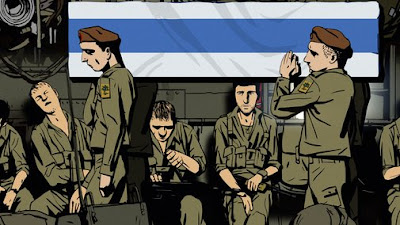
Since memory itself is dynamic, alive, visceral, and it constantly feeds off of new sensory data with each passing moment, it's only fitting that it can trick us as we will mentally fill in any gaps in our recollections as we see fit. This phenomenon startles Folman when a friend and fellow army veteran fills him in on a recurring nightmare which triggers Folman's realization that he's missing some rather large chunks of his own memory of time spent while serving as an Israeli soldier in the earliest Lebanon War of the 1980s.


Ascertaining that the nightmare plaguing his friend is most likely related to the same war, Folman makes a bold decision to fight against our internal human mechanism that prevents us from anything too uncertain to travel the planet in search of old friends, fellow soldiers, and others who may be able to illuminate what's really been left in the darkest recesses of his repressed memories.


And once the men begin talking, the memories start to finally float to the surface as though they existed just out of reach in the same ocean that's appeared in both the recurring nightmares and in a repeated vision of seemingly allegorical significance in the movie.


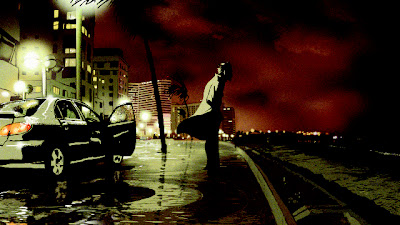
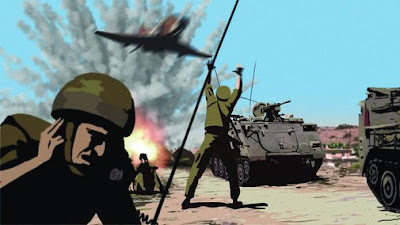
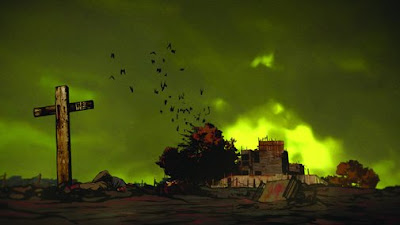
Using the authentic testimonies of all involved in a film that Folman first shot on ninety minute videotape and then worked alongside artists to animate separately via Flash, 3D, and by hand as opposed to rotoscoping in a process that took four years to produce, we're presented with a surrealist, highly original documentary feature that reminds us that no two recollections are alike.


Ambitious in its artistry and easily the most effective animated foreign work in recent memory (surpassing even the critically lauded Persepolis), Folman's Oscar nominated work is both tremendously unsettling and breathtakingly beautiful. Additionally it features a gorgeous score accompanied by both rock music and classic waltzes that hearken to the title which comes from one extremely memorable testimony.


And admittedly while the idea of animating recorded recollections may sound far-out on paper, the diverse styles incorporated in the painstaking 2,300 illustrations turned into animation make Bashir an extremely urgent, unique, and highly original artistic vision. More than just employing animation as a sort of cinematic stunt, Folman's decision to animate the documentary strengthens the work considerably. And it does so not just as a fearless retelling of the war and the shocking Sabra and Shatila Massacre that found an estimated 3,000 people murdered but it also helps augment the study of the human mind and how we try and adapt to such hellish events.


In doing so, the viewer is no longer passive or lulled into a false sense of security since there are no concrete heroes or villains or structural acts as evidenced in most Hollywood war films and we begin realizing that it's hard to anticipate just where this mystery of the past will take veterans in the future.


Likewise, it's also completely necessary from an artistic point of view to craft footage by filling out their memories with visuals to match since needless to say they weren't equipped with the technology of today's soldiers that post items on YouTube for the world to see.

Obviously it's intended as more than just one man's own personal journey to uncover what really happened during that tumultuous and deadly summer. And moreover, it's an important artifact to share with the next generation (including Folman's sons) who, like this reviewer, may be unfamiliar with the events that transpired. Additionally, Bashir feels incredibly timely as an antiwar film given not just our two ongoing wars but the endless threat of additional conflicts, nuclear devastation, and more battles with each passing year.


Expertly taking his own background as an award-winning writer, director and filmmaker where he'd begun toying with animation in a documentary television series about "the science of love," Folman moves from love to war for this particular work. In doing so, he shares that he's against his sons taking "part in any war, whatsoever," by painting the immediacy of it through daring imagery and cinematic techniques.


Revealing that the film was made from his own point of view of a soldier in the Israeli army and determining that engagement in war is useless-- seeing the images he pieces together in a visceral tapestry is the best example of his thesis that essentially war consists of "very young men going nowhere, shooting at no one they know, getting shot at by no one they know, then going home and trying to forget."


Sharing that "sometimes they can" indeed forget, he's quick to remind that "most of the time they cannot," and the powerful interpretation by Folman hits us much harder than the standard dry, military documentary he wanted to avoid making in the first place. For, due to the lack of footage, it would've consisted of "a middleaged man being interviewed against a black background, telling stories that happened 25 years ago, without any archival footage to support them."


Clocking in at a breakneck ninety minutes, Waltz With Bashir is reminiscent cinematically of Tim O'Brien's literary Vietnam masterpiece The Things They Carried which meandered from one narrative to the next. Loading the DVD with extras including behind-the-scenes footage, filmmaker commentary, and a Q&A session-- what is easily one of the strongest foreign works of last year may have shockingly failed to deliver Oscar gold but it will stand the test of time nonetheless.


The recipient of the National Society of Film Critics' honor as the Best Picture of the Year, Folman's Golden Globe winning imaginative artistic opus invites us to swim through the perilous ocean of human memory until inevitably our boat sinks or the camera breaks and we're left piecing everything together.


Moreover, by exploring the self-preservation technique we have of blending together fantasy to get by during horrific reality, in the end Waltz With Bashir is an achievement that manages to transcend language itself. And this is made all the more remarkable due to its striking presentation and unwillingness to compromise its vision as a humanistic thesis on the uselessness of war and the resilience of those who must endure it.


Text ©2009, Film Intuition, LLC; All Rights Reserved. http://www.filmintuition.com
Unauthorized Reproduction or Publication Elsewhere is Strictly Prohibited.

9/30/2008

Strangers


Digg!


Although if asked honestly, most of us share a preference of dating within our party lines, in America, we frequently express that it’s best to keep politics out of love. However, the discovery of a true romance seldom goes according to plan. And imagine how much tougher courtship becomes when in the Sundance hit Strangers when the man and woman who find they’re becoming increasingly drawn to one another are Israeli and Palestinian respectively.

Beginning with a typical “meet cute,” classic romantic comedy set-up, World Cup tourists Eyal and Rana first catch each other’s eye sitting opposite one another aboard a Berlin train. After mistakenly leaving with their opposite yet identical rucksacks and phoning to arrange a swap, the two strangers find themselves stranded in the overly-crowded city and find unlikely shelter in a large apartment upon learning that all hotels are booked. Despite a few tense moments and awkward jokes, they manage to form a bond despite their differences and soon slide rather naturally from friendship to romance amidst the celebrating city.

Although unlike the admittedly naïve characters in Richard Linklater’s similarly plotted Generation X classic Before Sunrise, the problems Eyal and Rana face are global in scale. Ultimately, following their separation in Berlin after a night of young passion, the two must come to terms with how their experiences, family duties and ethnicity will impact any chance of a future when Eyal forgoes Rana’s wish and heads to Paris to reunite with his beguiling new love. This becomes especially complicated when a second Israel-Lebanon war begins.

Hopefully optimistic, surprisingly touching and exuberantly photographed with earnest portrayals by its young leads, the fast-paced film admirably avoids the predictable tragedy one would fear. And along the way it should manage to inspire even the most politically cynical audience members that perhaps it isn’t too late to remember the old 60’s slogan to “make love, not war.”

9/12/2008

The Patriots (1994)


The Spy Who Came in From the Desert


Digg!

As outlined in writer/director Eric Rochant’s Cannes Film Festival award-nominated 1994 film, The Patriots -- much like David Fincher’s Fight Club -- the first rule of the Mossad seems to be that you do not talk about the Mossad. And, the second rule of the Mossad seems to go even further — if you’re ever asked about the Mossad, there is no Mossad. And these are probably the very reasons there are few movies about the Mossad, which Wikipedia explains is not only “the Hebrew word for institute or institution” but is also the “national intelligence agency of Israel.”

However, while it’s no doubt an important organization, it’s not quite the cloak-and-dagger corporation one would assume from Rochant’s film nor the secretive “men wailing on each other” experience to be found in Fight Club but a super cool, far-reaching, covert organization that serves as “Israel’s equivalent to the C.I.A,” as the DVD box for The Patriots explains.

Furthermore, in a year where Adam Sandler played a Mossad agent turned hairdresser in You Don’t Mess With the Zohan, I shouldn’t have been as surprised as I was to discover that here in the twenty-first century the Mossad (like any corporation or organization from the C.I.A. to Hello Kitty) actually greets visitors with their very own website. Although instead of adorable Sanrio characters, the Mossad's official site (which also has a link for career opportunities for those of you budding spies out there) states that their purpose is “to collect information, analyze intelligence, and perform special covert operations beyond its borders.”

Yvan AttalAnd while my prior experience with the Mossad only consisted of Sandler’s comedy and Steven Spielberg’s brilliant yet highly controversial Oscar-nominated film Munich, as a fan of spy films, I was eager to check out the recent SKD USA and KOCH Entertainment release of Rochant’s film. The Patriots earned him a Golden Palme nomination upon its screening at Cannes and also garnered its female newcomer Sandrine Kimberlane a Cesar nomination for the Most Promising Actress of that particular year. However, unlike the high tech world of Jason Bourne or the decades-spanning CIA epics such as The Good Shepherd or the far superior made-for-TNT miniseries The Company, Russian red scares and computer hacking are replaced by good, old-fashioned shoe leather and low-tech still and video cameras for the '80s setting of The Patriots.

For instead of a spy who came in from the cold, the secret agent man in Rochant’s film ventures into the desert, emigrating to Tel Aviv from Paris after his eighteenth birthday. Eager to fulfill his goal of joining the Mossad (and obviously this was pre-website when he could’ve inquired online before booking a flight), Ariel Brenner (Yvan Attal) leaves his family and friends behind and goes deep undercover. After psychological testing and endless attempts at tricking him into revealing too much, the brainy Ariel is recruited into Unit 238, headed by Yossi (played by Yossi Banai). The unit, notorious for not playing by the rules, quickly moves operations to wherever is necessary and Ariel quickly becomes acclimated to — as he narrates along the way in a diary and via letters — the “business of manipulation.”

Due to his French background, he heads up his first high profile assignment in his native homeland as his group of covert agents begins spying on a secretive nuclear scientist who, under the guise of a fake career as a math teacher, has begun working on a nuclear device for an anti-Israeli country. Employing the talents of a beautiful, street-wise, high-class call girl Marie-Claude (Sandrine Kimberlane) who captures Ariel’s heart, their assignment grows far more dangerous as it continues. However, it isn’t until Ariel begins working with an overly anxious and sympathetic American Jewish NSA employee (played by Richard Masur) to whom they give the codename Aladdin, that the doubts he’d been having about the nature of his business begin to grow heavily. As lives are jeopardized, questions of whether or not the end justifies the means begin to make him rethink the true nature of his alignment with the Mossad.

The gorgeous and gifted Yvan Attal (pictured throughout in various career stills), who actually got his start in film acting for director Rochant in A World Without Pity, is excellent in one of his early roles. Moreover we can already see the charismatic star he would become, evolving over the past few years into a talented writer and director in his own right with films such as My Wife is an Actress and Happily Ever After (starring his lovely significant other, Charlotte Gainsbourg). And although I was riveted throughout this film, which is noted to have been inspired by actual events, the structure of the Rochant’s work fails its lofty ambitions.


There are problems right from the beginning as it takes a good thirty minutes to successfully gain our interest since Ariel doesn’t share a scene with another character of significance and/or one who returns later on until well into the first act. And while we forgive the holes that exist throughout a majority as it never fails to entertain, the film’s overly rushed and unsatisfying conclusion leaves too many questions unanswered and there’s one particularly significant action made by Ariel that seems entirely out of character. While you can justify it by inventing a few explanations based on a few vague details scattered throughout (and indeed, the filmmaker may have been wanting us to leap to certain conclusions), by not inserting enough dynamic clues and prompts for the turn of events that occurs near the end The Patriots manages to leave us scratching our heads instead of feeling like the puzzle was solved.

Granted, it is fitting for us to use our intuition and skills of deductive reasoning when we’re dealing with international espionage, but for a movie one shouldn’t have to work that hard. And unfortunately the DVD offers us zero extra features to help answer any lingering questions. Thus in the end, despite The Patriot’s stellar production values we’re left with just the bare minimum amount of facts and the reminder not to talk about the Mossad… which, again could be why there are so few films about the Mossad in the first place. However, it's good to know that should we like to learn more, we're always welcome to visit their user friendly and easily navigable website.