Showing posts with label Isla Fisher. Show all posts

11/26/2010

Blu-ray Review: Double Feature -- Scooby-Doo 1 & 2: Scooby-Doo (2002); Scooby-Doo 2: Monsters Unleashed (2004)


Now Available to Own 


Photo Slideshow 


As Buffy the Vampire Slayer actress and all-around “girl power TV icon” Sarah Michelle Gellar revealed in an interview, originally – and much like the satirical update of The Brady Bunch Movie – the concept for the big-screen, live action Scooby-Doo adaptation was intended to skew towards a hipper teen to adult audience.

So instead of long, painfully unfunny scene catering to the lowest common denominator of those who love scatological humor comprised of nothing but Shaggy and Scooby trying do outdo one another flatulence-wise, the original plan was to construct the film with jokes playing off inferences we've all made about the characters from Hanna-Barbera's late '60s Saturday morning cartoon, from Shaggy's munchies to Velma's relationship with Daphne.


Unfortunately, ambitious and downright risky comedy was abandoned in favor of the tried-and-true Hollywood formula of lazy gag-writing as toilet jokes were in and everything we loved about the original series was left out in order to make it as commercial as possible.


Nonetheless, Matthew Lillard's eerily uncanny portrayal of Shaggy goes beyond simply a dead-on impersonation and it's even more impressive when you consider the fact that he's bringing an animated character to life.

For eight years later, Lillard's Shaggy remains the one great discovery of the two-film Warner Brothers franchise since he's continued to lend his voice to Cartoon Network Original Scooby-Doo Movies and the latest TV series to introduce a new generation to the generations-old show.


Ultimately however, the main thing the two movies achieve is an overwhelming desire to erase them from memory, go back in time and revisit the classic series.

And while I do grant that each film does have its moments of bright energy and throwback loopy chase sequences involving secret passageways and creepy contraptions that feel highly authentic, so much is lost in the translation that it's hard to enjoy them for very long.


And although it doesn't take much to dumb down an already admittedly formulaic original series, Scooby's greatest failure is in its downright, dubiously bizarre blend of a CGI Scooby with the live action Mystery Inc. detectives that distracts us to no end.

While Freddie Prinze Jr., Gellar, Linda Cardellini and Lillard all look the part as Fred, Daphne, Velma and Shaggy complete with their immediately identifiable color-coded wardrobe, once they share the screen with the technological amateur hour creation that is the series' namesake of Scooby-Doo, the only thing we can do is stare in jaw-dropped horror.


Although there is a slight improvement in CGI in the second picture, it's an even greater head-scratcher when you realize that the other computer generated monsters and ghouls onscreen in both pictures are far more believable and -- at times -- a bit too intense for young viewers, than the flawed four-legged canine.

And unfortunately for the folks at WB who went to great lengths to release this double feature in Blu-ray format, needless to say, high definition calls far more attention to the awkward combination of live action with CGI in Doo.


Had the entire feature been animated or a trained real-life dog been used instead, director Raja Gosnell's movies may have fared slightly better or at least not have screeched to a total halt whenever Scooby's in the picture, thereby making this mistake that much more unfortunate since the last thing we should be OK with leaving on the cutting room floor is the pooch that started it all in Hanna-Barbera's original mysteries.


Much more entertaining than the tonally all-over-the-place first flick that was obviously still finding its footing as the gang investigates a strange “spell” that seems to have taken away the personalities of college students at an island vacation destination, the second movie centers on the return of villains from the detectives' past.

Turning into a PR nightmare as the arrival of some of Mystery Inc.'s greatest ghouls (including ones from the original series) coincides with the opening of a local criminology museum in their hometown of Coolsville, the detectives must battle to save their reputation right along with their community in a far more cohesive second installment, penned by the first film's screenwriter James Gunn.


Despite raking in an enormous box office take for the original 2002 summer popcorn picture that no doubt played on people's love for the series, neither time nor the jump to high definition Blu-ray has enhanced my appreciation for the movies. Instead, this release only strengthens my concern for Raja Gosnell's upcoming live action take on another cartoon classic with Smurfs.


And although I wish they could initiate a moratorium on both talking dog movies and big-screen send-ups of small-screen material, it's worth noting that every once in awhile exceptions should be made.

Perhaps to make up for this disaster, the former editor and frequent Chris Columbus collaborator turned director Raja Gosnell eventually aced the dog movie market with Disney's underrated Beverly Hills Chihuahua which reteamed him with his Never Been Kissed leading lady, Drew Barrymore.

Nonetheless, it's safe to say that the price is most definitely right for WB's holiday-themed double feature Blu-ray release to deliver both movies in one for those willing to indulge their love of the series enough to look past the many, many shortcomings of the films, perhaps if only to watch Lillard deliver lines -- rather than excess gas -- as Shaggy.


Text ©2010, Film Intuition, LLC; All Rights Reserved. http://www.filmintuition.com Unauthorized Reproduction or Publication Elsewhere is Strictly Prohibited and in violation of the Digital Millennium Copyright Act.  

FTC Disclosure: Per standard professional practice, I received a review copy of this title in order to evaluate it for my readers, which had no impact whatsoever on whether or not it received a favorable or unfavorable critique.

7/01/2009

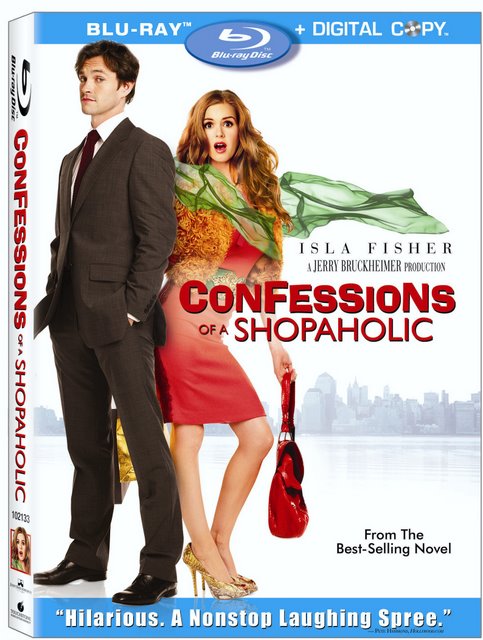
Blu-ray Review: Confessions of a Shopaholic (2009)


Now Available to Own on DVD & Blu-ray


Photo Slideshow


Apple iTunes

Click Here to View Film Clips & Behind-the-Scenes Videos


Delicious
Bookmark this on Delicious
submit to reddit
Print Page

Digg!

MovieBlips: vote it up!

Much like Rebecca Bloomwood (played by Isla Fisher), as a young girl I too was entranced by the idea of "magic cards" that could be swiped instead of handing over real, actual, tangible money for goods and services. This fascination also extended to checks to such an extent that I actually remember advising my mom to "go for it" once when we were at the grocery store after she told the clerk she had forgotten to stop at the bank so would need to whip out the checkbook.


"You don't need money, mom; just write a check," I informed her-- seriously unaware that much like the pretty cards (which are far more gorgeous today with impressionistic backgrounds and AmEx status plastic that resembles shiny gold)-- the pieces of paper you tore from the book that always seemed to stick to the messy carbons were temporary stand-ins for what was in your bank account. Of course, I also assumed that the reason you had to show your driver's license when you wrote a check (back when people actually wrote checks) was to prove to the cashier that you had a driver's license, were trustworthy, and would therefore drive the groceries home safely.

While it was safe to say that a career involving personal finance or accounting was not in my future-- it's exactly this line of work that Fisher's Bloomwood alarmingly finds herself in-- advising readers of Successful Saving magazine how to manage their money and understand the lure of a store credit card and initial 0% APR under the pseudonym of "The Girl in the Green Scarf."


Aside from it being a cute moniker to use as she types in a fresh hip style-- sort of like a feminine or flirtatious Dear Abby for the Madison Avenue and Wall Street set in the male dominated world of finance-- the choice not to share her real name in her byline is extremely savvy for two reasons. And selfishly the most primal excuse for Fisher's journalist is that-- as per the case in most chick-lit works-- the magazine scribe Bloomwood longed to join the staff of a Devil Wears Prada a.k.a. Vogue, Elle, Marie Claire, or Glamour style magazine with the film's fictitious Alette run by Kristin Scott Thomas in her new, irresistibly funny, sassy French mode. To this end, she realizes that she doesn't want the less-than-chic Saving gig to immediately limit her resume (that also boasts work on a gardening magazine) or have it tied to her name as she aspires to use her position as a stepping stone to move into the publication that's printed by the same company.


However, Bloomwood's second reason for taking the fifth-- or hiding behind that luscious green scarf that led to the first encounter with her would-be editor Luke Brandon (Jane Austen Book Club actor Hugh Dancy) which then led to the cushy assignment in a world where magazines go under every day-- is to stay several dress-lengths ahead of Robert Stanton's merciless collector who's eager to have the shopping addicted Bloomwood settle her roughly seventeen thousand dollars of credit card debt.


Forever dodging Stanton's crafty Derek Smeath-- Bloomwood persuades Luke and her new workplace family that he's a stalker who just can't let their relationship end to hilarious yet admittedly illogical effect. And conveniently she misses him long enough to discover that-- although her own spending is out of control and she's resulted to reading Money for Dummies, trying to follow the advice of a stop spending DVD hosted by Ed Helms and using Google to pad out her stories-- she has a knack for helping others understand their own fiscal situation.


As beautiful as a dress by Vera Wang and as bright as a Marc Jacobs patchwork purse-- Confessions of a Shopaholic dazzles especially in the ridiculously stiletto sharp clarity of Walt Disney Home Entertainment's Touchstone Pictures Blu-ray. And the film from Muriel's Wedding and My Best Friend's Wedding director P.J. Hogan based on two of bestselling author Sophie Kinsella's five books in the Shopaholic series manages to amuse despite its vacuous frivolity and the misfortune of being released not only a few years after the far superior Devil Wears Prada but also in a time of economic recession.


Audiences who've been box office shy anyway and also coolly received the dumbed-down female-centric works like Bride Wars, What Happens in Vegas, The House Bunny, 27 Dresses, He's Just Not That Into You, and Made of Honor which continually casts women in either the pursuit of the right accessory or just the right male form of accessory-- avoided the ill-timed theatrical run of Shopaholic to a large extent. And most likely it's because the last thing you want to do when you can't afford your own credit card bills, rent, or student loan payments is to try and relate to a character who has a job and her health yet rings up couture as though it were nickel cups of Kool-Aid from a child's lemonade stand.


However, much to my surprise and delight, I actually was pleasantly surprised by this adaptation of Shopaholic. While I'd never read any of Kinsella's books in the Becky Bloomwood series and there are some contradictory messages both subtextually and on the surface in this adaptation as our heroine learns she needs to watch her spending yet at the same time marches her dreamy boss into a Prada store-- overall I applauded the attempt to remind viewers that you can't find yourself in a label (even if at times, the movie seems to argue the opposite in its fetishistic handling of designer wear and upscale stores).

Furthermore I must confess that honestly, it'd be nice if we were presented with a heroine not quite as daffy as this Manhattan damsel in distress who comes complete with salt-of-the-Earth parents (Joan Cusack and John Goodman) and a saintly best friend (Kristen Ritter). Still, Isla Fisher who actually studied at a Parisian clown college as part of her performance training is a master at the pratfall and able to pull off that difficult trick of-- instead of piling a bunch of clowns into a car-- making us like Rebecca Bloomwood's warmth and true heart even though there's so much about her personality we just don't understand.


And with this in mind-- despite our enjoyment of the movie-- it's hard to completely forget the real tough facts about debt as it dances (literally with a fan in one of Isla Fisher's funniest moments) over the devastating truth that shopping addiction can be as catastrophic as any other. Thus instead it uses the idea for laughs in some over-the-top shopaholic anonymous meetings and via some cat-fights involving women who wield credit cards like weapons whenever there's a sale. So by trying to make the movie more escapist than sociological-- which definitely wouldn't have been appropriate for Disney nor a Jerry Bruckheimer production (he was responsible for such ahem "strong female?" works such as Coyote Ugly and Flashdance after all)-- the focus is shifted from Successful Saving to watching our heroine ditch the money man.


However, it still remains mindlessly fun entertainment despite some flaws and my fear that in lieu of an ultimately good message-- I think young girls will still want to look like Rebecca Bloomwood in Gucci and Zac Posen among others, not understanding the joke that those really responsible for her attire were Master Card, Visa, American Express and Discover among others who make those irresistible magic cards-- bankruptcy and personal relationships be damned.


A great deal of the film's charm is owed to Fisher who consistently seems to be on the verge of the A-list with wonderful work in movies such as this one (arguably her biggest star vehicle), the bittersweet romantic comedy drama Definitely Maybe, Wedding Crashers and others. Overall, she's beautiful, bubbly, and willing to unleash her "inner idiot"-- as she calls it-- to make us laugh with the confidence to switch from drama to comedy when her partner Sacha Baron Cohen (a.k.a. Borat or Bruno) suggested she should audition for those films. And the movie is always elevated by Fisher who pitched her own jokes despite the fact that she was five months pregnant while meeting the filmmakers during the casting process and her investment in making Bloomwood lovably funny is Shopaholic's saving grace. Frequently it is Fisher as Bloomwood who manages to draw our attention no matter how much eye candy, Fashion Week wear, historical New York buildings, Miami scenery, or shots of the yummy Hugh Dancy are included in the same frame.


Overall it's a typically exceptional Disney Blu-ray with an impressive soundtrack and the sharpest of clarity in a package that also comes with a Digital Copy of the film. And while the extra features including unfunny bloopers, music videos, and deleted scenes are easy to skip-- fashionistas will want to explore the super short exploration of the film's amazing costumes and couture courtesy of designer Patricia Field whose taste in wardrobe is unparalleled, having also worked on Devil Wears Prada and both the film and television versions of Sex and the City.


12/07/2008

DVD Review: Dr. Seuss' Horton Hears a Who (2008)


Coming Soon,
Available to All,
On DVD & Blu-ray,
You'll Have a Ball!

(12/9/08)


Digg!


In 2008 with the release of-- what could very well be the most wholly satisfying animated feature of the year-- Dr. Suess' Horton Hears a Who!, Fox's CGI divisional company Blue Sky Studios proudly announced to Pixar and DreamWorks Animation, "WE ARE HERE!"

Having already burst onto the scene with Ice Age as well as providing some truly spectacular bits of CGI for our pop culture landscape such as augmenting David Fincher's incredible Fight Club and the memorable "talking fish" episode of The Sopranos, Blue Sky has always been one of the best kept secrets in effects work and computer animation.


However, with this tremendous new release of Horton, which-- typical for computer animated works-- stuns in a visually eye-catching transfer to DVD and Blu-ray and in doing so we're actually let behind-the-scenes of the company to see the talented and impossibly young inventors at work. But before I delve into the extra features, here's a reprint of my original theatrical review of Horton.

Dr. Suess' Horton Hears a Who!


Alternate Title:
Horton Hears a Who!
Directors: Jimmy Hayward & Steve Martino
Original Publication Date: 3/29/08

“I meant what I said, and I said what I meant. An elephant’s faithful one hundred percent,” so goes the famous quote from Dr. Seuss’ Horton Hatches the Egg that seems to be even more poignant when scripted for actor Jim Carrey as he lends his vocal talents to bring children’s literature’s best loved elephant to life in Dr. Seuss’ Horton Hears a Who! From the same studio that created the family films Ice Age and Robots, Blue Sky Studios of 20th Century Fox, directors Jimmy Hayward and Steve Martino craft not only the best adaptation of Dr. Seuss brought to screen thus far but also the best family film of 2008 as of this review.

For years, I’ve been wondering if I was simply growing too impatient with animated features, having found myself bored by critical smashes such as the overly long Pixar hits The Incredibles and Cars and struggling to stay awake during films such as Curious George and Bee Movie and although there’s been a few notable exceptions (Surf’s Up, Over the Hedge), I’ve found myself steering clear of animation. However, it wasn’t until I saw Horton Hears a Who that I fell back in love with the concept of bright, magical animated family films that manage to blend positive messages with high flying entertainment and quality humor that gave at least this viewer the same kind of amazing theatrical experience that I had while seeing Finding Nemo or the Toy Story films years earlier.

While on one hand, the film, like several animated works filled with A list stars for better or worse (which take jobs away from voice-over actors), has a boast worthy roster that comprise a comedic dream team in the form of not only Carrey but also Steve Carell, the legendary Carol Burnett, Seth Rogen, Will Arnett, Amy Poehler and Isla Fisher, I found myself forgetting the magnitude of the stars after only a few lines by each were uttered as admirably they began to ham less and instead preferably stick with telling the terrific tale.


For those who, like myself, barely remember the book, I’ll bring you up to speed—moments into the film we meet our unlikely elephant hero Horton who hears a noise coming from a tiny speck on a clover flower, only to discover that he’s listening to residents of the tiny universe Whoville or more accurately, the mayor of Whoville (Steve Carell). Eventually concluding that “a person’s a person, no matter how small,” Horton tries to save Whoville by bringing the flower to a place where it will be protected from outside forces such as the disbelieving kangaroo (Carol Burnett) who feels Horton is becoming a dangerous agitator that must be stopped and hires the Russian vulture Vlad (Will Arnett) to do just that.

Touching, beautifully animated, fast-paced (refreshingly just 88 minutes) and undeniably heroic, Horton Hears a Who is the type of film that will entertain adults just as much, if not more than children as I found myself laughing frequently throughout by the increasingly wild situations and characterizations by the cast.

Note: The book, which was published in 1954 sent some readers and journalists looking at Seuss’ work as a political allegory and in a fascinating sidebar “Who are the Whos?” by Entertainment Weekly’s Adam Markovitz (3/21/08, p. 42) he chronicles three takes on the work, including the two likeliest which saw it as first a look at postwar Japan (which Seuss has admitted) and secondly as yet another 1950’s artistic offering that echoed the political climate of America during the devastating McCarthy hearings.

The DVD


Having seemed to been sent a combination of both the Single Disc and Two-Disc Special Edition of the film all included on one critical screener copy, I'm unable to dissect exactly which version I'm reviewing but wanted to deliver you the inside scoop on the bonuses included throughout. Containing an entertaining director's audio commentary with the filmmakers Jimmy Hayward and Steve Martino-- both the single and two-disc versions also boast an all-new animated Ice Age short featuring the memorable characters Sid and Scrat, which is aptly dubbed Surviving Sid.

Reminiscent of vintage Warner Brothers cartoons, Surviving Sid is filled with misadventure and comical peril as little animals try to endure camp counselor Sid and while cute-- it's instantly outdone by two more memorable shorts included with animated features-- the brilliant BURN-E available on the WALL-E DVD as well as the bonus DVD Secrets of the Furious Five which came along with Kung Fu Panda.


Yet, the most fascinating extras for me all surrounded the making of the film. While sometimes we're overwhelmed by insistent and phony Electronic Press Kit styled interviews filled with pompous narration and interviews that nearly seem scripted, what's apparent right from the start of these extras is just how passionately everyone involved felt about the making of Horton. Also containing deleted footage and animation screen tests (with optional introductions and commentaries), it's an amazingly inspiring all-access pass to the dedication and tireless energy of the young animators who tried to stay true to Suess' trademark drawings filled with curves, wrinkles, swirls, and the struggle they had to make the short classic book into a compelling feature that still captured the same heart and spirit of the tale.


Ensuring they had the blessing of Dr. Suess' widow-- the filmmakers note that Suess had never been adapted as a feature length animated work and they discussed the trials and joys of translating the author's 2-D designs into a 3-D world, right down to certain shadings and even making their first version of the screenplay a book-like treatment with the original animation in tact when they made their presentation to the Suess family. Once they received the go-ahead to make the film, Blue Sky developed a critical style guide and complete set of rules for everyone involved to follow as they point out the various Suess qualities that animators had to reproduce faithfully.

And while it's a riot to watch the all-star cast record their scenes, which then sends the animators back to the storyboard panels to re-imagine and invent the animation yet again-- going as far as to literally act out the scenes themselves in front of computer cameras, just lip-syncing to the actors to get their movements, it's even more intriguing to watch the brainy, young animators themselves. Agonizing over different reads and styles of relaying a thought or action with varying body language by bringing in other colleagues to do an alternate "read" of their scene, one reveals they shoot twenty minutes of live video, then edit it until they have a usable tiny amount they animate to fit the right emotional core of the scene and stay faithful to the actor's voice work. And thankfully, they note that some of the actors allowed themselves to be filmed while they were in-house doing their voice-work, and the artists noted that they'd take some strange visual cues or movements possessed by cast-mates such as Steve Carrell, Will Arnett, and Amy Poehler and incorporate it directly into the drawings.

Horton also offers a treasure trove of features from elephant fun facts, interviewing kids about how the smallest of actions can help promote a more peaceful existence, to the importance of being open-minded and without judgment in others with "A Person is a Person: A Universal Message," along with games and cast interviews. Additionally, saving the best for last-- there is some terrific footage of Jim Carrey as he relishes in completing his first CG cartoon and what drew him to the part of Horton-- the innocent elephant and it's humbling and admirable to witness his own anxieties and perfectionism in wanting it to be a success. Moreover, it's a wonderful addition to an already superior year of animated DVDs and Blu-rays, along with the recent releases of Panda, WALL-E, Tinker Bell, Sleeping Beauty, and others.

Also available as a special gift set with a Horton plush toy available this coming Tuesday right in time for holiday shopping-- no matter which version of Horton you pick up, the result is anything but "small" as it's sure to become a modern, childhood favorite. Moreover, it's a highly recommended, life-affirming, positive, and inspiring film. And it's truly exciting to anticipate what Blue Sky and the other first-rate animation studios will release next to a world that desperately needs to be reminded right now that we're more alike than one thinks and in this time of conflict (as opposed to the brilliant yet bleak last forty-five minutes of WALL-E) that there's always hope if we band together. So clean out those ears, pick up a flower, and get ready to listen to some Whos.

Read the Books


8/08/2008

Soundtrack: Definitely, Maybe Original Score


Composer Clint Mansell is a Definitely; the soundtrack is a Maybe


Review Originally Published at Blogcritics:

Prior to his breakout success composing the score for Darren Aronofsky’s groundbreaking Sundance Film Festival winning directorial debut, Pi, Clint Mansell was best known in his native England as the front-man for his band Pop Will Eat Itself. And although he earned some cult status following the success of Aronofsky’s independent sensation, it wasn’t until he composed not just the score but the masterful track “Lux Aeterna” for Aronofsky’s follow-up Requiem for a Dream that he’d completed the work which would become synonymous with his name.


Arguably one of the most gifted and inventive composers working in the cinematic medium today with “Lux Aeterna” being used in countless trailers, as the official theme for several sporting events and more, nonetheless despite critical acclaim and awards, Mansell stayed true to his indie roots. While he’s earned enough fans that Wikipedia reported Lakeshore Records was forced to issue a second edition of the Smokin’ Aces soundtrack after the filmmaker, Joe Carnahan received “blatant threats” due to Mansell’s relative absence from the original disc release, Mansell still remains one of the industry’s best kept secrets.

Having contributed compositions for such films as Barbet Schroder’s Murder By Numbers (which launched Ryan Gosling), Nicolas Cage’s directorial debut Sonny (starring a then-unknown James Franco), twice collaborating with indie filmmaker Bart Freundlich for Trust the Man and World Traveler, it wasn’t until he reunited with Aronofsky that he earned a Golden Globe nomination for his score to the otherwise largely critically panned film, The Fountain.

However, most recently, he was offered the chance to move into considerably lighter genre territory with the prospect of composing the score for writer/director Adam Brooks’ clever 2008 romantic comedy Definitely, Maybe. To summarize my original review, the film surrounds Will Hayes, a thirty-something father (Ryan Reynolds) who is coerced into revealing the saga of his romantic life to his precocious ten year old daughter Maya (Abigail Breslin). Intriguingly opting to avoid the traditional tale of his courtship with Maya’s mother, Will crafts an impromptu love story mystery that features his associations with the three women with whom he had any serious attachment: Emily (played by Invincible’s Elizabeth Banks), Summer (Rachel Weisz; incidentally Aronofsky’s fiancé), and April (Wedding Crashers star Isla Fisher). Thus, in the end, Will leaves it up to Maya to decipher which one is her mother since the names and some facts have been changed. Ultimately, like 2007’s Peter Hedges’ romantic comedy-drama Dan in Real Life, Brooks’ Definitely, Maybe turned out to be one of the most sophisticated and intelligent offerings for adults in the otherwise predictable genre overly reliant on gross-out gags and clichéd stereotypes.


Eager to work on a romantic comedy “that won’t make you puke,” composer Clint Mansell confessed on his MySpace blog that as the film provided “a new challenge… compared to recent movies,” he’d scored, he was eager to take a “different approach,” adding, “it was just what I was looking for.”

Yet despite my deep admiration and respect for Mansell’s musical genius, I wish I could say that the soundtrack was as memorable as the film but unfortunately it isn’t. Ironically, with a soundtrack that clocks in at less than thirty-four minutes, the problem isn’t with his work per se. No, rather it’s that Definitely, Maybe’s eighteen track disc plays like a clichéd high school tease as just when Mansell's barely exited the set-up and moved into the song itself, the tune is over nearly as abruptly as it began. Despite this, it kicks off on a strong note with the album’s theme-establishing standout track “Will Hayes For President!” which could just have easily been titled “Download This Immediately,” as it’s a great song on its own.


And right away, we realize that we’ve been introduced to a softer side of Mansell than the masculine, hard-edged combination of metal, steel, and computerized techno offered in his earliest work for Aronofsky. In fact, initially, it seems as though he’s working in the same vein as Badly Drawn Boy’s score for the movie About a Boy and Mark Mothersbaugh’s work for Wes Anderson’s first few films (especially The Royal Tenenbaums).

However, some of the deliciously groovy, techno entrenched hooks, romantic guitars, and jazzy drums Mansell utilizes end far too quickly, making us crave longer, more complete tracks to revel in as a rather large majority of Definitely, Maybe’s singles average two minutes or less with a few concluding after just forty or fifty seconds. Thereby, it makes it hard to stay entirely invested or differentiate between some of the titles as a few feel like lukewarm, unfinished exercises in theme variation of the romantic motif he establishes in the first track.

And indeed, in the next four songs, “Here Comes Summer,” “For Emily (Whomever She May Be…), “April (Come She Will)” and “Jane Eyre,” he builds that theme to a passionate effect that’s pleasant to listen to as pianos, guitars, and other instruments are added in to reinvent the same theme but ultimately it still feels like it’s an unanswered musical phrase.

While admittedly, this fits in with the constant questioning the audience and Maya wrestles with throughout the film as we struggle to identify which woman became his mate, however to employ this musically makes it frustrating for listeners who want the phrase answered.

Moreover, I couldn’t help but wonder if additional romantic themes had been introduced (perhaps one for each woman) or some of the tracks which flowed into one another naturally had been joined for the soundtrack, if it would’ve benefited the experience, since it’s hard to imagine roughly thirty-four minutes of music filling the nearly one hundred and twenty minute running time of the film. While some nice playful musical exploration occurs in “Cometh The Hour, Cometh The Man” along with “Summers Over” (one of a few typos included in the track list), the brevity of the disc is bogged down as the same familiar theme creeps into nearly every song.


Although, to be fair, there are a few other standouts on the album, such as the painfully short forty second “Panic Situations” that sounds like vintage Mansell, the cool jazzy cocktail lounge feel of “An Evening At The Odeon” which wouldn’t have been out of place alongside David Holmes’ scores for Soderbergh’s Ocean’s Eleven series, and another download-worthy, full-length track entitled “The Candidate.”

But the thing that’s the most heartbreaking is that some of the tracks such as “Sunday, Sunday” — which is staged like a rock song and would’ve benefited from a longer length and possibly lyrics — would’ve probably made outstanding songs in their own right, yet when they’re all packaged together as a whole, Definitely, Maybe’s Original Motion Picture Score mostly makes for likable background music on a Sunday morning. Needless to say, given the immense talent of Mansell, this is a major letdown. However, this being said, it did make me instantly return to some of my favorite titles from the composer’s catalogue like the incredible “Lux Aeterna” and wish that Definitely, Maybe had been given the “Lux” treatment.


3/29/2008

Dr. Seuss’ Horton Hears a Who!


Alternate Title: Horton Hears a Who!
Directors: Jimmy Hayward & Steve Martino

“I meant what I said, and I said what I meant. An elephant’s faithful one hundred percent,” so goes the famous quote from Dr. Seuss’ Horton Hatches the Egg that seems to be even more poignant when scripted for actor Jim Carrey as he lends his vocal talents to bring children’s literature’s best loved elephant to life in Dr. Seuss’ Horton Hears a Who! From the same studio who created the family films Ice Age and Robots, Blue Sky Studios of 20th Century Fox, directors Jimmy Hayward and Steve Martino craft not only the best adaptation of Dr. Seuss brought to screen thus far but also the best family film of 2008 as of this review.

For years, I’ve been wondering if I was simply growing too impatient with animated features, having found myself bored by critical smashes such as the overly long Pixar hits The Incredibles and Cars and struggling to stay awake during films such as Curious George and Bee Movie and although there’s been a few notable exceptions (Surf’s Up, Over the Hedge), I’ve found myself steering clear of animation. However, it wasn’t until I saw Horton Hears a Who that I fell back in love with the concept of bright, magical animated family films that manage to blend positive messages with high flying entertainment and quality humor that gave at least this viewer the same kind of amazing theatrical experience that I had while seeing Finding Nemo or the Toy Story films years earlier.

While on one hand, the film, like several animated works filled with A list stars for better or worse (which take jobs away from voice-over actors), has a boast worthy roster that comprise a comedic dream team in the form of not only Carrey but also Steve Carell, the legendary Carol Burnett, Seth Rogen, Will Arnett, Amy Poehler and Isla Fisher, I found myself forgetting the magnitude of the stars after only a few lines by each were uttered as admirably they began to ham less and instead preferably stick with telling the terrific tale.

For those who, like myself, barely remember the book, I’ll bring you up to speed—moments into the film we meet our unlikely elephant hero Horton who hears a noise coming from a tiny speck on a clover flower, only to discover that he’s listening to residents of the tiny universe Whoville or more accurately, the mayor of Whoville (Steve Carell). Eventually concluding that “a person’s a person, no matter how small,” Horton tries to save Whoville by bringing the flower to a place where it will be protected from outside forces such as the disbelieving kangaroo (Carol Burnett) who feels Horton is becoming a dangerous agitator that must be stopped and hires the Russian vulture Vlad (Will Arnett) to do just that.

Touching, beautifully animated, fast-paced (refreshingly just 88 minutes) and undeniably heroic, Horton Hears a Who is the type of film that will entertain adults just as much, if not more than children as I found myself laughing frequently throughout by the increasingly wild situations and characterizations by the cast.

Note: The book, which was published in 1954 sent some readers and journalists looking at Seuss’ work as a political allegory and in a fascinating sidebar “Who are the Whos?” by Entertainment Weekly’s Adam Markovitz (3/21/08, p42) chronicles three takes on the work, including the two likeliest which saw it as first a look at postwar Japan (which Seuss has admitted) and secondly as yet another 1950’s artistic offering that echoed the political climate of America during the devastating McCarthy hearings.


Read the Books


8/25/2007

The Lookout

Director: Scott Frank

Although he’d discussed and worked on his long-time pet project, the screenplay for The Lookout with directors including Sam Mendes and David Fincher, it wasn’t until Academy Award nominated screenwriter Scott Frank (Little Man Tate, Get Shorty, Out of Sight) talked Michael Mann out of directing the film that he realized that he wanted to do the job himself. Explaining his creative mid-life crisis to Elvis Mitchell on KCRW’s The Treatment (see below: available as a free podcast on iTunes), Frank shared that he was in danger of getting bored and wanted the new challenge of controlling a set. Cinematically inspired by the visual look of 2005’s Capote along with the classic films of William Wyler (most notably The Best Years of Our Lives) and Dog Day Afternoon, Frank took the character of a young man with a brain injury, derived after a friend of his suffered a similar injury and decided to place him in a heist film.


Joseph Gordon-Levitt who is quickly becoming one of Generation Y’s most impressive actors with turns in Mysterious Skin (that seems to have inspired Ledger’s Brokeback performance) and Brick, worked on his role as Chris Pratt for roughly one year before shooting the film. As the film opens, it’s nearly black and white in an impressive visual sweep as Pratt speeds along a deserted rural road along with his girlfriend, best friend and best friend’s girlfriend all dressed in prom attire. Feeling that ridiculous and dangerous sense of invincibility and as Mitchell and Frank explained, the idea of “self destruction” meets the “American sense of entitlement,” Pratt switches his headlights off to show off the fireflies and ultimately gets into a car accident so horrifying that the two occupants in the backseat end up dead, his girlfriend is left maimed and he is left a shell of the person he was—the star hockey player whom the town constantly reminds was once great. Picking up a few years later, we meet Pratt as he struggles with everyday tasks, sequencing difficulties, and memory issues—everything from extensive labeling of items throughout his apartment to remind him to shower with soap, to writing down important things in a little notebook, he spends his days trying to learn how to live with his condition, rooms with a blind man named Lewis (Jeff Daniels) and works as a night janitor in a bank. Lewis serves an important function in a film that has the danger of becoming far too grim as the comic relief and Frank seasons the film with humor and surprises that turn what begins as sort of a younger version of Memento, brimming with more tragedy, into a fairly complicated heist piece as Pratt is befriended by Gary Spargo (Matthew Goode) and Isla Fisher (Luvlee) who the audience and Lewis realizes are really using the young man as a pawn to get inside the bank. Literary but without pretension, the film seems to play out with a prologue and epilogue as noted on The Treatment with as Frank calls a two act as opposed to a three act structure consisting of his trademark as a screenwriter, which according to Mitchell is his “divided character” struggling with identity and self-destruction while another character (Lewis) serves as the voice of common sense.


With a nearly forgettable camera, The Lookout is stylistically impressive and aided by deft classical direction by Frank who uses clever blocking to keep his leading man in corners to heighten his sense of alienation and loneliness as everyone else dominates the young man, he told Mitchell that it proved challenging to make sure that Chris Pratt was a reactive character rather than an easier passive character and indeed he turns out to have a satisfying ark, as he must fight his condition and use the skills he struggles with to try and get himself and Lewis out of an increasingly complicated situation that audiences know will lead to foul play. Excellent, clever and unfairly dismissed by audiences—as of this review and research it received a national critical ranking on Rotten Tomatoes as 87% fresh (or positive), it’s a nice twist on an old genre and an even more impressive entry in the disability genre for its accurate, unapologetic portrayal of life with a head injury without once falling into an overly sentimental television drama or gimmicky film mold. Frank, like his leading man Gordon-Levitt, is definitely someone who just keeps getting better with each new cinematic venture.

Subscribe to the Free Podcast:
KCRW's The Treatment With Elvis Mitchell

Elvis Mitchell - KCRW's The Treatment - KCRW's The Treatment

Download The Lookout

The Lookout