Showing posts with label David Suchet. Show all posts

7/20/2009

TV on DVD: Agatha Christie’s Poirot: The Movie Collection -- Set 4 -- Mrs. McGinty's Dead ('08); Cat Among the Pigeons ('08); Masterpiece Mystery!


Shop AcornOnline.com


Now Available on DVD


View a Clip from the Set

Photo Slideshow


Poirot: The Movie Collection


Delicious
Bookmark this on Delicious
submit to reddit
Print Page

Digg!

MovieBlips: vote it up!

Devotees of the novels of Agatha Christie-- the most prolific author in history whose extraordinary body of work ranks only third behind the Bible and Shakespeare for the most widely read pieces of literature around the globe-- may find it easy to mistake Ms. Christie with the fictitious Ariadne Oliver.

Like Christie--Oliver, you may recall was a mystery writing heroine who was more than a little fed up with her fictitious masculine character as well as a woman who was very good friends with Christie's most famous invention of Hercule Poirot--who similarly was a bit of a thorn in Christie's side.


Eagerly describing himself to anyone who asks as the most famous detective in all the world-- Poirot's Belgian sleuth who sees England through the beneficial eyes of a foreigner is so superbly played by David Suchet to the point that one cannot even pick up a novel today without envisioning that penguin like walk, feeling the tickle of that bizarre mustache, the intensity of the strange gaze and hear the richness of the Royal Shakespeare Company trained actor's voice. Suchet's Poirot is more than just a character but a masterful tour de force in pulling a man off a page and turning him into a flawed human being who can solve a crime but can't manage to solve the problem of a normal relationship with his overly focused ways.


So instead of a significant other-- he has plenty of friends-- and to this end, characters crop up throughout including the memorable Ariadne Oliver (portrayed by Zoe Wanamaker) as an author growing weary of the main character she's created in her own series of novels.

Obviously some took this invention as a commentary on Christie's own attitudes towards Poirot whom she was so eager to kill off that she'd written his final case several decades before it was ultimately published and the fictitious man's obituary made its way onto the front page of The New York Times.

However as Suchet and others interviewed in the fascinating roughly fifty minute documentary Super Sleuths contained within this box set note-- Christie was far too clever to do something as prosaic as that and instead used Oliver satirically, the way that as Suchet intriguingly points out, her decision to make Poirot foreign gave her the freedom to poke fun of her homeland.


While the creation of Poirot was most likely inspired by the arrival of Belgian immigrants who arrived in her area when she worked in a nearby pharmacy including (as the legend goes) one man who had a singularly identifiable mustache-- whatever the case may be-- the woman who used her knowledge of poisons and pharmacology from working as a hospital dispenser managed to create her own unique brand of detective novel that she seldom strayed from, both to the delight and the dismay of her readers and critics alike.

Therefore, she was part of the burgeoning renaissance (of predominantly female!) British authors who were crafting what would become known as the "village mystery" whereas on this side of the pond-- with the lean muscular stylings of men like Dashiell Hammett and Raymond Chandler-- we moved towards the dark, pulp and noir based shadowy streets instead of deceptively cheerful countrysides.


Still, Christie's incredibly intricate plots could send you reeling for days. Granted, yes, with that many red herrings and a few sort of obvious clues as well as characters to introduce that people ended up being more or less types rather than psychologically three dimensional people (which was her biggest criticism as referenced in Super Sleuths)-- for Poirot especially, it was less about the crime or even the supporting players and more about those amazing denouements. Moreover, they were so endlessly complicated that it's a wonder that poor David Suchet didn't pass out during those challenging tongue twisting monologues that may as well have been soliloquies for all the involvement they required from the rest of the cast-mates.
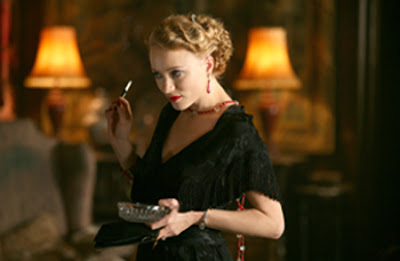


And while cinematically, you're committing screenplay suicide when the writers realize they have to work in Poirot explaining how something went down for--I checked my watch in one case to discover that we had a twenty-five minute denouement-- the brilliance of the Masterpiece Mysteries movie collection of the Poirot cases as opposed to the original television hour long series of Christie short works is that the editors are able to go in and help us along by showing earlier scenes, inserting new points-of-view to explain the motive and/or killer etc.


This is especially beneficial for this viewer since-- despite my first acting gig being in the musical Little Miss Christie about the author and being able to perform two solos-- I've always been more of a Miss Marple fan since Poirot's character is so peculiar and his cases are often beyond comprehension at times that even when I reread the ending or watch the conclusion again, I still feel like I'm missing something which is exactly what happened with the first film in the box set of Mrs. McGinty's Dead.


Par for the course of the superb production values and ensuring that the films all blend together nicely so that-- as Suchet noted-- he will have left the complete works of Poirot on film for future generations to cherish when they film his final case very soon, McGinty is gorgeously crafted and boasts a solid opening hook.

Namely, a handsome and poor young man has been convicted to death for the murder of his elderly landlady and-- although the case itself was sound-- even the prosecutor doesn't feel like he's sent the right man to the gallows. Asking a favor of his old friend Poirot to head off to the countryside and journey to the area where the man resided-- soon our hero discovers that there's far more secrets lurking in the village than he ever would've imagined. Of course, fortunately he finds there are pleasant surprises to be had as well when his friend Ariadne Oliver arrives out of the blue to help add some much needed humor to the mystery-- aside from once again laughing with our "Belgian fish out of water" lead who is-- as played by Suchet fond of misplacing verbs in his sentences and doesn't exactly blend in with the locals.

Although there's a few predictable twists along the way not to mention one great wicked usage of Poirot's wit when the fact that someone tries to push him in front of a train not only thrills the sleuth but makes him realize that the wrong bloke is behind bars-- somehow the third act of the ninety-three minute film feels a bit too rushed. Eventually it finishes in a confusing manner and never manages to grab us in the same way that its superior counterpart-- Cat Among the Pigeons does within the very first act, only growing stronger as it continues.

Basically, all it takes is the sight of Poirot trying to give an introductory speech at a prestigious British upper class girl's boarding school for us to realize that mystery lovers' favorite wise Belgian who can solve a crime just by thinking is entirely out of his element.


However, he's quick to realize that he's not the only male on campus-- as the young, handsome and overly friendly Adam Goodman who catches the eye of every young woman in both school and on staff-- immediately sticks out as well and when Poirot is asked by his friend, the headmistress to stay on for awhile and help her choose a successor from among the teachers in her employ, murder unexpectedly arrives at Meadowbank School.

Interrupting his employment head-hunting search to find the person or people hunting heads when more crimes begin to hit the school-- Poirot soon realizes that nothing is what it seems at this boarding school where false identities, royalty, dirty secrets, voodoo dolls, blackmail, jealousy, and even espionage infiltrate the campus.

Thus, Agatha Christie's Poriot: The Movie Collection Set 4 manages to win us back from its rocky, standard opener with the seen-it-all-before Mrs. McGinty's Dead along with a fully up-to-date documentary that finds Suchet and others talking about their plans to film the final Poirot mystery and the history of the series by closing with this stellar title.

Of course and true to Christie form, in Cat Among the Pigeons, the denouement is extraordinarily long and not altogether unexpected (at least in places) but this time in addition to providing us with some more entertaining supporting players than the previous film which had just aired on Masterpiece Mystery!, the title also has the benefit of at least keeping you in step with Poirot and the others throughout the final act.


And as long as you don't have to attempt to adopt that unique accent or do the Poirot walk, any chance to try and think like Poirot-- and far more impressively-- solve a case like Poirot without lifting a finger, is a success in my book and I'd venture to say probably one in both Agatha Christie's and Ariadne Oliver's as well.


Text ©2009, Film Intuition, LLC; All Rights Reserved. http://www.filmintuition.com

Unauthorized Reproduction or Publication Elsewhere is Strictly Prohibited.

6/09/2009

DVD Review: Playing Shakespeare (1982)


NEW:
Acorn Media & Athena Release
A Series of Titles That
Celebrate Lifelong Learning


Shop AcornOnline.com


Delicious
Bookmark this on Delicious
submit to reddit
Print Page

Digg!

MovieBlips: vote it up!

Okay, all "to be or not to be" aside-- can you imagine how intimidating it would've been to have taken an acting class alongside individuals such as Ben Kingsley (I mean Gandhi himself!), Ian McKellen and Judi Dench?


So with this in mind, thank goodness that Playing Shakespeare-- the 1982 legendary in-depth, nine episode master class led by John Barton on behalf of the Royal Shakespeare Company has now been made available for Bard buffs to enjoy in the privacy of their own home.

Recently it was served up as a four disc, slim-packaged exquisite collection from Acorn Media and Athena that also comes complete with a twenty page viewer's guide which offers more avenues for learning, history, points to ponder and highlights of the episodes as a sort of CliffsNotes version to the originally lauded companion text released in tandem with the London Weekend Television production. Furthermore, it's a wonderful way to appreciate the renowned and still so relevant production that was dubbed "required watching" for actors by The New York Times.

Still, of interest for more than just Shakespearean inclined actors-- whether you have a thing for iambic pentameter or are just simply interested in the tremendous creative output of Shakespeare's versatile plays (both tragic and comic alike)-- it's intellectual nourishment of the highest order. And likewise it makes an ideal companion work to more modern interpretations from my favorite Shakespeare professor, Mr. Kenneth Branagh to Al Pacino's fun documentary Looking for Richard.


Admittedly, on the surface it's safe to say it's even more pretentious than an entire season of the knowledgeable, brainy, but nonetheless amusingly SNL mocked stylings of James Lipton on our very own Actor's Studio (based on the Stanislavski system, a.k.a. "method acting" in its New York City setting). And it's additionally hindered by the fact that some of Barton's episodes and discussions feel a bit repetitive. Nonetheless it's a great deconstruction of the various choices one makes when taking on a role in a Shakespeare production and a thorough analysis of the texts at the same time.


Having seen a majority of the series in a random order sporadically during the last fifteen years via not just television (I'm guessing PBS, Bravo or BBC America perhaps) but academia-- in everything from high school acting classes to collegiate literary studies on Shakespeare and master's level humanities coursework-- it was thrilling to finally take it all in the correct order when I could simply view it as a work instead of painstakingly taking notes for use in a required paper or for a scene study.

Breaking down the works with Barton's ongoing thesis that Shakespeare planted clues (or cues) throughout the text that are meant to help the actor and offer a guide for the the Bard's true intention on how a work should be played-- throughout the series Barton and the cast of twenty-one acclaimed and award winning actors play intellectual detectives.

Additionally, they weigh some of the inconsistencies in his use of short lines followed by long speeches, controversies surrounding the characters (for example Shylock in Merchant of Venice) and try to avoid overplaying the scenes as well as using iambic pentameter in too mannered of a style. By discussing the challenges of tackling the centuries old works as modern method trained and/or naturalistic actors, it makes one realize just how daunting it would be to take on the texts we know so well that-- as Barton acknowledges in the opening of the set-- over one thousand books and articles are written about the playwright and poet every single year.


Although it's far easier to say whether or not something is good or bad (acting-wise), it's a different obstacle altogether to dissect why we make those judgments as this highly talented group dissects their reasoning regarding how to choose the approach to deliver a particular line (or even simply one word) from an infinite number of options. And while Barton is the one running the show, it's especially great to see the way that the actors (or more specifically Ian McKellen routinely ask him to define or clarify words and phrases) in order to test their own theories and opinions as they go back and forth.

Despite Barton's earnest wish that he wouldn't do too much directing during the series nor have the members of the Royal Shakespeare Company do more talking than acting, both of these well-intentioned promises are broken early on as the one weakness the collection has is the fact that it comes off as "much ado about nothing," or quips aside, far too much conversation about what they think and not enough actual scene work that allows them to transfer these thoughts into action. However, when the characters-- even in modern dress-- deliver a line like the wondrous McKellan in a multitude of ways to illustrate how something can endlessly be interpreted, that's when the series shows us the glory of the best Shakespeare company in the world.

While all of the cast-mates have their moments, for me, the major "must see" segment was witnessing two extremely different takes on Shylock by David Suchet and Patrick Stewart as despite the fact that Barton had directed both men in their interpretations, neither actor had seen the other one perform it.

First discussing the alleged anti-semitism of the play which becomes a matter of personal significance for the Jewish Suchet who recalls getting horrific letters from Americans questioning his decision to act in such a work-- he and Stewart agree that you can't judge the play in terms of the twentieth century holocaust and it's interesting to see the way the two men address the Jewish religion in their respective characterizations.

While to Stewart, Shylock is "an alien" and "an outsider" who happens to be Jewish, to Suchet, Shylock is an outsider "because he is Jewish" and his passion comes through at once in their scenes together as they trade off. And although Stewart is a talented actor, to me it's apparent right off the bat that his approach to making the character so overly broad (to the point that at one moment he slips strangely into what sounds like a Scottish accent) is a grievous error for the work. Essentially his take makes Shylock a spectacle whereas Suchet moves us to such an extent-- although he works hard against playing scenes like "hath not a Jew eyes" for sheer sympathy-- that I realized I would never look at the man most famous for his portrayal of Agatha Christie's Hercule Poirot the same way ever again.


Simply put, I wanted to start a Suchet fan club and wondered why on Earth he hadn't broken free to the same level of stardom as McKellan and Kingsley (both of whom look so amazingly young you'll do a double take in episode one).

A wonderfully valuable treasure for fans of Shakespeare and filled with great debate on his most famous texts, discussion regarding the significance of the word "time" (which should be said with two syllables) in the work of the Bard, it's safe to say this collection will be a must-own for those who've ever done more than just passively read along with his work in elementary school.


Shakespeare:
In Print


Shakespeare:
On Film


10/24/2008

Agatha Christie: Mystery Lover's Collection


Digg!

Dame Agatha Christie, dubbed the "Queen of Crime" for leaving an overwhelmingly successful and influential body of work including eighty detective novels has been long valued as "one of the most important and innovative writers in the development of the [mystery] genre." With "only the Bible... known to have outsold her collected sales of roughly four billion copies of novels," and a global readership which can pick up her work in any of the more than fifty-six languages in which they've been translated, it's no wonder that time and time again Christie's ingeniously crafted tales of murder and mayhem have been adapted to stage and screen.

With the October 28th release of Acorn Media's beautifully packaged boxed set, Agatha Christie: Mystery Lover's Collection, we're presented with five timeless mysteries spread over four DVDs and including some of her most cherished characters such as Hercule Poirot, Miss Jane Marple, and Tommy & Tuppence.

With David Suchet's impeccable portrayal of Hercule Poirot, we're introduced to a made-for-British-television adaptation of Agatha Christie's very first published novel which introduced the Belgian police detective to readers in The Mysterious Affair at Styles. Although her diaries would reveal that Christie found Poirot "insufferable," and in later years dubbed him "an ego-centric creep," she shared that he could never have been written alongside her preferred Miss Marple since Poirot "would not like being taught his business or having suggestions made to him by an elderly spinster lady." Nonetheless Poirot was her most popular character, appearing in more books than any other and holding the auspicious honor of being "the only fictional character to have been given an obituary in The New York Times... in 1975."


While the film adaptation of Styles is of interest for its sheer historical and literary importance in depicting Christie's first foray into the world of writing, perhaps its shortcomings lie in the novel itself, as onscreen far too many characters are introduced much too quickly, easily confusing viewers from the start. However, much like Marlowe in the equally impossible to follow adaptation of Raymond Chandler's The Big Sleep, the plot takes a backseat and it's Poirot's show all the way.


However, Christie's love for Miss Jane Marple shines through in the wonderful reinterpretation albeit a loose adaptation of The Body in the Library which is also included in the set. Featuring an extraordinary cast including Tara Fitzgerald and Geraldine McEwan as Miss Marple, we follow a mysterious case involving a beautiful blonde woman discovered dead in the library of the home of Marple's dear friend, Dolly Bantry.


With no idea just who the woman is or how she came to be in the library, Marple and Dolly conduct their own investigation alongside the official police one as they journey to the seaside to gain greater access to the posh hotel she worked at as a dance hostess. With quite a surprising finale and several twists and turns throughout, it's a standout in the set and one you may have to view twice to pick up on all of the clever clues, red herrings and nuances throughout.

However, my greatest surprise was upon the discovery of the delightful Partners in Crime, detective couple Tommy & Tuppence. In the feature length, screwball inspired mystery The Secret Adversary which was my favorite in the entire set, we're introduced to the young, ambitious characters who reunite after the end of the first World War and by chance find themselves quickly embroiled in a major political mystery. With superb chemistry between the leads played by James Warwick and Francesca Annis and a wonderful script, it's a treasured find for those readers, such as myself, who were mostly preoccupied with Marple and Poirot.

Unfortunately, the follow-up mystery on the disc, The Affair of the Pink Pearl which was made as part of the short-lived British television series Partners in Crime finds our brave and hilarious duo relegated to a life of the idle rich in an overly staged and cringe-worthy production that's best to be skipped in favor of a second viewing of The Secret Adversary.


Rounding out the set is the A&E version of Christie's suspenseful Macbeth-tinged mystery, The Pale Horse. Set in the swinging 60's of London with the appropriate Kinks heavy soundtrack included for good measure, this chilling tale of black magic and mayhem seems more Buffy the Vampire Slayer than quintessential Christie. However, soon our likable lead Mark Easterbrook (Colin Buchanan) finds himself as the Hitchcockian wrong man when he stumbles upon the body of a dying priest whose fingers are clutching a secret list of names. With the sculptor and artist Mark on the case along with his two friends (played by Hermione Norris and Jayne Ashbourne), Mark must get to the bottom of the case before more terrifying events begin spiraling out of control.

Eerie, sinister and perfectly timed in its release just before Halloween-- it wasn't as entertaining as The Body in the Library or The Secret Adversary but served as a swiftly paced and unexpected inclusion for Christie devotees. Packaged together for the first time, these BBC, Granada, PBS and A&E mysteries make a great introduction to the world of Christie for newcomers as well as a set that rewards those who've been reading her books for years. And in the case of this reviewer, it may even make you seek out more Acorn Media packaged adaptations featuring the stars involved (like the excellent new Miss Marple portrayed by Geraldine McEwan) or pick up a few novels chronicling the adventures of Tommy & Tuppence. Agatha Christie: Mystery Lover's Collection will be available from Acorn and online via select retailers such as Amazon on October 28.