Showing posts with label Sarah Paulson. Show all posts

11/18/2020

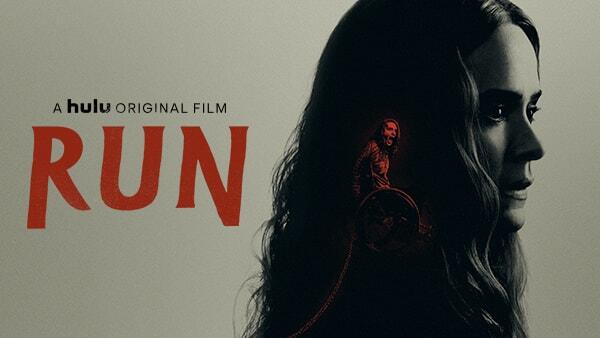
Movie Review: Run (2020)


Imagine you need to look something up, something you're worried might be poison, something that's frightening you, and you don’t have a smartphone. There's one computer in the house. It's on the bottom floor but because you don't want your mother knowing you're worried that she's giving you poison (because how crazy does that sound?), the only time you feel safe venturing downstairs is in the middle of the night when she’s fast asleep. 

Oh, and did I mention that you're also disabled? You're a wheelchair user who can't just flee your home, someone with multiple chronic conditions like atrial fibrillation and asthma that make you out of breath just crossing the street. This means that when you need to go down a flight of stairs to conduct this top-secret search, you must use the loud motorized lift to bring you safely down, and somehow do this without waking up your mother. That's when you discover that somehow, for some unknown reason, when you press search, the internet has suddenly been disconnected. 

Moments like these, accessibility issues that able-bodied individuals take completely for granted – including the ability to run, drive, or sneak down the stairs to use the computer – are what make the ironically named “Run” so utterly terrifying. Yet, while merely intense on one level to an able-bodied viewer, watching this as a disabled woman who's learned how to walk again multiple times after multiple spine surgeries and has been stuck in rooms or on high levels when elevators have broken down, is a harrowing experience I can’t fully describe with words. 


Still, intriguingly, although it’s centered on a bright seventeen-year-old disabled girl who’s suddenly worried that her caretaker mother might be doing her more harm than good, as viscerally, urgently thrilling as "Run" feels to a disabled viewer, it's an oddly inspiring picture as well.

With Kiera Allen cast in the role of our heroine Chloe, at last, we're watching an actress who is actually disabled in real life bring our own fears, dreams, trials, and successes to life. In fact, if you are disabled, you might want to watch this for the first time alone, because, even if, like me, you're lucky to have always had a wonderfully loving caretaker, since we so often fall prey to gaslighting by strangers and authority figures outside our circle of trust, “Run” is a far more emotional movie than I assumed it would be going in.

When we watch Chloe get up each morning and swallow a box full of medications (just for the A.M., mind you), we see ourselves. And this goes double when she uses assistive devices like a grabber to try and carefully reach a bottle on the top shelf of her bathroom medicine cabinet without her mother becoming wise. We inherently relate, understanding – even if our disability differs from hers – how frustrating it is to need to have secrets (as all human beings do) in a situation where unfairly for both our caretakers and us, we often have no choice but to depend upon them for every whim. 


“Run” is the sophomore feature from Aneesh Chaganty, who dazzled viewers in 2018 with the release of “Searching,” another thriller that places not only one scene but the entire thrust of the film around an urgent internet search. In "Run," you can tell that Chaganty did his due diligence to make sure that this film would accurately reflect the capabilities and pursuits of its young heroine. And while, par for the course of the genre, it goes a little too far in the stakes-raising, absurdly twisty third act as Chloe's mental chess match with her secretive mother Diane (the brilliant Sarah Paulson) turns more physically threatening, it's still fun to see a genre-requisite Final Girl that resembles us all.

But is her mother evil? Or is Chloe jumping to conclusions because, now that she's so close to graduating high school, and therefore asserting her own independence in college, she's begun to want it so desperately that she needs it right now? Or is there some other perfectly reasonable explanation why there's suddenly a new pill in her P.M. medicine box, one that doesn't match the name of the drug, the color it should be, and was prescribed to her mother? In the case of “Run,” it's the pill that launches a thousand suspicions and puts Chloe on hyper-alert. Diane's even-handed yet nakedly apparent defensiveness about the mysterious medication only makes her daughter more determined than ever to find out what it is and what's really going on.

Essentially, "Run" is a new version of “Searching,” by way of classic psychological domestic noir like “Gaslight,” “My Name is Julia Ross,” and “Suspicion.” And just like in Chaganty’s freshman feature, in “Run,” the question of the search gets us involved, but then he and his “Searching” co-writer Sev Ohanian pull the switch. For, just like in “The Matrix,” now that we've accepted this unusual pill, we must learn more. However, as it turns out, the pill is only the first thread, and we fear for Chloe as the fabric of the only reality she's ever known begins to unravel, with or without her mother's help. 


To a large extent, "Run" plays like gangbusters. Of course, granted, employing a major, exposition-heavy info dump to bring everything awkwardly to a head just in the nick of time feels like a disappointing cheat, even if I do like the “identity” element they incorporate very much.

But with the commitment of our leads – particularly the mix of love and hate we see in Paulson who is one of our most exciting actresses working today – and the decision to ground the film in the question of safety, which is first and foremost in the mind of a disabled individual, makes me far more prone to forgive "Run" its missteps.

Following “Searching,” which focused on a Korean-American father's desperate quest to find his sixteen-year-old daughter by looking through her online history for clues as to her whereabouts, “Run,” marks the second time that writers Chaganty and Ohanian have crafted a thriller with a minority lead. Yes, this time it's a disability, as opposed to a non-caucasian ethnicity but it's still a very welcome change to traditional suspenseful storytelling that in a perfect world, shouldn't be as revolutionary as it is.

Yet, even without reading that much into Chloe as a new kind of heroine in a genre that, in its purest form, usually focuses on women who can run, scream, and get naked before they're cut down in the night by a bloodthirsty killer, “Run” plays like a sophisticated throwback to the gaslight noirs of the 1940s. With terrific, all-encompassing work by Allen and Paulson, “Run” is a loopy, fast-paced, at times cathartic thriller that's only slightly hindered by an unnecessarily over-the-top, M. Night Shyamalan inspired twist, and one that might make you think twice the next time you take a pill or conduct a search. 


Text ©2020, Film Intuition, LLC; All Rights Reservedhttps://www.filmintuition.com  Unauthorized Reproduction or Publication Elsewhere is Strictly Prohibited and in violation of the Digital Millennium Copyright Act.  Also, as an Amazon Associate, I earn from qualifying purchases made off my site through ad links. FTC Disclosure: Per standard professional practice, I may have received a review copy or screener link of this title to voluntarily decide to evaluate it for my readers, which had no impact whatsoever on whether or not it received a favorable or unfavorable critique. Cookies Notice: This site incorporates tools (including advertiser partners and widgets) that use cookies and may collect some personal information to display ads tailored to you etc. Please be advised that neither Film Intuition nor its site owner has any access to this data beyond general site statistics (geographical region etc.) as your privacy is our main concern.

4/13/2009

Blu-ray Review: The Spirit (2008)


On Blu-ray & DVD 4/14/09


Or Download on iTunes

The Spirit


Delicious
Bookmark this on Delicious
submit to reddit
Print Page

Digg!

If renowned photographer Annie Leibovitz made a comic book movie, it would probably look a lot like Frank Miller's The Spirit. However, Miller's fingerprints are all over the work which marks his first solo directorial effort, after having collaborated with filmmaker Robert Rodriguez on Sin City (note: Blu-ray review forthcoming) and Zack Snyder on 300. In fact, based on the earliest previews alone-- I initially thought that footage of The Spirit were really clips from the upcoming Sin City 2.


Featuring some of the most gorgeous and talented actresses currently working in the field of cinema today including Eva Mendes, Scarlett Johansson, Paz Vega, Sarah Paulson, and Jamie King-- graphic novel author and artist, the innovative Frank Miller thoroughly relishes in Comic Book Hall of Famer Will Eisner’s original 1930s creation that centered on an everyman hero with a signature red tie and black eye-mask who leaves a string of broken hearts in his wake as he fights for the justice of his true love—Central City.

In the luscious Blu-ray featurette “History Repeats”—just one of several excellent behind-the-scenes featurettes that also give you a history lesson on the world of comics (regardless of what you may have thought of the film), we take an invaluable and knowledgeable insider’s look at the origins at Eisner’s “Urban Zorro” styled 1938 newspaper comic that gave the young man unprecedented power while still in his twenties to ditch the idea of three or four panel imagery in lieu of seven full pages every week.


And with his decision not to make a Superman like ultra-strong superhero, he wanted to go with an everyman--possibly one that most male readers could identify with as Eisner’s protégé Frank Miller jokes that the veteran comic book innovator worked so hard, he seldom had the pleasure of female company so in order to get by, he sublimated by drawing an endless parade of extremely sexy, powerful women all magnetically drawn to the mysterious crime fighter.


As Miller even goes as far to explain—it wasn’t the drawing of the women themselves that provided the ultimate sensuous thrill but the inking of them-- paying loving care to ensuring that every curve was well defined and it’s a dedication that comes through even more today. This is exceptionally evident as Miller went to extensive lengths (far more than Rodriguez did in Sin City) to guarantee—along with his extremely gifted special effects team—that at all times, the women look unbelievable no matter how much chaos they cause or danger from which they flee. Or to put it another way-- they’re a walking and talking version of a Vogue Magazine layout or Vanity Fair spread shot by Liebovitz as Miller went so far as to film a scene featuring Eva Mendes underwater without any water to ensure the end result is spectacular.


But far more than fetishistic in the pre-James Bond comics that may very well have been (although I'm unfamiliar with the source material)-- thankfully Miller rewrote female characters to make them much richer. In doing so he reworked Sarah Paulson’s Ellen Dolan as a surgeon who literally is the only one who knows the Spirit’s body so well that she can stitch him up whenever he’s injured and crafted a brand new, exceptionally bright and psychologically knowledgeable female rookie police officer (Stana Katic) to work alongside the hard-nosed Commissioner Dolan (Dan Lauria). Likewise, he designed a great role as the easily bored but bright Silken Floss (Scarlett Johansson) to be the brainy sidekick to Samuel L. Jackson’s evil Dr. Octopus.


Yet still-- more than 70 years later in Frank Miller's gorgeous feat of artistry in tackling Will Eisner’s work from a purely visual standpoint, ultimately it is the women in the world of The Spirit that hold our attention the most. Sadly, poor Gabriel Macht who takes on the titular role of a former police officer who returns from certain death to fight for justice is a clinically cool, less-than-interesting and underwritten lead who manages to deliver his great Raymond Chandler like film noir dialogue, even though he’s the least interesting one in the lot.


Of course, this isn’t saying much since—aside from Lauria’s Commissioner, Jackson’s deranged Octopus (who goes from western villain to Nazi in a few unintentionally humorous scenes that just don’t work) and Louis Lombardi’s dozens of identically genetically engineered dim-bulb henchmen—Macht is one of the only men in a world filled with women and feline cats.


However, it isn’t just Macht who suffers but also some of the strongest female characters (i.e. Sand Saref, the police officer, Ellen Dolan, Silken Floss) when a few too many supporting players are introduced as merely distraction causing eye-candy including Jamie King’s Angel of Death Lorelai and Paz Vega’s bizarre Plaster of Paris. And soon, it feels like it’s a circus of gorgeous women suffering from the Joel Schumacher era Batman problem of trying to juggle far too many characters in what becomes a disarmingly beautiful but nonsensical circus.


While undoubtedly, one of the major problems in the work involves its structure as a few surprises about the Spirit’s origin. Namely, new converts to the mythology of The Spirit want to know why he’s indestructible as well as how everyone else still assumes he’s dead save for one individual would’ve probably paid off in a far more emotionally satisfying way had they been revealed a bit earlier or more time had been spent fully fleshing out the tale of the man formerly known as Denny Colt who shortly into the film realizes that his childhood sweetheart turned international jewel robber, Sand Saref (Eva Mendes) is back in town and accused of murder.

Although he stayed extremely true to the heart of the original comic, Miller—who is responsible for ushering in the newer vision of a darker Batman that Tim Burton introduced Generation X to two decades back-- decided he wanted to make the comic more violent and raw than Eisner had back in the day.


While initially Miller walked away from the prospect of helming a big-screen adaptation of the work—the rights of which were acquired by Michael E. Uslan in 1992 (following his successful production of Burton’s Batman)-- finally he changed his mind, deciding that he couldn't bear to “let anyone else touch it,” as the production notes reveal. Thus, in what the producers called “a coup” in bringing aboard the man “who was Will’s protégé, peer, friend and battler partner,” as executive producer Deborah Del Prete of OddLot noted, it honoring Uslan’s promise to Eisner in which—as Uslan recalls-- he “swore to Will that nobody would touch The Spirit-- not a company, not a person -- unless they were willing to respect the property and do it the right way.”


And while the intent and passion is in every single frame as in another behind-the-scenes featurette, one of the CGI wizards note that “every shot was a special effect,” allowing Miller the freedom to use his “graphic notepad” to draw everything he wanted to film and show the actors and crew when they arrived on the set which consisted of an entirely green box with green screens and green props—more often than not, it just feels stale and uninviting.


Still, while it’s hard to feel invested in the over-crowded storyline and the fact that the second half is mind-numbingly slow as it grows stranger and stranger, Miller makes up for the narrative shortcomings with mind-blowing use of color including an emphasis on my favorite color combination of red, black, and white (or in my mind a joke to the comic's newspaper origins and the childhood joke of “what’s black and white and read all over?”).


In the end—a digital masterpiece of just how far you can go with the medium (yet one that also serves as a cautionary tale that plot is far more important than picture and perhaps another writer should have been brought on board)—the Blu-ray heightens the experience of The Spirit in what could be used as a visual moving painting you can simply watch and marvel over (while wanting to put the sound on mute).


Filled with audacious effects that can blend together different elements from different decades giving the film an indefinable sense of time period, and along with Matrix cinematographer Bill Pope play with light by “taking things away” using a “subtle variation that there is barely perceptible background” in some scenes—the sound and picture quality of Lionsgate’s first official Lionsgate Live title (that also features Molog), giving greater interactivity to Blu-ray fans by serving Blu-ray owners updateable and exclusive content “such as commentaries, games, ringtones, wallpapers, trailers, and much more via a series of on-screen notifications and widgets,” is phenomenal.


Moreover, it elevates the work despite its shortcomings much like Twentieth Century Fox’s Blu-ray of Max Payne did as well. Likewise it boasts a digital standard edition copy of the film that’s compatible with both Mac and PC for use on your portable devices. And another plus of The Spirit that I’m hoping will catch on with other studios in regards to Blu-ray releases is a completely customizable menu set-up that allows you to adjust its effects as well as the inclusion of bookmarks under the Special Features menu that makes it a bit easier to navigate than some other overly complicated presentations.


Additionally, it also contains an alternate storyboard ending complete with voice-overs by stars Samuel L. Jackson and Gabriel Macht as well as a greater in-depth look at working in an entirely digital “Green World” and more historical features about Miller and Eisner as well as commentary for the feature from Miller and Deborah Del Petre.


And while the film failed to match the importance of screenplay with the art--exceeding far beyond our wildest expectations with Miller’s extraordinary artwork and beautiful way he captures the women of Central City—at just 108 minutes, it’s much easier to digest than the bloated, extreme, misanthropic and even chillier Watchmen, made by his 300 co-director Zack Snyder.