Showing posts with label Gabriel Macht. Show all posts

9/11/2009

Movie Review: Whiteout (2009)


Photo Slideshow


Read the Graphic Novels


Delicious
Bookmark this on Delicious
submit to reddit
Print Page

Digg!

MovieBlips: vote it up!

Citing everything from a shower scene as the sole high point by the overwhelming boys club of critics to an overly computer generated opening plane crash-- recently horrific reviews have likened Dominic Sena's latest film as being ideally suited for the common usage of the product that shares its title or have toyed with the movie's setting of Antarctica to describe it in terms of an avalanche of awfulness.
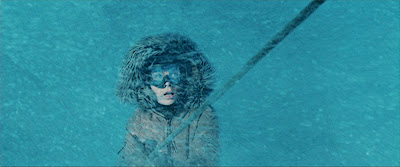


However, if you shovel beyond the surface level ice and strip down the layers of some plot contrivances and structural missteps that were piled on like the fifteen layers of clothing you would need to survive in that environment, you may be surprised to discover that Whiteout actually contains some pretty solid elements for what could've been a mighty little sleeper of a thriller.


Working from Jon and Erich Hoeber's screenplay adaptation of the 1998 Eisner nominated graphic novel which was released in four installments by Oni Press from creators Greg Rucka and Steve Lieber, the movie bounces back from an admittedly video game like and possibly plot spoiling prologue of sorts after gunfire erupts on a Russian plane and they crash to the ground with the introduction of our strong, conflicted heroine.

Played by Kate Beckinsale, we follow U.S. Marshal Carrie Stetko as she returns to the South Pole based American research station Amundsen-Scott and steps into that much discussed shower. While my heterosexual male colleagues checked out of critic mode temporarily, honestly Beckinsale's shower scene reveals about as much skin as an evening television program and is roughly on par with a shampoo or shower gel commercial.

And as we later discover, getting acquainted with Carrie and another colleague in and around her bathroom does have a purpose. Instead of just passing it off as gratuitous, it does pay off later metaphorically as we're hit with brutal Memento influenced bathroom-set violent flashbacks of Carrie before she traded the continental U.S. for the solitary surrounding of miles of snow.
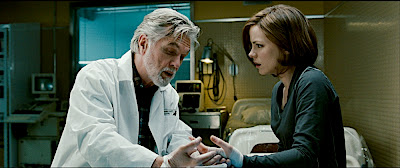


Like an old cop movie cliche, she's just about to resign and return home when she and her closest ally Doc (Tom Skerritt) along with a refreshingly well-adjusted war veteran pilot Delfy (Columbus Short) discover an especially gruesome crime scene in the middle of the unforgiving landscape. With no tracks, climbing gear, or trace of the weapon, the Marshal who is used to dealing with misdemeanors becomes embroiled in Antarctica's first homicide. And while she and Doc briefly discuss just sending the body off to the next stop to analyze, Carrie realizes she can't abandon the reason she became an officer.
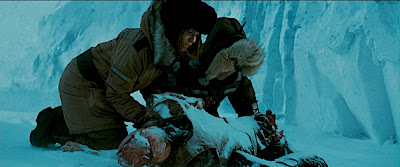


As one body grows into multiple murders, an unidentifiable killer welding an ice axe chases Carrie Stetko as the movie morphs from "C.S.I.: Antarctica" to Dead Calm meets "Friday the 13th on Ice." And although I was able to guess the murderer among the tiny main ensemble cast of Beckinsale, Short, Skerritt, Gabriel Macht (as a UN sent investigator) and a few other inhabitants, the ultimate a-ha moment is rushed in the last twenty minutes in a ludicrous, dissatisfying finale with a run of the mill motive and weak showdown.

For instead of playing it as a straight mystery or a spooky thriller with another nail-biting chase pitting Carrie against the freezing temperatures and the murderer, Whiteout suffers unevenly with its cinematic hybrid and may also have been plagued with the daunting task of trying to cram four graphic novels into one roughly two hour movie.


As such, Beckinsale's Carrie is the only character remotely fleshed out via the gritty flashback sequences that reveal her past and also given the partial bathroom setting and what took place offers you an immediate sense of whom the culprit will turn out to be in case you hadn't guessed in the opening act. Yet unfortunately she's never given a true opportunity to right the wrong of her past or the way she's been senselessly punishing herself for it since the Whiteout finale goes for a cop-out instead of a cop-on-the-case resolution.


However, this being said, she fares much better than her male counterparts like Skerritt and Macht who are essentially playing "types" yet admirably Short's charm and humor give his character the most life and onscreen joy. While overall, producer Joel Silver's film is surprisingly better than most critics would have you believe and it's a damn sight more watchable than Smilla's Sense of Snow, I couldn't help wishing they would've taken Whiteout's strong building blocks and turned it into what for a moment seemed like a twenty-first century icy version of Dead Calm.
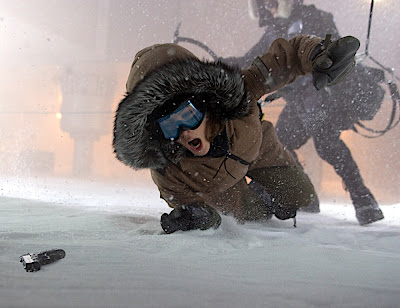


And as a a writer who can't simply trash a film without trying to figure out what went wrong and how to rectify it, my brain was put into overdrive especially since female heroes are few and far between in Hollywood and I desperately wanted Beckinsale's film to be the brainy woman's answer to the junk usually hurled our direction.
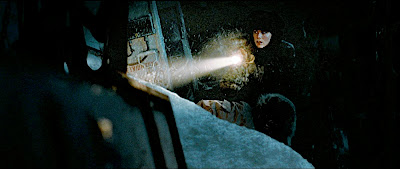


While I won't know precisely what the most crucial elements were without taking in the graphic novel, I felt that Whiteout could've been incredibly enhanced by possibly ditching the opening sequence to make the discovery of the plane far more surprising as well as giving our murderer a motive that's much more unique than a '60s style heist film from the plane's cold war era.
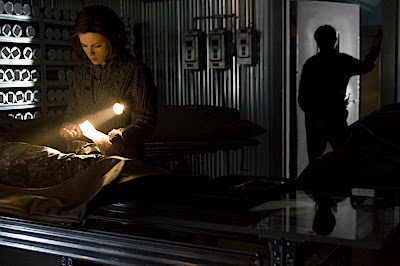


Likewise by inserting more characters and red herrings, the filmmakers could've cashed in on the ultimate atmosphere of claustrophobia when Carrie and a small handful of colleagues (one of whom is the villain) are stuck there for the winter. And again by encouraging the writers to view films of varying success levels like Blair Witch Project, Panic Room, P2, The Mist, and Dead Calm to see how to make the most of "group-think" and having characters confined as evidenced in producer Joel Silver's Die Hard series, I know it would've gone from a relative C+ to a much more frightening, realistic and psychologically engrossing work.


Although most reviewers have gone overboard in telling you to stay away as if the movie was on par with some of the true over-produced, silly with CGI works of the last year including Macht's beautiful bomb The Spirit, Watchmen, Quantum of Solace, and others, I'd still give it a cautious low recommendation. While it's definitely rental worthy for the gorgeous scenery also, it's also intriguing for writers to try and use the otherwise promise filled movie as a great creative exercise in analyzing just how it would've gone from an indecipherable blizzard to an intoxicating yet undeniably freaky frozen sensory feast.


Text ©2009, Film Intuition, LLC; All Rights Reserved. http://www.filmintuition.com
Unauthorized Reproduction or Publication Elsewhere is Strictly Prohibited.

4/13/2009

Blu-ray Review: The Spirit (2008)


On Blu-ray & DVD 4/14/09


Or Download on iTunes

The Spirit


Delicious
Bookmark this on Delicious
submit to reddit
Print Page

Digg!

If renowned photographer Annie Leibovitz made a comic book movie, it would probably look a lot like Frank Miller's The Spirit. However, Miller's fingerprints are all over the work which marks his first solo directorial effort, after having collaborated with filmmaker Robert Rodriguez on Sin City (note: Blu-ray review forthcoming) and Zack Snyder on 300. In fact, based on the earliest previews alone-- I initially thought that footage of The Spirit were really clips from the upcoming Sin City 2.


Featuring some of the most gorgeous and talented actresses currently working in the field of cinema today including Eva Mendes, Scarlett Johansson, Paz Vega, Sarah Paulson, and Jamie King-- graphic novel author and artist, the innovative Frank Miller thoroughly relishes in Comic Book Hall of Famer Will Eisner’s original 1930s creation that centered on an everyman hero with a signature red tie and black eye-mask who leaves a string of broken hearts in his wake as he fights for the justice of his true love—Central City.

In the luscious Blu-ray featurette “History Repeats”—just one of several excellent behind-the-scenes featurettes that also give you a history lesson on the world of comics (regardless of what you may have thought of the film), we take an invaluable and knowledgeable insider’s look at the origins at Eisner’s “Urban Zorro” styled 1938 newspaper comic that gave the young man unprecedented power while still in his twenties to ditch the idea of three or four panel imagery in lieu of seven full pages every week.


And with his decision not to make a Superman like ultra-strong superhero, he wanted to go with an everyman--possibly one that most male readers could identify with as Eisner’s protégé Frank Miller jokes that the veteran comic book innovator worked so hard, he seldom had the pleasure of female company so in order to get by, he sublimated by drawing an endless parade of extremely sexy, powerful women all magnetically drawn to the mysterious crime fighter.


As Miller even goes as far to explain—it wasn’t the drawing of the women themselves that provided the ultimate sensuous thrill but the inking of them-- paying loving care to ensuring that every curve was well defined and it’s a dedication that comes through even more today. This is exceptionally evident as Miller went to extensive lengths (far more than Rodriguez did in Sin City) to guarantee—along with his extremely gifted special effects team—that at all times, the women look unbelievable no matter how much chaos they cause or danger from which they flee. Or to put it another way-- they’re a walking and talking version of a Vogue Magazine layout or Vanity Fair spread shot by Liebovitz as Miller went so far as to film a scene featuring Eva Mendes underwater without any water to ensure the end result is spectacular.


But far more than fetishistic in the pre-James Bond comics that may very well have been (although I'm unfamiliar with the source material)-- thankfully Miller rewrote female characters to make them much richer. In doing so he reworked Sarah Paulson’s Ellen Dolan as a surgeon who literally is the only one who knows the Spirit’s body so well that she can stitch him up whenever he’s injured and crafted a brand new, exceptionally bright and psychologically knowledgeable female rookie police officer (Stana Katic) to work alongside the hard-nosed Commissioner Dolan (Dan Lauria). Likewise, he designed a great role as the easily bored but bright Silken Floss (Scarlett Johansson) to be the brainy sidekick to Samuel L. Jackson’s evil Dr. Octopus.


Yet still-- more than 70 years later in Frank Miller's gorgeous feat of artistry in tackling Will Eisner’s work from a purely visual standpoint, ultimately it is the women in the world of The Spirit that hold our attention the most. Sadly, poor Gabriel Macht who takes on the titular role of a former police officer who returns from certain death to fight for justice is a clinically cool, less-than-interesting and underwritten lead who manages to deliver his great Raymond Chandler like film noir dialogue, even though he’s the least interesting one in the lot.


Of course, this isn’t saying much since—aside from Lauria’s Commissioner, Jackson’s deranged Octopus (who goes from western villain to Nazi in a few unintentionally humorous scenes that just don’t work) and Louis Lombardi’s dozens of identically genetically engineered dim-bulb henchmen—Macht is one of the only men in a world filled with women and feline cats.


However, it isn’t just Macht who suffers but also some of the strongest female characters (i.e. Sand Saref, the police officer, Ellen Dolan, Silken Floss) when a few too many supporting players are introduced as merely distraction causing eye-candy including Jamie King’s Angel of Death Lorelai and Paz Vega’s bizarre Plaster of Paris. And soon, it feels like it’s a circus of gorgeous women suffering from the Joel Schumacher era Batman problem of trying to juggle far too many characters in what becomes a disarmingly beautiful but nonsensical circus.


While undoubtedly, one of the major problems in the work involves its structure as a few surprises about the Spirit’s origin. Namely, new converts to the mythology of The Spirit want to know why he’s indestructible as well as how everyone else still assumes he’s dead save for one individual would’ve probably paid off in a far more emotionally satisfying way had they been revealed a bit earlier or more time had been spent fully fleshing out the tale of the man formerly known as Denny Colt who shortly into the film realizes that his childhood sweetheart turned international jewel robber, Sand Saref (Eva Mendes) is back in town and accused of murder.

Although he stayed extremely true to the heart of the original comic, Miller—who is responsible for ushering in the newer vision of a darker Batman that Tim Burton introduced Generation X to two decades back-- decided he wanted to make the comic more violent and raw than Eisner had back in the day.


While initially Miller walked away from the prospect of helming a big-screen adaptation of the work—the rights of which were acquired by Michael E. Uslan in 1992 (following his successful production of Burton’s Batman)-- finally he changed his mind, deciding that he couldn't bear to “let anyone else touch it,” as the production notes reveal. Thus, in what the producers called “a coup” in bringing aboard the man “who was Will’s protégé, peer, friend and battler partner,” as executive producer Deborah Del Prete of OddLot noted, it honoring Uslan’s promise to Eisner in which—as Uslan recalls-- he “swore to Will that nobody would touch The Spirit-- not a company, not a person -- unless they were willing to respect the property and do it the right way.”


And while the intent and passion is in every single frame as in another behind-the-scenes featurette, one of the CGI wizards note that “every shot was a special effect,” allowing Miller the freedom to use his “graphic notepad” to draw everything he wanted to film and show the actors and crew when they arrived on the set which consisted of an entirely green box with green screens and green props—more often than not, it just feels stale and uninviting.


Still, while it’s hard to feel invested in the over-crowded storyline and the fact that the second half is mind-numbingly slow as it grows stranger and stranger, Miller makes up for the narrative shortcomings with mind-blowing use of color including an emphasis on my favorite color combination of red, black, and white (or in my mind a joke to the comic's newspaper origins and the childhood joke of “what’s black and white and read all over?”).


In the end—a digital masterpiece of just how far you can go with the medium (yet one that also serves as a cautionary tale that plot is far more important than picture and perhaps another writer should have been brought on board)—the Blu-ray heightens the experience of The Spirit in what could be used as a visual moving painting you can simply watch and marvel over (while wanting to put the sound on mute).


Filled with audacious effects that can blend together different elements from different decades giving the film an indefinable sense of time period, and along with Matrix cinematographer Bill Pope play with light by “taking things away” using a “subtle variation that there is barely perceptible background” in some scenes—the sound and picture quality of Lionsgate’s first official Lionsgate Live title (that also features Molog), giving greater interactivity to Blu-ray fans by serving Blu-ray owners updateable and exclusive content “such as commentaries, games, ringtones, wallpapers, trailers, and much more via a series of on-screen notifications and widgets,” is phenomenal.


Moreover, it elevates the work despite its shortcomings much like Twentieth Century Fox’s Blu-ray of Max Payne did as well. Likewise it boasts a digital standard edition copy of the film that’s compatible with both Mac and PC for use on your portable devices. And another plus of The Spirit that I’m hoping will catch on with other studios in regards to Blu-ray releases is a completely customizable menu set-up that allows you to adjust its effects as well as the inclusion of bookmarks under the Special Features menu that makes it a bit easier to navigate than some other overly complicated presentations.


Additionally, it also contains an alternate storyboard ending complete with voice-overs by stars Samuel L. Jackson and Gabriel Macht as well as a greater in-depth look at working in an entirely digital “Green World” and more historical features about Miller and Eisner as well as commentary for the feature from Miller and Deborah Del Petre.


And while the film failed to match the importance of screenplay with the art--exceeding far beyond our wildest expectations with Miller’s extraordinary artwork and beautiful way he captures the women of Central City—at just 108 minutes, it’s much easier to digest than the bloated, extreme, misanthropic and even chillier Watchmen, made by his 300 co-director Zack Snyder.