Now Available to Own
Photo Slideshow

Gone are the long takes of people walking down lonely streets and dimly lit hallways from In the Mood for Love.
In Wong Kar Wai’s The Grandmaster, shots are roughly two to three seconds long on average but manage to convey the fluidity and dizzying aesthetic ballet of Wing Chun martial arts all the same by taking you through each movement shot by shot, similar to the way he led us down those streets and halls.
And while it’s edited differently, there’s still no mistaking the imagery for anything other than the creative realization of Wong Kar Wai given its buttoned up passion, gorgeous framing and overall aesthetic sweep that practically stamps his signature onto every frame.
Though it is undoubtedly the fastest moving Wong Kar Wai film, it’s also the first one that’s bursting at the seams with details – not just due to the astounding set pieces and costumes – but its multifaceted characters who are introduced so quickly that there are tons of bonus subtitled screen cards to underline who each player is before they even begin branching off into their own subplots.
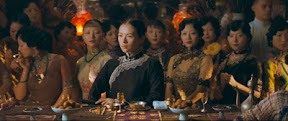
Needless to say, it’s a complicated picture that relies on fast hand eye coordination from its grandmasters onscreen as well as its audiences off the screen to digest not just the typed information as well as the subtitled dialogue but also put it together with the constantly moving scene cuts, which leave you trying to absorb a vast amount of cinematographic data at the exact same time.
The type of film that you’ll only grow to better understand and appreciate that much more on a second viewing than just based on its dizzying first impression alone, The Grandmaster is filled with repetitions in dialogue, choreography, music and its subtlest nuances come to life to represent an altogether different feature on a second viewing than the one you’d first experienced.
What purports to be a biopic is in all actuality a study of honor in the face of adversity and a film that emphasizes far more than just one subject. To this end, The Grandmaster is a major achievement by Wong Kar Wai and a work that begs to be dissected on par with his celebrated ‘90s masterpieces.
Although the title is translated in the singular for its English language release, Wong Kar Wai’s period epic actually results in the plural in Asia whereby more than just honoring the heroic Ip Man martial artist who would go on to train Bruce Lee, the helmer’s work transcends the limits of the biopic.
In doing so, The Grandmaster honors all of the other unheralded grandmasters of various schools throughout the regions of North and South China before the Japanese invasion.

The film reunites the director with actors Tony Leung and Ziyi Zhang – both of whom give mesmerizing turns as Ip Man and the daughter of another grandmaster who inherited her father’s gifts (whom Ip Man is hopelessly in love with despite being a faithful husband).
Utilizing his favorite ingredients of romantic longing, love triangles and a person being pulled in opposite directions by duty and their heart, Wong Kar Wai has made another passionate, potent, poetic and hypnotic work.
Intriguingly and unlike the recent Ip Man trilogy which dedicated itself solely to its subject, The Grandmaster challenges its initial thesis. Testing the limitations of a biopic to tell what is an even more emotionally riveting story of Zhang’s grandmaster in her own right, the film celebrates the plural far more than the literal singular translation of one master from start to finish.
Playing out multiple character arcs throughout the film’s narrative, we see a Yin and Yang approach to their journeys as Zhang is fueled by vengeance and Ip Man refuses to give in, no matter how much he is tested as both individuals experience highs and lows due to these decisions.

While the romantic angle echoes themes the filmmaker explored early on in his career (perhaps most famously in Happy Together, Chungking Express and In the Mood for Love), Zhang’s character’s plight rivals our hero’s as the most riveting one in the film as she vows to track down the man who betrayed her father.
Touching on gender power issues of the time and place and her own war-like quest for revenge during wartime, Zhang gives one of her strongest performances to date in Grandmaster, which I read gives her character an even greater arc in the Chinese cut of the film which is twenty minutes longer than this version.
While so far to date there’s said to be at least three different editions of the film that Wong has screened as he is famous for tinkering with the final frames of his features, only the shortest American theatrical version is included in this Blu-ray release.

And admittedly, this cut does suffer slightly from abrupt segues in the final act that lose the fiery rhythm of the film’s divine first hour and the rapid fire introduction to so many grandmasters in Grandmaster’s first act may make some viewers glad this razor sharp Blu-ray comes with an impressive English language dub to switch back and forth between reading and listening.
Yet all things considered, this is Wong Kar Wai's strongest release since Mood. Making up for the standoffish 2046 and beautiful trifle My Blueberry Nights, The Grandmaster is a master effort that’s filled with impressive fight sequences which rival some of action choreographer Yuen Woo Ping’s finest achievements in the Ziyi Zhang starring Crouching Tiger, Hidden Dragon.

Visually intoxicating on Blu-ray, one of the highlights of The Grandmaster occurs as a Ping/Zhang collaboration once again in a character-defining battle by a train that (given the amount of sound blaring over the speakers and their relationship to vengeance for their fathers that will alter them forever) seems to echo the same pivotal moment for Al Pacino’s Michael Corleone in the original Godfather, in which he comes out of a bathroom with a gun in his hand.
Although it didn’t garner a foreign film Oscar nod, Wong’s unique action-driven philosophical tale defies the martial arts or biopic genres, remaining in the end true to that unique and rare heading as a Wong Kar Wai picture, which (much like his others) uses sumptuous visuals and a sweeping score to help translate the “opera of life” to use a phrase uttered by Leung’s Ip Man.
Filled with more romantic yearning, heartache and regrets of the doomed game of chess that occurs between man and woman kept from one another by timing and fate, the characters nonetheless keep the light of love burning by “being, knowing and doing,” while choosing to stay upright in the battle of life, love and death, whether they’re on camera for two seconds, two scenes or two hours.

Text ©2014, Film Intuition, LLC; All Rights Reserved. http://www.filmintuition.com Unauthorized Reproduction or Publication Elsewhere is Strictly Prohibited and in violation of the Digital Millennium Copyright Act. FTC Disclosure: Per standard professional practice, I may have received a review copy of this title in order to evaluate it for my readers, which had no impact whatsoever on whether or not it received a favorable or unfavorable critique.