Showing posts with label Robbie Coltrane. Show all posts

7/15/2009

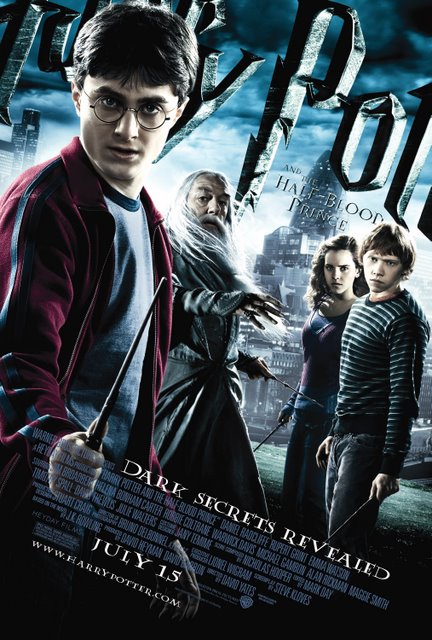
Movie Review: Harry Potter and the Half-Blood Prince (2009)


Official Shop of Warner Bros

Get Caught Up With the Movies


For Potter-- Reading is FUNdamental
Share J.K. Rowling's Series


Read Jen's Take on Prisoner of Azkaban


Half-Blood Prince
Photo Slideshow


Delicious
Bookmark this on Delicious
submit to reddit
Print Page

Digg!

MovieBlips: vote it up!

For the non-readers, the excitement of the next cinematic Harry Potter installment has always been in the steady development of experiencing J.K. Rowling's mythology unfold on the big screen. And as such the films have served as a sort of conveniently abridged version of the works for those either too busy, not quite interested enough, or just seeking a perfunctory knowledge of the world of Hogwarts to fake their way through office conversation.


Yet this is a series that at its heart seems to celebrate its readers the most given its painstaking adaptations and the evidence of this is sometimes its downfall via the detriment of the yawn-inducing screenplays-- as each and every important building block has been included throughout the movies. And in doing so, the directors and strategies have changed throughout which has not only been a brilliant tool in tapping into the short attention spans of the youngest audience members but also ensuring that there isn't only one vision for the Harry Potter universe that's being presented on the screen since the boy who lived in the cupboard under the stairs belongs to everyone who carries him around in their bag.

Moreover, despite his great beginning-- thankfully we've come a long way from the extraordinarily dull first film from one of the great filmmakers of my youth-- Mr. Chris Columbus-- which was surpassed by his own second movie (although book-wise for Rowling number two had been a literary step backward) before Alfonso Cuaron released the masterful Harry Potter and the Prisoner of Azkaban which was and remains the crowning achievement of the works so far.


Essentially, while aside from one exception with Wonder Boys scripter Steve Kloves wielding the pen for all of the transitions from books to movies-- for viewers who know the source material before going in-- the main attraction is from the visual point-of-view and the way in which this franchise has managed never to grow stale is by constantly bringing in a revolving door of new directors, cinematographers, and editors and endless behind-the-scenes talent to switch up the look.


Some of the experimentation offered up has been ghastly in my opinion such as in Mike Newell's The Goblet of Fire wherein every cast member and camera lens looked like it had been dragged through the mud (purposely according to the director's desire for grubbiness) before he yelled “action.”

In terms of script, direction, cinematography, editing, and overall execution,
the most successful adaptation all-around is still Azkaban as that final "Time-Turner "sequence has yet to be topped and Hermione was given her due for the first time in the series. And although I'd cite the first and fourth film as the weakest entries-- despite Newell's success in Harry's terrifying and violent showdown with Voldemort when death hits Hogwarts-- the one recurring complaint aside from the predictable format of "the end of summer break to end of school year standard structure" is the sheer length of the films themselves. Still, I'd like to throw one more problem into the pile-- namely Rowling's over-reliance on the “overhear” device which made more sense when the kids were younger since eavesdropping was conceivably the most reliable way for the trio to acquire information... but more on that later on.


And dropping extraneous details-- to the chagrin of some die hard fans-- Girl in the
Café director David Yates (who had cited Cuaron's work as his own personal favorite) moved the series back in the right direction with the much faster paced fifth film which found Harry developing his own army on behalf of Dumbledore which leads to a devastating conclusion as his godfather Sirius Black is murdered before his eyes.


After being asked to return to helm the rest of the series including the final book which will be broken into two films--(although I'm not sure if that's wise and wonder if perhaps blending books six and seven into two films may have led to a stronger narrative)-- Yates reveals supreme confidence right from the start with a bravura opener unlike anything we've seen before in Harry Potter that's sure to dazzle in 3D despite my admitted weariness of the format. In doing so he offers audiences an entirely new visual look by bringing aboard Jeunet's Amelie cinematographer Bruno Delbonnel that adds a striking color palette and style to the work especially in tandem with veteran Potter editor Mark Day. And some of the sequences in this-- the sixth Potter film to hit the screen-- are so breathtakingly gorgeous that they rival Azkaban on sheer beauty alone.


Whether Delbonnel employs old-fashioned trickery to move easily into flashbacks from water drops in a cauldron into the past with a soft focus or words on a page that evolve from ink and font into kids walking in the snow-- it's always dazzling and just flows so well that an argument can be made for Delbonnel to receive a cinematography nomination for his mind-blowing work.
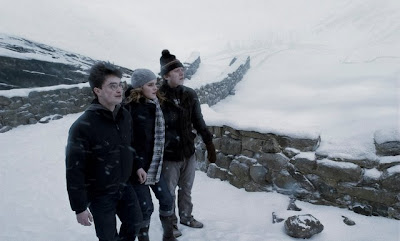


And it's a great thing too because while the film is sumptuous-- readers of Half-Blood Prince go into the theatre keenly aware that it's a very introspective, flashback heavy, chatty (a.k.a. not exactly action packed entry) which is designed to push everything in the right direction towards an unsettling “throw the uninitiated off a narrative cliff” ending as one main character is murdered and another we've been on the fence about is the one wielding the wand, thereby effectively leaving those breathlessly anticipating what's to happen next.


As a film, it's still quite good--if a bit too long again-- and filled with Rowling's structural Achilles heel as the trio and especially Harry this time-- since Ron and Hermione are busy obsessing over which one the other one is “snogging” (the Brit slang for kissing)-- are seen more than half a dozen times at least eavesdropping or listening in on conversations as if Rowling forgot that there were other ways Nancy Drew, Miss Marple, or any number of detectives could find clues.
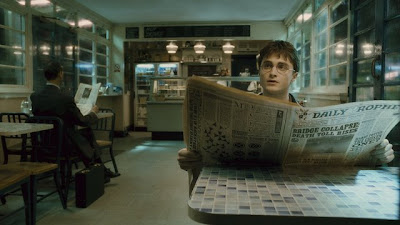


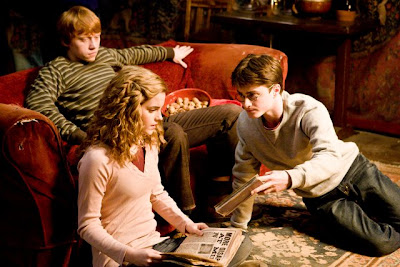
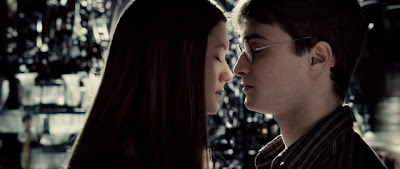
Since the cast is getting older-- they're predictably more caught up with their raging hormones. To this end, Harry starts to return Ginny's previously unrequited affection only to realize that she'd moved on to the athletic Quidditch player Dean Thomas whereas Ron has caught the eye of a stereotypically clingy girly-girl named Lavender much to Hermione's wrath that he hasn't realized that girls with the ability to carry on a conversation are much more interesting than those who snog so much that poor Ron is going to have the market cornered on chapstick.


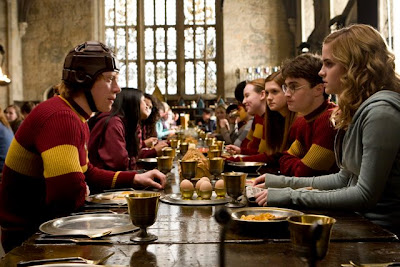
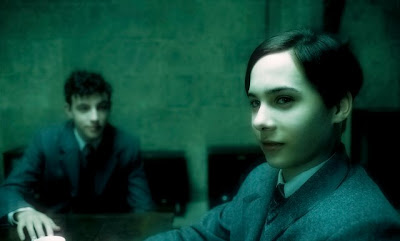
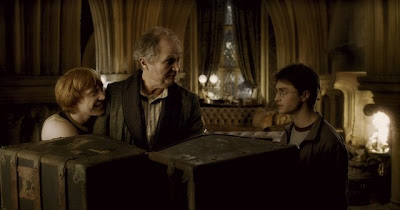
Yet, it's not all "The Young and the Hogwarts"-- as The Death Eaters have stepped up their fight on behalf of the Dark Lord and we learn early on that not only is Draco Malfoy to be an important player but that Alan Rickman's Severus Snape has promised Helena Bonham Carter's Bellatrix Lestrange to step in if he's unable to fulfill his duty. Likewise, Michael Gambon's Dumbledore has been turning Harry into a double agent to get close to one of Tom Riddle's old teachers-- Horace Slughorn (Jim Broadbent).


And despite the tradition that the final showdown is always the most exciting-- honestly the one captured in Half-Blood Prince isn't quite as memorable as some of the ones which have come before it. One of the reasons for this could most likely be because the events leading up to the big murder were executed with such overt Christian symbolism like we were watching a Charlton Heston movie to the point that afterward others including myself wondered when it suddenly became The Ten Commandments thereby in making these choices, it pulled viewers out of Harry Potter suspension-of-disbelief and into post-modern, pop-culture referential mode.


Additionally, in the book although Harry was outnumbered and out-wanded to help prevent a beloved friend from death, there was much more to the scene than having him stand there like yet another "overhear" in an anti-climactic fashion.
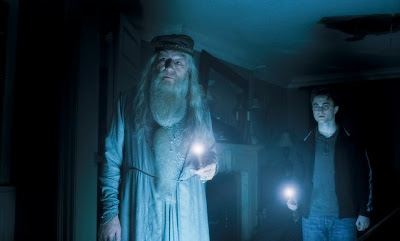


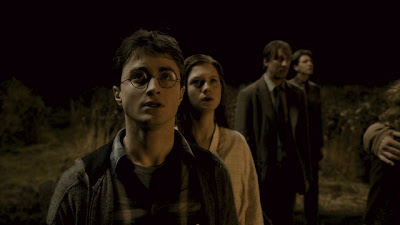
Despite this, there is one amazing sequence that keeps you in check within the film that I don't remember-- at least to this extent-- in the novel which takes place at Christmas at the Weasley household when Bellatrix Lestrange shows up and a huge chase through the cornfield ensues as though we were in a vintage horror movie classic.


Furthermore it's surprises like these-- unexpected, away from Hogwarts, brilliantly lensed and pieced together in the most dynamic way that heightens the tension which brilliantly keepsus watching even when we're left realizing that this time around, Ron and Hermione have very little to do (with the former given hardly anything save for the obligatory comic relief scene). And likewise the filmmakers will definitely have their work cut out for them in making us buy into the Harry and Ginny relationship
in Deathly Hallows since the ultimate few second "snog" looked about as passionate as a walk to Hagrid's hut.


And in the end, for the readers who've been joyfully treated with
Delbonnel's beautiful lensing, you'll find yourself growing excited and anxious for the plot division of the next book since obviously the big revelation that sets up the final quest for the end of the series is revealed in this title. Yet this one may be rough going for the non-readers given the lack of action in comparison to the rest. However, for the patient viewers who manage to watch all the way through-- the best achievement of the picture's final sequence (and indeed the film itself) is that the murder and perpetrator are so startling that you may find yourself going over to the bookstore to grab Hallows just to see what happens next.


Text ©2009, Film Intuition, LLC; All Rights Reserved. http://www.filmintuition.com

Unauthorized Reproduction or Publication Elsewhere is Strictly Prohibited.

5/22/2009

Movie Review: The Brothers Bloom (2008)

Brothers Bloom 10

Now Available to Own


Delicious
Bookmark this on Delicious
submit to reddit
Print Page

Digg!

"I wanted to make a movie that is essentially very good-hearted. It's about life being this grand story that you can tell. We can't control what the world gives us, but we can control how we tell it back to ourselves, our story. And if you tell it well, and tell it as a beautiful worthwhile adventure, in a way that's what you can make your life into."


-- Writer/Director Riann Johnson
(As Quoted in The Brothers Bloom Production Notes)

As a child, Riann Johnson was enchanted by the tales of comedic adventure and the con man landscape discovered while watching The Sting and Dirty Rotten Scoundrels. So when it came time for the filmmaker's hotly anticipated sophomore project following the smash success of his Sundance award winning Brick, Johnson decided to make his own version of a quirky globetrotting humorous con tale.


Essentially it's a film that blends together the fields of magic and the con trade to literal visual sleight of hand by the characters who populate the brightly colored landscape as well as in the complex, multi-layered screenplay. Moreover the fascinating thing about Brothers Bloom is that as Johnson himself noted "eventually it evolved into a film about storytelling and the way we use storytelling in our lives."

Brothers Bloom 8

Likewise, the acclaimed Oscar nominated and Oscar winning cast seemed equally intrigued by the idea of the film's notion that we are constantly telling our own story since as actors they routinely must "con" or fool audiences into buying into the fact that they're someone completely different for two hours. However, to dub Bloom simply a "con" movie is to miss the point entirely.

Essentially, The Brothers Bloom works successfully as a movie that celebrates film and humanistic storytelling, all the while somehow managing to intermingle a wonderful and offbeat appreciation for a truly unique set of characters. Having been delayed for release since last Fall, Johnson's film finally lands in theatres this week in my neck of the woods opposite the titan that is Terminator Salvation.

Yet seeing the two movies just one day apart, I can honestly say that not only is Bloom far superior to the mega-budget, big studio blockbuster franchise picture but it's also my favorite sleeper film of the summer so far and one that should appeal to fans of last year's irresistible Son of Rambow.


Obviously influenced not just by The Sting and Dirty Rotten Scoundrels but initially in its narration by Ricky Jay (Magnolia narrator, real-life magician, and frequent David Mamet player) it seems to be also drawing from the well of Mamet, Paul Thomas Anderson, and most pointedly Wes Anderson. In fact, when it started, it seemed like the next installment from Wes Anderson, before he went off the deep end with Life Aquatic and Darjeeling Limited. And intriguingly as it stars his Darjeeling lead Adrien Brody, I couldn't help but wish that this superior film would have been released in Darjeeling's place.


Like the aforementioned title, the dynamic centers on brothers although this time and for good measure, we're only introduced to two in the form of Stephen (What Doesn't Kill You and Zodiac star Mark Ruffalo) and Bloom (Adrien Brody).

Brothers Bloom 7

Having survived a rotten youth going from one foster home to the next-- it isn't long before they realize that they could become the architects of their own lives. This epiphany comes from Stephen's decision to look out for his younger brother by engineering stories (cons really) that "Bloom" likens to Russian novels. And similarly, it's curious right from the start that Brody's character is never saddled with a first name since overall, it's that problem that we're faced with twenty-five years later as we catch up with the Brothers Bloom.

By adulthood, we discover the Brothers have come a long, long way from suburban playground cons to major larceny and "fake deaths" complete with pyrotechnics courtesy of their "fifth Beatle," the mostly silent Bang Bang (Babel's Rinko Kikuchi). Yet once again and mirroring his endless wish, Brody's Bloom tells his brother he wants to quit the con.


It seems that Brody is tired of waking up next to people who think he's someone else and realizing that he actually has no identity other than the one supplied for him in the elaborate, highly literary puzzling cons Stephen creates wherein his brother promises "everyone gets what they want."

Yet, as far as Bloom is concerned, he tells his brother that all he wants is "an unwritten life." Not content to just write him out completely however, the two split ways temporarily until Stephen and Bang Bang entice Bloom to get involved in the old genre favorite of the final, ultimate score that will set them up for life.

Brothers Bloom 2

Leaving an exotic foreign locale for New Jersey (!), Bloom quickly meets and is disarmed by their newest mark, Rachel Weisz's Penelope. A thirty-three year old, exceedingly shy, epileptic recluse, Penelope "collects hobbies" ranging from pinhole photography in watermelons to learning fourteen languages when she isn't busy crashing her Lamborghini into inanimate objects in lieu of parking.

Brothers Bloom 9

Figuring that with her driving skills, the crash would be the best way in, Bang Bang and Stephen gleefully send Bloom riding a banana-seated bicycle down a hill where she indeed strikes him, before things go wrong, her epilepsy kicks in, and ultimately Penelope is the one who winds up in the hospital costing Bloom his much needed sympathy points to ingratiate himself into her life.

However, somehow it works as she asks him for a ride back to her place and after a series of strange exchanges she's ill-equipped to handle (unaccustomed to having conversations with others), soon the two bond enough for Penelope to impulsively decide to tag along with the Blooms and Bang Bang-- whom she assumes are antique dealers-- on an overseas adventure by freighter to Greece.

Brothers Bloom 1

Working in a few other players to help set up a trap to ensnare the wealthy heiress into handing over a large amount of money, the men are stunned when Penlope is not only into the con but so gung-ho she begins taking risks and taking charge. And more importantly, she displays a new side of herself that reveals she's no stranger to making up beautiful lies which helped bolster her mood from an isolated childhood.

Filled with gorgeously breathtaking scenic shots as they hop from one country to the next involving as Johnson notes, "steamer ships across the Atlantic and trains through the Hungarian mountainside and ports in Greece and gritty alleyways in St. Petersburg," the film is bursting at the scenes with as he explains, "all sorts of highly romanticized stuff that has much more to do with an American's fantasy of Europe [than the actual Europe]".

Likewise, fantasy and imagination seem to be the film's driving force as the train utilized purposely recalls the 1940s, the ship echoes the 20s and despite its contemporary setting, The Brothers Bloom offers a liberating and tremendously spirited, picturesque, and dazzling view of characters and situations.

Brothers Bloom 3

Always presenting situations with a "wink" to the audience such as the homage to Wes Anderson, some great camera work that moves forwards and backwards quickly while panning from one extremely long shot to the right as a character is picked up and followed from the left-- it's a fluid, fast-paced work that exceeds Johnson's innovative high school film noir debut feature, Brick.


Viewers familiar with his previous movie will instantly recognize the cast as we see the brothers celebrate an early successful con with a film style "wrap party" and actors like Joseph Gordon-Levitt are captured for a split second onscreen. And although again, Johnson is taking the established rules of a genre piece like the "con man" movie-- he gets extra points for carefully leading you down many paths throughout as initially we feel that one character may be in on the con, another could be truly running it, and someone else is unexpectedly being had, which consistently changes throughout.

Brothers Bloom 5

Admittedly, while it ends precisely in the manner I assumed it would (for one character in particular) as Johnson's clever screenplay inserts snippets of dialogue that pay off later in a multitude of unexpected ways-- it's the getting there that makes Brothers Bloom a true delight. However, a few of my film critic colleagues felt that the film had one final magic act too many in the closing twenty minutes. And partially they're right, since indeed once the film goes in a decisive direction after what you assume was possibly a good place to stop it, it takes a minute to see what purpose it will ultimately serve to continue the running time.

Yet contemplating it now again in retrospect-- I believe it served Johnson's thesis and made a fitting Russian novel like bookend of his own. Since at its heart and more than just a con movie, Bloom is a story about two brothers who made up beautiful stories of adventure and success just to keep themselves moving forward, empowered, and not looking back so the story had to continue until it finally stops by the decision of the author.

Brothers Bloom 4

A stunner of a picture-- it's one that additionally benefits from offering the two women truly great, offbeat roles (Kikuchi in particular makes a great mysterious Bang Bang who gives off much more spark with Ruffalo than Cato did for Peter Seller's Inspector Clouseau in the Pink Panther series to name another possible homage). And while Johnson's film on the surface may resemble a classic con picture or feel like it's in the mold of the Wes Anderson universe (back when his films were good and he penned them with Owen Wilson), it's a triumph that goes beyond homage and into blissfully entertaining originality.


3/20/2009

TV on DVD: Cracker -- The Complete Collection (10 DVD Set)


Own the Entire Award-Winning Series
3/10/09


Already Available


Delicious
Bookmark this on Delicious
submit to reddit
Print Page

Digg!

In the debut episode of the 25-time award-winning British ITV television series Cracker, the amnesiac prime suspect accused in a series of brutally bloody slice-and-dice killings tells the forensic criminal psychologist interviewing him that he is “the one who needs the psychologist.”

And sure enough, the man on the receiving end of this observation is one about which the audience has already most likely had similar thoughts just moments after we’re first introduced to Scottish actor Robbie Coltrane’s brilliant, arrogant, deeply flawed, yet fascinating character Dr. Edward Fitzgerald.


Known throughout the series as Fitz—series creator and mastermind Jimmy McGovern (Fitz’s real-life alter-ego) created a British police drama unlike anything else on the airwaves. Inspired by his disappointment with the cool overly procedural and detached Helen Mirren hit Prime Suspect--McGovern, who wanted to introduce a criminal psychologist to her series in the second season—instead centered an entire show around the individual he was determined to make just as seriously flawed and demon-plagued as those with whom he must analyze and interrogate.

While the terms “groundbreaking,” “genius,” and “visionary,” are thrown around fairly cavalierly in a buzz-fueled media where blurbs rule as opposed to insightful articulation-- in the case of Cracker, all three words are not only justified but demanded.


Sharing his belief that the show’s success was in its audacity to become what he feels “was the first post-feminist drama series,” which benefited from its frank tell-it-like-it-is characters since in the early ‘90s, “everyone was getting sick of political correctness,” so that “the timing couldn’t have been better,” McGovern’s unique blend of complex Edgar award-winning mystery storytelling and emphasis on the neuroses, emotions, and problems of its characters on both sides of the law made this Manchester set drama a critical smash.


An admitted hypocrite who reveals that he drinks, smokes, and gambles too much—correctly surmising that “I am too much”-- Fitz is the type of anti-hero from the days of Cagney and Bogart in the films he worships whose ability to size up anyone with whom he crosses paths in two minutes makes him not only invaluable in assisting the local police department but far too gifted for his own personal devices.

And as a result, whenever he’s unable to gamble with people’s lives by assisting the police, he tries to lose himself in risky backrooms gambling away his finances and unhealthily working towards a heart attack in a mess of a private life where his skills as “an emotional rapist,” hold everyone around him-- especially his long-suffering wife Judith captive.

In order to understand the criminal mind, Fitz eerily must put himself in the criminals' shoes, skin, and mind-- empathizing with them in ways that chill us to our very core as he discusses their thought processes and primal urges to help them crack. And in doing so, he argues in the first episode’s bravura opening, that instead of initially reaching for books on philosophy and psychology (which he violently hurls at a lecture hall filled with university students), you first must force yourself to explore the darkest recesses of your soul.

Further revealing that he’s rehearsed his father’s death without the satisfaction of an "opening night" numerous times, the guilt ridden extremely lapsed Catholic runs hot and cold on people—especially those closest to him in the series’ most effective relationship-- namely his initially professional but later flirtatious and romantic tinged partnership with Manchester Police Department’s sole female detective sergeant, Jane Penhaligon (Geraldine Somerville).


Nicknamed “Panhandle"-- Jane’s character—much like Fitz’s is the underdog and outsider in the perpetual boys' club of the department and as the copper who is always sent to deliver bad news, it becomes her duty as well to perpetually chauffeur Fitz around from location to location where the two reach a chemistry that sizzles within the first season.

With highly complicated and shockingly brutal crimes that span multiple episodes (typically two to three) before reaching a resolution, each fifty minute episode is included in Acorn Media’s recent release of the entire collection of the show, only previously available from HBO.

A comprehensive set that includes the original first three seasons which aired from 1993 to 1995-- the ten-disc collection also includes two stand-alone feature length mysteries made a decade apart in 1996 and 2006 respectively, as well as a forty-five minute new retrospective, interview filled documentary.

Although the show also aired here in the states on A&E and BBC America and was also remade into a short-lived and poorly received American version starring Robert Pastorelli—each episode of UK's Cracker is so compelling that in my view they always moved far beyond the limitations of traditional television storytelling and work much better when viewed in mini-marathons to absorb all eleven addictive mysteries to best appreciate the nuances, red-herrings, and subtle ways that certain jokes and throwaway lines come back to haunt people in the most unexpected of ways.

While in America in the '90s, we were treated with high caliber police dramas such as NYPD Blue and Homicide: Life on the Street-- honestly, they pale in comparison to the gritty authenticity of Cracker. And moreover-- when viewing this show for the first time in 2009-- I’m amazed by how much I feel McGovern’s work has inspired some of our most effective and highly praised dramas featuring anti-heroes in such critically lauded shows as The Sopranos, Dexter, Mad Men, The Shield, Rescue Me, and House M.D. which all seem to be going for (most notably in the case of Tony Soprano) Fitz’s unique mixture of angel and devil that we alternately root for and shrink away from sometimes within the same five minutes.


From the first riveting episode directed by Michael Winterbottom(24 Hour Party People, A Mighty Heart) to the very last one helmed by Antonia Bird(Priest, Total Eclipse), the gritty urban noir hasn’t lost any of its ability to startle with some truly incredible cases including three that I found to be the series’ strongest: “One Day a Lemming Will Fly,” “Men Should Weep,” and “Brotherly Love,” all penned by Jimmy McGovern.


Ironically, as McGovern reveals, “Lemming” was the hardest episode he had to write since it was supposed to have been completed by a theatre writer who “handed in an appalling script,” leaving McGovern no alternative but to “write it from scratch in something like a week.” Centering on the case of a teenage boy found hanging in the woods—what begins with the appearance of a simple suicide grows into an incredibly complex murder investigation as witnesses come forward reluctantly, family members reveal some biases they’d had about their son, and Fitz pursues one strict line of inquiry and promises to share the suspect’s “burden,” if he confesses.

When a confession is offered and simultaneously Fitz and Panhandle’s relationship tentatively starts moving to another level, Fitz is dealt an ego-shattering blow that his fierce desire to be right may have blinded him to what really happened. Moreover, his hypocrisies are unearthed in a way that puts the master manipulator and smooth talker on the receiving end of some dead-on analysis of his own.


While it would’ve been extremely satisfying to offer a clear-cut resolution or follow up on this case, brilliantly yet maddeningly, McGovern stays with the emotions over the crime and leaves interpretations up to us as it moves towards the final credits.

In two of the most alternately upsetting yet shocking episodes—which following the death of one major character earlier on should’ve found us a bit more prepared—the crimes hit much closer to the station. In the first, as a serial rapist brings out the worst in some of the ensemble as “Men Should Weep,” leads into an extremely chilling yet unforgettable conclusion in “Brotherly Love” that uses the set-up of three episodes each to produce six hours of some of Cracker’s finest and most troubling television that leads to a turning point in the lives of every major character, including those no longer standing by the end.

Additionally, it’s equally compelling in some of the series’ most provocative tales including the fact-inspired Hillsborough Disaster case that moved into a startling look at blue collar white male angst and culture clash fueled prejudice as Trainspotting’s Robert Carlyle’s troubling motive “To Be a Somebody” results in the death of one of Manchester’s finest and guest star Liam Cunningham’s closeted homosexual tendencies are tested when he falls for a troubled, seventeen year old orphan in “Best Boys,” which—similar to “True Romance” and “To Say I Love You”—illustrates the twisted lengths people go to for love.

While when the series as we knew it ended with “True Romance,” from McGovern’s replacement writer Paul Abbott (State of Play), eventually and most likely due to popular demand, Fitz returned in a mediocre but entertaining special entitled “White Ghost” in ’96 and once again in a collaboration with McGovern a decade later for the politically charged “A New Terror.”


And while they’re both adequate, “A New Terror,” especially feels like a major let-down in comparison to the original series. Likewise, despite the fact that the opportunity to watch Coltrane in any episode as Fitz is better than the alternative-- in my opinion, the show only worked to the best degree in its original three season run heyday in what is arguably England’s best contemporary police drama created thus far.

Packaged in a compact box with a DVD holder book that keeps all ten discs including the great 45 minute interview (unfortunately missing Geraldine Somerville) in accessible slide in “pages,” thankfully it also boasts subtitles and/or closed captioning on every episode for the deaf and/or hearing impaired which you’ll find yourself especially grateful for the opportunity to read Fitz’s lines when the drunken Scottish monologues slur together occasionally in order to savor every word.

A riveting series with Coltrane’s tour-de-force in a role that will make you view his Potter alter-ego Hagrid in an entirely new light—for mystery lovers and fans of whip smart, provocatively written dramas, you’ll definitely want to help yourself to this particular Cracker.


3/09/2009

New on DVD & Blu-ray for the Week of 3/8/09

Jen's Pick of the Week


Milk


Delicious
Bookmark this on Delicious
submit to reddit
Print Page

Digg!

Batman Anthology


Battle in Seattle


Ben X


The Best Years: The Complete First Season


The Boy in the Striped Pajamas


Brokeback Mountain [Blu-ray]


Cadillac Records


Caroline in the City: The Second Season


Cracker: The Complete Collection


Escape to Witch Mountain


Family Ties: The Complete Fifth Season


Get Smart: Season 3


Happy-Go-Lucky


Howard the Duck


Let the Right One In


Marie and Bruce


Milk


The Miracle Worker


Pinocchio


Primal Fear [Blu-ray]


Rachel Getting Married


Return from Witch Mountain


Role Models


Seven [Blu-ray]


The Shiralee


South Park: The Complete Twelfth Season


The Starter Wife: Season 1


Synecdoche, New York


The Transporter 3