Showing posts with label Kristin Scott Thomas. Show all posts

8/25/2021

Film Movement Movie Review: Final Set (2021)


Opens Virtually & in NYC on 8/27


“If you'd won quicker, you'd suffer less.”
 
Watching her son, thirty-something professional tennis player Thomas Edison (Alex Lutz) apply an ice pack to his knee during dinner, Judith (Kristin Scott Thomas) can't help but ask, “why lose the first set?”
 
Having helped propel Thomas to early greatness as a young prodigy, Judith struggles to remove her coaching hat to support her son the way that a typical mother would. Coming from a place of not only criticism but also love – because to care for Thomas and the knee he'd had operated on multiple times in the past is to question why he still feels the need to try to compete against the top players of the world at his age – to say that their relationship is complicated would be an understatement. But understating it is precisely what makes their dynamic and everything else in French writer-director Quentin Reynaud's “Final Set” so real and compelling.
 
Minimal and precise, the dialogue between not only Thomas and Judith but also Thomas and his loving, supportive, but equally conflicted wife Eve (Ana Girardot) is spare throughout the work which boasts a quasi-documentary feel. Yet, delivered by this exceptional group of actors who can say so much with a look or tone, we feel the weight of one’s meaning even though the English subtitled lines are spoken in French. In fact, generating a great deal of conflict and depth from these micro-moments, it's a film where those inquisitive looks over dinner or cautious actions – even the way one character packs or carries a tennis bag – speak louder than words.


From the Australian Open in January to the ATP finals for the highest-ranked male players in November, tennis, more than most sports, is essentially played for eleven months out of the year. Unfortunately, with a ranking of 245, which is a far cry from the great hope he was supposed to be twenty years earlier when he choked during a grand slam, Thomas' respectable but still low stats keep him out of most major tournaments, which cater only to the top players in the sport. 

And while he would prefer to enter every competition he can, his wife – a former player herself who now handles the behind-the-scenes business decisions – has to gently remind her husband that when you subtract the travel, food, and lodging costs, far too often, the actual winnings from some of these events don't justify the expense. Supplementing the income he barely receives from matches he's allowed to enter by working as a children's coach at his mother's tennis club, while everyone around him is waiting for him to hang up his racket or join the over thirty-five tour, Thomas decides to make one last stand at Roland Garros.
 
Otherwise known as the French Open, at Roland Garros, tennis is played on courts of famous red clay where the surface of the terrain not only sticks to a player's shoes, socks, legs, clothes, and arms if they take a nasty fall, but as legends like Andre Agassi and Roger Federer are first to admit, it's also sheer hell on the knees. And if it's hard on those joints at any age, you know it's destined to be agony for Thomas whose prominent knee surgery scars, arthritis, ligament lesions, and osteoarthritis are shown and discussed within the first five minutes of Reynaud's movie.


Nonetheless, knowing he doesn't have a lot of time left but not quite ready to follow in his wife's footsteps and train for another career because – despite being a husband and father – a life outside of tennis isn't something he's ever considered, Thomas decides to make a run at the Open by playing several brutal rounds as a qualifier. Facing other players not lucky enough to get in via wild card or ranked highly enough, even though his wife Eve tells him to “have fun” before he leaves for a match, we know that for the serious Thomas, fun doesn't really enter the equation. No, in this quixotic, underdog run, it's just about determination, desperation, and the work.

Drawing a parallel throughout to a cocky, young, but exceptionally gifted seventeen-year-old phenom on the rise (played by real pro player Jürgen Briand), who even Eve admits reminds her of her husband, obviously, you know that eventually, the two men will have to square off at some point to achieve the dramatic potential of Thomas “playing himself” in “Final Set.” Still, it's in the authenticity of the film's battle to that battle – and particularly the amount of regret, guilt, excitement, frustration, and pain of both the past and present that flood our main ensemble from start to finish – that makes this film feel like something beyond just your typical inspirational sports drama.
 
Furthermore, the time that Reynaud takes off the court and how much trust he puts into this excellent trio of actors (with once again, Scott Thomas doing some of her best work both later in life and in French) makes his bold decision to spend the film's final twenty-five minutes on the court so incredibly effective. Set during a showdown between the two pros at different points in their life, Reynaud goes right for the greatest hits of dramatic tennis. 


Zeroing in on a five-set grand slam match between a David and a Goliath, which features a never-ending deuce, racket smashes, cramps, long rallies, and more, the film achieves something so thrillingly intense that for a long time, I actually forgot for a while that I was watching a movie instead of championship play. More than that, as someone whose TV is often left on The Tennis Channel, it was only after the movie ended when I was reading the film's production notes that I realized that the final match went on for nearly the length of a traditional “act” of a Syd Field screenplay.
 
Yet, similar to the way that I love a good football movie even if it isn't a sport I actually watch, this isn't to say that one needs to be an avid tennis fan or even know much about the sport to enjoy “Final Set.” Filmed at Roland Garros and using that tried and true blueprint of “Rocky,” which similarly spends a good chunk of the film's last half right in that boxing ring as we watch events unfold in what I'd call “hyper-real time,” Reynaud's film is wildly ambitious in its scope. Refreshingly, though, it's as invested in the human story as it is in its tennis, which comes through in the film's fully earned last shot. A superbly executed ensemble effort that plays out against a backdrop that's the stuff of modern myth-making, as we watch Alex Lutz's Thomas fight against time and his own body's wear-and-tear, we're right there with him, eager to battle it out to the very end.


Text ©2021, Film Intuition, LLC; All Rights Reserved. https://www.filmintuition.com  Unauthorized Reproduction or Publication Elsewhere is Strictly Prohibited and in violation of the Digital Millennium Copyright Act.  Also, as an Amazon Associate, I earn from qualifying purchases made off my site through ad links. FTC Disclosure: Per standard professional practice, I may have received a review copy or screener link of this title to voluntarily decide to evaluate it for my readers, which had no impact whatsoever on whether or not it received a favorable or unfavorable critique. Cookies Notice: This site incorporates tools (including advertiser partners and widgets) that use cookies and may collect some personal information to display ads tailored to you etc. Please be advised that neither Film Intuition nor its site owner has any access to this data beyond general site statistics (geographical region etc.) as your privacy is our main concern.

5/22/2020

Movie Review: Military Wives (2019)


Now Playing on Hulu & VOD


Starting and disbanding a knitting club on the very first night it meets after it becomes extremely clear that they can't knit, in the new film from director Peter Cattaneo, the military wives of the fictional British military base of Flitcroft realize they must look for another way to pass the time while their husbands and partners are overseas in Afghanistan.

Taking the suggestion of a young, newly married arrivee on the base to start a singing club, much like the straight-laced company colonel's wife Kate (Kristin Scott Thomas) and Lisa (Sharon Horgan), the sergeant major's wife and laid-back new chair of the base's social committee disagree about everything else, they greatly differ in their approach to the new activity.

Threatening to make the choir as short-lived as the knitting club, whereas Kate wants to teach the women to sing by formal numbered scale, Lisa knows that the quickest way to improve morale and ease the women's minds is to get them lost in the words of a beloved pop song. Eventually putting egos aside and finding a happy medium between the two wildly different styles, as the voices of their diverse choir of women from all backgrounds begins to meld together in a lovely harmony, Kate and Lisa begin to discover that they are more alike than they are dissimilar.


A pleasant if predictable trifle written by Rachel Tunnard and Rosanne Flynn and now available on demand and for free on Hulu, the 2019 film is inspired by the formation of the very first military wives choir as well as the second one, which was chronicled in the popular British television series The Choir: Military Wives. Made with a clear market in mind, because that series struck such a chord with viewers that afterward, 75 choirs (serving 2,300 people) started to spring up on British military bases both in the U.K. and overseas, the film will undoubtedly appeal to members of the military and their families, regardless of the country for which they fight.

Constructed with the noblest of intentions, Wives benefits from its authentic surroundings and the research the screenwriters did in making sure they get the little details right when it comes to life on a military base. Yet as important as it is to pay tribute to the real sacrifices being made by the families of soldiers who don't receive nearly as much credit as they deserve for the vital role they play in serving their country, Military Wives is as bland as it is forgettable. Formulaic in terms of both its script development — which follows the three act structure to such an extent that you can almost set your watch by it — and when it comes to its prosaic characters, in the end, the reason Wives works as well as it does is thanks to its marvelous cast.

Giving the role of Kate more intriguing contradictions than can be found on the page, Kristin Scott Thomas is a master at thawing the edges of the specific brand of ice queen she frequently plays in order to shatter us in a wordless scene when she watches old home video footage of the son she'd lost on a previous military tour. Balancing out Kate and helping to give the film buoyancy when it needs it most, the lively, effortlessly funny Sharon Horgan spars very well with Scott Thomas and propels the movie forward towards the women's inevitable "big show" at the Royal Albert Hall.


Supremely skilled in the subgenre of dramedy, as evidenced throughout his filmography where his ensemble casts of characters frequently find themselves through the performing arts — from striptease in The Full Monty to theater in the underrated Lucky Break or music once again in his American crossover attempt The Rocker, director Peter Cattaneo's steady hand keeps everything afloat and makes the shallow work seem deeper than it actually is.

Still an altogether amiable picture, if you don't go in with the highest of expectations, a burning desire to really connect with the characters beyond the periphery, or the hope that you'll think about it much — if at all — when it's over, Military Wives plays very well as an adequate time waster made with assembly line efficiency.

Hitting all of the notes you'd expect it to, Wives follows the paradigm that's been practically sewn into our DNA thanks to generations of underdog stories made by the House of Mouse and others since their rise in the 1970s. And while it's great that military wives are being celebrated onscreen, in the end, Wives' narrative success is as short-lived as its filmic knitting club, which reaffirms my belief that the movie would've been better off as an original solo instead of a mere duet of everything else that came before it.


Text ©2020, Film Intuition, LLC; All Rights Reserved. https://www.filmintuition.com  Unauthorized Reproduction or Publication Elsewhere is Strictly Prohibited and in violation of the Digital Millennium Copyright Act.  Also, as an Amazon Associate, I earn from qualifying purchases made off my site through ad links. FTC Disclosure: Per standard professional practice, I may have received a review copy or screener link of this title in order to voluntarily decide to evaluate it for my readers, which had no impact whatsoever on whether or not it received a favorable or unfavorable critique. Cookies Notice: This site incorporates tools (including advertiser partners and widgets) that use cookies and may collect some personal information in order to display ads tailored to you etc. Please be advised that neither Film Intuition nor its site owner has any access to this data beyond general site statistics (geographical region etc.) as your privacy is our main concern.

9/28/2009

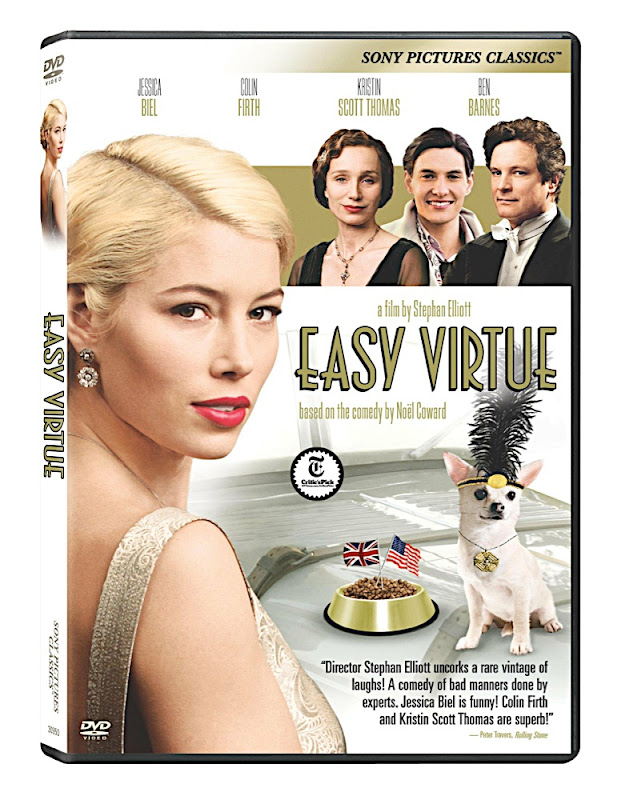
DVD Review: Easy Virtue (2009)


Now Available


All film buff allegiance to Alfred Hitchcock aside but on an enjoyment scale, the idea of watching a silent version of a Noel Coward play is roughly on par with being presented a single crayon to use for an extraordinarily detailed coloring book. Of course, if the stimuli is interesting enough, you’ll make due with what you have and thus, since in the ‘20s sound wasn’t readily available when Hitch filmed Coward’s 1924 play Easy Virtue four years later in ’28 during his London years, he did so silently.


However, I'm sure that those who've read the playwright's work or seen it before will no doubt agree that Coward was a man worth waiting for the new technology to fully appreciate his daring plays which were filled rich witticisms and his penchant for ridiculing social conventions like marriage and child rearing which were filtered-- as in the case of Virtue-- via the culture clash of an American feminist who finds herself in the stuffy England countryside.

And indeed this exceptionally well-made adaptation co-written and directed by Adventures of Priscilla, Queen of the Desert and Eye of the Beholder Australian filmmaker Stephan Elliott is just the right proof one will need to come to that same conclusion. Likely to entertain not just Coward devotees and also those who’ve enjoyed studying all things relating to the Master of Suspense, Elliott's Easy Virtue is doubly fascinating in the latter respect when you consider Hitch's affinity for Coward's work. To explain, by viewing Virtue, it helps retroactively foreshadow the type of unconventional humor that Hitchcock would seek out throughout his eventual career post his own '28 Virtue in films such as The Lady Vanishes, Mr. and Mrs. Smith, The Trouble With Harry and others.


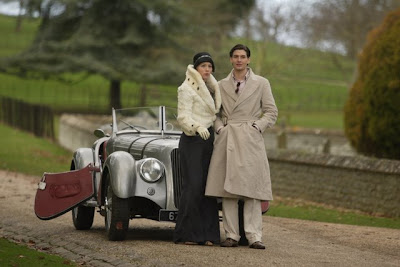
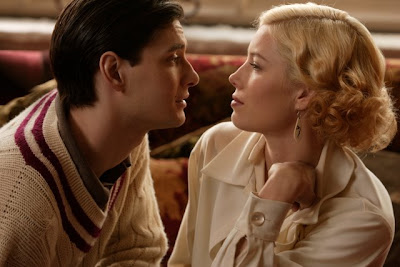
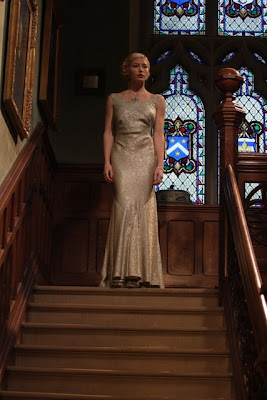
In Jessica Biel's best role and performance since the one that first bewitched many film lovers in The Illusionist, she plays a character we are quick to ascertain is slightly older than Ms. Biel in reality and one whom additionally is much wiser than her years. A widowed feminist race car driver from Detroit who's fresh off the high of winning the Grand Prix, Biel's Larita finds herself caught up in the excitement in Monaco when she waves to a thunderously applauding crowd and her eyes stop on the attentive eyes of the young handsome John (Ben Barnes) whom we gather is more than a little smitten with Larita by the time she appeared before her fans.


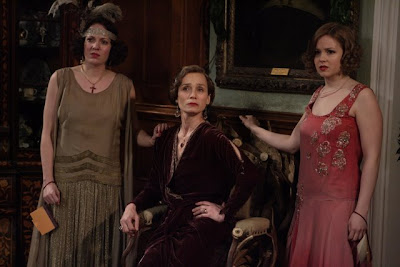
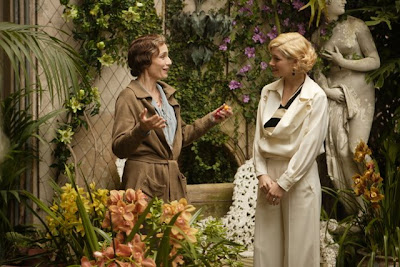
Using the old love-at-first-sight romantic comedy staple of marrying first and discovering each other's backgrounds later, Larita and John visit his dysfunctional family in the English countryside where even before they arrive and as opposed to John's initial adoration, his mother Mrs. Whitaker (Kristin Scott Thomas) is predisposed to loathe the feisty, uncouth American on sight.


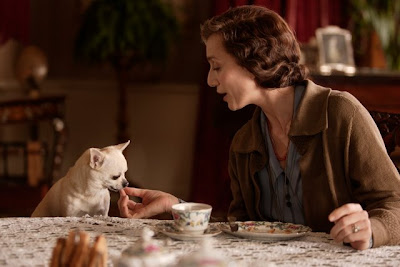
Scott Thomas perfectly embodies an icy wicked witch complete with a "yippy" dog too in the form of a Chihuahua named Poppy whose picture takes up more space in Mrs. Whitaker's home than the portraits of her equally offbeat daughters, Marion (Katherine Parkinson) and Hilda (Kimberley Nixon). Larita-- the new Mrs. Whitaker-- and Scott Thomas' firm main Mrs. Whitaker clash almost right from the start as despite her kind attempts to fit in with her new in-laws, Larita fails at every turn whether mildly due to an uncontrollable allergy to the woman's flowers or majorly by an unfortunate and macabre accident with the dog.


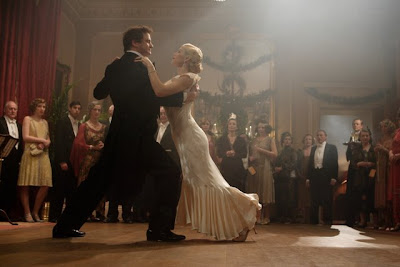
Although John initially tries to stay on his new wife's side, we quickly realize he's still unable to clip the apron strings that bind him to his mother especially when she uses guilt, familial obligation, an old neighbor sweetheart he'd been expected to marry, and financial woes to keep him in line, deftly playing these cards at precisely the right times. As John is too weak, his long-suffering, unhappily married father Jim is too strong for Mrs. Whitaker and Kristen Scott Thomas and Colin Firth fall into an easy banter like the parents in Jane Austen's Pride and Prejudice, no doubt also aided by the fact they'd worked together previously playing a married couple in The English Patient which helped launch both of their careers internationally.


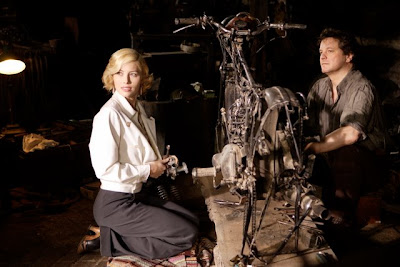
And throughout the obvious culture clash that intriguingly presents the English countryside as even more gossip hungry and cliquish than London since in contrast to the acres of land, the people make it seem as claustrophobic as a rowdy boarding house, Larita finds an important ally via the elder Jim Whitaker. Therefore, soon the two bond over Firth's passion for an old motorcycle he's restoring which reminds Larita of life back in Motor City as well as their pasts that are filled with battle scars when we learn more about Larita's former husband and Jim's survivor guilt as the only man his age still alive in the community after the first World War.


Intelligent and inventive yet still identifiable with modern audiences since Elliott and Sheridan Jobbins ensured their script went beyond Meet the Parents like gags to play up issues to which we can relate today concerning the pasts of Larita and Jim while still not venturing so far from Coward's original source material in the period film that it calls too much attention to itself a la the awkward reinterpretation of Oliver Parker's 2002 Oscar Wilde adaptation of The Importance of Being Earnest.


Nonetheless the decision to incorporate modern songs like "Car Wash" and "Sex Bomb" and orchestrate them in the style of Cole Porter and George and Ira Gershwin struck me as peculiar initially. And although I do feel it's still something of a flaw overall, the saving grace of Elliott's decision was to make sure the music never overpowered the scene by making the film's action our focal point and handling the selections carefully to make sure the period music was far more prominent and echoed in dialogue along with song and dance moments throughout that just felt right.

Moreover, as opposed to staging Moulin Rouge-esque production numbers (aside from the funniest and most unfortunate display of American sarcasm and joke delivery just not translating overseas in a Can-Can crisis), I was stunned to learn after the film ended that Barnes and Biel had actually performed some of the songs on the soundtrack.


Traditionally, this would've been a major marketing push in a Hollywood production to sell the soundtracks or by placing showstopping sequences in the film yet Elliott underplays the musical accompaniment and the most breathtaking scene of the film isn't even sung as Firth and Biel dance a tango at the end of the picture that replaces Coward's banter with action in telling the story yet still in a way that couldn't have had the same impact in the silent production.


While I'm unsure how the film played overseas, sadly Easy Virtue was a blink-and-you-missed-it release here in the states as it was overpowered by testosterone popcorn movies. However, thankfully given Sony Pictures Classics' beautiful transfer to DVD and Blu-ray, I'm hopeful the work will move beyond appealing to the Coward and Hitchcock crowd and garner more interest on disc. Additionally in the same turn, it's sure to remind admirers of Biel who suffered through Powder Blue along with those who've been unimpressed with her choices since The Illusionist just how much she's capable of as an actress who can walk the dramedy fine line and go toe-to-toe with Firth and quip-to-quip with Scott Thomas.

Text ©2009, Film Intuition, LLC; All Rights Reserved. http://www.filmintuition.com
Unauthorized Reproduction or Publication Elsewhere is Strictly Prohibited.

7/01/2009

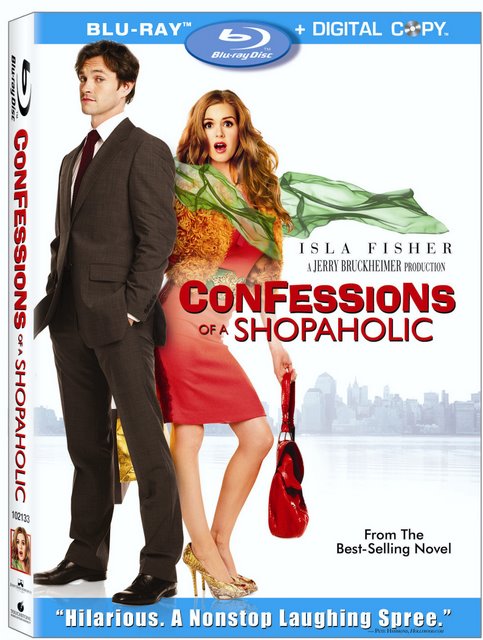
Blu-ray Review: Confessions of a Shopaholic (2009)


Now Available to Own on DVD & Blu-ray


Photo Slideshow


Apple iTunes

Click Here to View Film Clips & Behind-the-Scenes Videos


Delicious
Bookmark this on Delicious
submit to reddit
Print Page

Digg!

MovieBlips: vote it up!

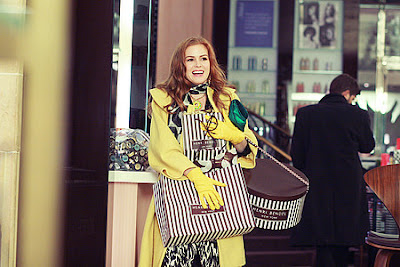
Much like Rebecca Bloomwood (played by Isla Fisher), as a young girl I too was entranced by the idea of "magic cards" that could be swiped instead of handing over real, actual, tangible money for goods and services. This fascination also extended to checks to such an extent that I actually remember advising my mom to "go for it" once when we were at the grocery store after she told the clerk she had forgotten to stop at the bank so would need to whip out the checkbook.


"You don't need money, mom; just write a check," I informed her-- seriously unaware that much like the pretty cards (which are far more gorgeous today with impressionistic backgrounds and AmEx status plastic that resembles shiny gold)-- the pieces of paper you tore from the book that always seemed to stick to the messy carbons were temporary stand-ins for what was in your bank account. Of course, I also assumed that the reason you had to show your driver's license when you wrote a check (back when people actually wrote checks) was to prove to the cashier that you had a driver's license, were trustworthy, and would therefore drive the groceries home safely.

While it was safe to say that a career involving personal finance or accounting was not in my future-- it's exactly this line of work that Fisher's Bloomwood alarmingly finds herself in-- advising readers of Successful Saving magazine how to manage their money and understand the lure of a store credit card and initial 0% APR under the pseudonym of "The Girl in the Green Scarf."


Aside from it being a cute moniker to use as she types in a fresh hip style-- sort of like a feminine or flirtatious Dear Abby for the Madison Avenue and Wall Street set in the male dominated world of finance-- the choice not to share her real name in her byline is extremely savvy for two reasons. And selfishly the most primal excuse for Fisher's journalist is that-- as per the case in most chick-lit works-- the magazine scribe Bloomwood longed to join the staff of a Devil Wears Prada a.k.a. Vogue, Elle, Marie Claire, or Glamour style magazine with the film's fictitious Alette run by Kristin Scott Thomas in her new, irresistibly funny, sassy French mode. To this end, she realizes that she doesn't want the less-than-chic Saving gig to immediately limit her resume (that also boasts work on a gardening magazine) or have it tied to her name as she aspires to use her position as a stepping stone to move into the publication that's printed by the same company.


However, Bloomwood's second reason for taking the fifth-- or hiding behind that luscious green scarf that led to the first encounter with her would-be editor Luke Brandon (Jane Austen Book Club actor Hugh Dancy) which then led to the cushy assignment in a world where magazines go under every day-- is to stay several dress-lengths ahead of Robert Stanton's merciless collector who's eager to have the shopping addicted Bloomwood settle her roughly seventeen thousand dollars of credit card debt.


Forever dodging Stanton's crafty Derek Smeath-- Bloomwood persuades Luke and her new workplace family that he's a stalker who just can't let their relationship end to hilarious yet admittedly illogical effect. And conveniently she misses him long enough to discover that-- although her own spending is out of control and she's resulted to reading Money for Dummies, trying to follow the advice of a stop spending DVD hosted by Ed Helms and using Google to pad out her stories-- she has a knack for helping others understand their own fiscal situation.


As beautiful as a dress by Vera Wang and as bright as a Marc Jacobs patchwork purse-- Confessions of a Shopaholic dazzles especially in the ridiculously stiletto sharp clarity of Walt Disney Home Entertainment's Touchstone Pictures Blu-ray. And the film from Muriel's Wedding and My Best Friend's Wedding director P.J. Hogan based on two of bestselling author Sophie Kinsella's five books in the Shopaholic series manages to amuse despite its vacuous frivolity and the misfortune of being released not only a few years after the far superior Devil Wears Prada but also in a time of economic recession.


Audiences who've been box office shy anyway and also coolly received the dumbed-down female-centric works like Bride Wars, What Happens in Vegas, The House Bunny, 27 Dresses, He's Just Not That Into You, and Made of Honor which continually casts women in either the pursuit of the right accessory or just the right male form of accessory-- avoided the ill-timed theatrical run of Shopaholic to a large extent. And most likely it's because the last thing you want to do when you can't afford your own credit card bills, rent, or student loan payments is to try and relate to a character who has a job and her health yet rings up couture as though it were nickel cups of Kool-Aid from a child's lemonade stand.


However, much to my surprise and delight, I actually was pleasantly surprised by this adaptation of Shopaholic. While I'd never read any of Kinsella's books in the Becky Bloomwood series and there are some contradictory messages both subtextually and on the surface in this adaptation as our heroine learns she needs to watch her spending yet at the same time marches her dreamy boss into a Prada store-- overall I applauded the attempt to remind viewers that you can't find yourself in a label (even if at times, the movie seems to argue the opposite in its fetishistic handling of designer wear and upscale stores).

Furthermore I must confess that honestly, it'd be nice if we were presented with a heroine not quite as daffy as this Manhattan damsel in distress who comes complete with salt-of-the-Earth parents (Joan Cusack and John Goodman) and a saintly best friend (Kristen Ritter). Still, Isla Fisher who actually studied at a Parisian clown college as part of her performance training is a master at the pratfall and able to pull off that difficult trick of-- instead of piling a bunch of clowns into a car-- making us like Rebecca Bloomwood's warmth and true heart even though there's so much about her personality we just don't understand.


And with this in mind-- despite our enjoyment of the movie-- it's hard to completely forget the real tough facts about debt as it dances (literally with a fan in one of Isla Fisher's funniest moments) over the devastating truth that shopping addiction can be as catastrophic as any other. Thus instead it uses the idea for laughs in some over-the-top shopaholic anonymous meetings and via some cat-fights involving women who wield credit cards like weapons whenever there's a sale. So by trying to make the movie more escapist than sociological-- which definitely wouldn't have been appropriate for Disney nor a Jerry Bruckheimer production (he was responsible for such ahem "strong female?" works such as Coyote Ugly and Flashdance after all)-- the focus is shifted from Successful Saving to watching our heroine ditch the money man.


However, it still remains mindlessly fun entertainment despite some flaws and my fear that in lieu of an ultimately good message-- I think young girls will still want to look like Rebecca Bloomwood in Gucci and Zac Posen among others, not understanding the joke that those really responsible for her attire were Master Card, Visa, American Express and Discover among others who make those irresistible magic cards-- bankruptcy and personal relationships be damned.


A great deal of the film's charm is owed to Fisher who consistently seems to be on the verge of the A-list with wonderful work in movies such as this one (arguably her biggest star vehicle), the bittersweet romantic comedy drama Definitely Maybe, Wedding Crashers and others. Overall, she's beautiful, bubbly, and willing to unleash her "inner idiot"-- as she calls it-- to make us laugh with the confidence to switch from drama to comedy when her partner Sacha Baron Cohen (a.k.a. Borat or Bruno) suggested she should audition for those films. And the movie is always elevated by Fisher who pitched her own jokes despite the fact that she was five months pregnant while meeting the filmmakers during the casting process and her investment in making Bloomwood lovably funny is Shopaholic's saving grace. Frequently it is Fisher as Bloomwood who manages to draw our attention no matter how much eye candy, Fashion Week wear, historical New York buildings, Miami scenery, or shots of the yummy Hugh Dancy are included in the same frame.


Overall it's a typically exceptional Disney Blu-ray with an impressive soundtrack and the sharpest of clarity in a package that also comes with a Digital Copy of the film. And while the extra features including unfunny bloopers, music videos, and deleted scenes are easy to skip-- fashionistas will want to explore the super short exploration of the film's amazing costumes and couture courtesy of designer Patricia Field whose taste in wardrobe is unparalleled, having also worked on Devil Wears Prada and both the film and television versions of Sex and the City.


3/04/2009

Blu-ray Review: I've Loved You So Long (2008)


On DVD & Blu-ray 3/3/09


Delicious
Bookmark this on Delicious
submit to reddit
Print Page

Digg!

The French language becomes Kristin Scott Thomas like Mourning Becomes Electra in Eugene O'Neill's famous Greek tragedy inspired woman's weepie. And indeed, Thomas' turn in novelist turned director Philippe Claudel's debut film resonates with audiences on the same level O'Neill's work did as it's highly literary, female-centric, tragic at its core, and marks the finest tour-de-force portrayal in Thomas' career so far.


Understated and subtle-- it's a wonderfully ambiguous work that unfolds slowly and methodically revealing the plot through the characterization and aside from one major confrontation near the end of the film where finally the truth comes to light-- it's quiet and poignant throughout its running time.


Yet, moreover I've Loved You So Long feels entirely authentic and achieves a feat for which so many American independent films aim. Namely, it succeeds by telling a tragic tale but it does so without opting for the easy route of wallowing in the dysfunction or devastation of its subject matter.

In fact, by not spelling out all the details of the main character's past locked up for fifteen years in prison for murder-- we're therefore far more engaged in the plot in its far more intimate approach as writer/director Claudel treats viewers as though we're members of the family. More specifically, we find ourselves simultaneously fearful yet saddened as we tip-toe around Thomas' Juliette Fontaine whose horrific past is only hinted at until roughly a quarter of a way into the 117 minute film when we learn whom it is she has killed.


Despite a collective gasp and the fact that aside from a few careless critics spelling it out in cheap headlines or giving it away within the opening paragraphs of their reviews-- thus not understanding that revealing the nature of the crime goes against why the film works so well-- we continue watching, wanting to learn more, appalled and fascinated by Thomas' haunting turn.


Having been released into the custody of her much younger sister, Lea (Elsa Zylberstein) a married mother of two adopted Vietnamese girls who works as a professor-- Juliette struggles with life on the outside with the defeated, hardened expression that stays on her face as she meets with the requisite social service agent and a parole officer whose nervous chattiness seems to reveal that he only understands too well what she's going through.

A former medical doctor now content to find any manner of suitable work after having taken secretarial coursework in prison, Juliette faces the prejudices of others and manages to throw everyone off balance as she and Lea try to hide the truth of where she was from Lea and her suspicious husband Luc's inquisitive circle of friends. This proves to be a far more complicated task during a remarkably arresting scene that finds Juliette interrogated by a drunken host until finally she reveals where she was and only gets laughter in response of what the guests assume must be a joke.


But it isn't a joke as we and Juliette's family know all too well and there's nothing funny about the dimensions Thomas brings to her performance. However, intriguingly, the film has a genuinely redemptive tone to it as she tries to re-adjust to a life and sister she doesn't now know as a grown woman. And in doing so, Claudel leads you down a few different psychological paths as we discover that strangely Lea (who was a teen when Juliette went away) has somehow managed to block out most of the memories she has of her sister. Is there an even deeper family mystery at play?


Claudel drops hints throughout the work and while even when the film ends, we still have questions about Juliette pre-incarceration (including being divorced while inside)-- yet justifiably for the tone of the material, nothing is neatly wrapped up. And the ambiguity and sense of vagueness of I've Loved You So Long lingers throughout and long after it ends in a way that makes it all the more effective as we're presented with what we need to know and the realization that we're not even entirely sure that Juliette herself has been able to process all that has happened.


Overall, it's a far greater film than a majority of the confrontational and brutal American works made popular over the last few years including The Savages, The Squid and the Whale, and Margot at the Wedding that go to great lengths to antagonize the viewer with ugly characters we can't identify with in an endless parade of overly depressing independent works of dysfunction.

No instead, when we do begin to tear up at this film's ending, we feel as though it was genuinely earned. And perhaps far more refreshingly, we understand that the tears are bittersweet as having finally unburdened herself and with the stark realization that she can never go back-- perhaps Juliette can move forward instead of psychologically remaining in the prison she'd exited at the start of the film.


Although Thomas garnered a Golden Globe nomination for her role and the film also was nominated as the Best Foreign Language Film for the year from its native France and it scored numerous accolades and nominations around the globe, unfortunately it was overlooked when it came time for the Academy Awards.

Now released onto a gorgeous transfer to DVD and Blu-ray from Sony Pictures Classics, the Blu-ray also boasts double the proof of Thomas' innate understanding of her role by offering viewers the chance to hear her performance in the dubbed English version as well as Sony's BD-Live network and deleted scenes that can be screened with Claudel's optional commentary if one so desires.

And by giving viewers the option of languages, hopefully it will encourage those afraid of subtitles who avoided it at the theatre or lived in cities that didn't carry it to give it a chance as we can now experience her extraordinary work in two languages, making it that much more upsetting that she was overlooked by the Academy voters.

3/03/2009

New on DVD & Blu-ray for the Week of 3/1/09

Jen's Pick of the Week


Delicious
Bookmark this on Delicious
submit to reddit
Print Page

Digg!


Ace Ventura Jr.: Pet Detective


Air Bud: Special Edition


Ashes of Time Redux


Australia


Beverly Hills Chihuahua


Doctor Who: The Key to Time (Special Collector's Edition)


East of Eden


E.R. -- The Complete Tenth Season


In the Electric Mist


I've Loved You So Long


Lake City


My Two Dads: Season 1


Nash Bridges: Season 2


Ramsay's Kitchen Nightmares


The Return of Man from U.N.C.L.E.


The Smurfs, Volume 1


SpongeBob SquarePants: SpongeBob Vs. the Big One


Trial & Retribution: Set 2


Watchmen: The Complete Motion Comic


Wildfire: Season Three


Wonder Woman