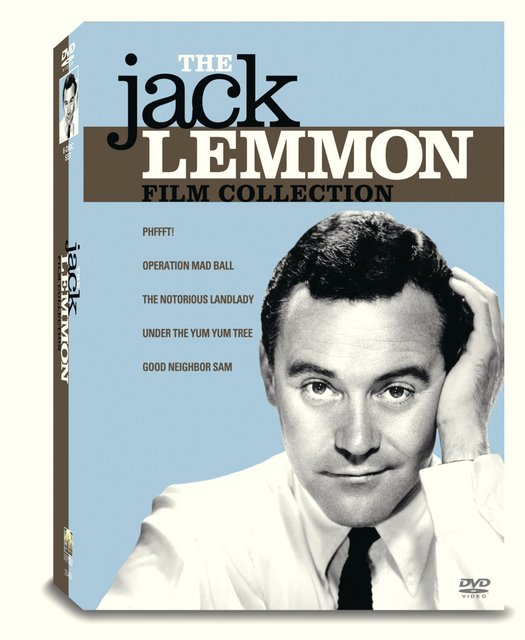
Now Available to Own on DVD

An Introduction

With the bonus of an all-new documentary hosted by Chris Lemmon featuring accounts of those who worked with or were friends of the legendary actor Jack Lemmon such as Kevin Spacey and Shirley MacLaine-- five previously unreleased works from Lemmon's Columbia Pictures endeavors finally make their way to DVD in this must-own set.
Naturally skeptical about the movies since-- as both a classic film lover and one who was especially fond of Jack Lemmon-- I was shocked to realize that I hadn't seen any of the five titles (and in fact had only heard of Under the Yum Yum Tree). Luckily, I was thrilled to discover that each one was entertaining in their own way. And in fact, after viewing two in particular-- Good Neighbor Sam and The Notorious Landlady-- I realized at once that I wouldn't hesitate to include both of those in a list of the actor's very best movies.
Since we're normally accustomed to thinking about Lemmon in terms of his partnerships with his best friend and best onscreen counterpart Walter Matthau as well as his great collaborations with Neil Simon and Billy Wilder, it was a tremendous discovery to see the way he fostered many excellent friendships and working alliances early on in his career.
And to this end, the collection features some notable overlaps in regards to two works co-starring Kim Novak, a few directed by Richard Quine, a lively duo from filmmaker David Swift, and a couple penned by Blake Edwards that showed his early dazzling ability to blend pratfalls with complicated monologues to endlessly witty effect in five vastly different films reviewed below.
Phffft!
(1954)
Director: Mark Robson
Writer: George Axelrod
(1954)
Director: Mark Robson
Writer: George Axelrod
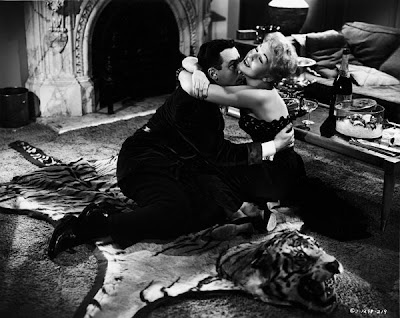
To quote the luminous and vastly underrated Ms. Kim Novak who appears in the film's trailer-- while referencing the impossible to pronounce and abysmal title-- "if you can't say it, see it." Yet despite the fact that she's front and center in the trailer as part of Columbia Pictures' attempts to elevate Kim Novak as a "rising love goddess" in the same vein as their rival studio's Marilyn Monroe, Novak's part in Phffft! is relatively small and silly.
And this is especially in comparison to the film's real draw for fans of the year's previous collaboration between Judy Holliday and Jack Lemmon in the lovely George Cukor classic It Should Happen to You as they were no doubt eager to see them reunite.
Penned by George Axelrod (who also wrote the cinematic classics Breakfast at Tiffany's and The Seven Year Itch), the movie opens with an amusing set-up of marital discontent as-- after eight years of life together as man and wife-- Judy Holliday's character Nina announces that she wants a divorce.
Annoyed that she's interrupting the sexy hard-boiled pulp novel he tries to read throughout the film (as a great running gag as he's stopped in the foreplay stage every single time) and just as glad at the prospect of putting a stop to their relationship that's fizzled out, Lemmon's Robert agrees far too easily and quickly for Nina's taste that the feeling is mutual and the same thought had occurred to him.
While clearly they seem to be on the same page-- personal inventory wise if not literally as Robert has to reluctantly close his book-- the way the couple continues to argue over the grounds of the arrangement and who thought of dumping the other one first makes viewers instantly realize that perhaps the shock of addressing their boredom has most likely made their marriage come alive for the first time in years. Still they dash to Reno for a quickie divorce with both predictably trying to figure out the best way to move on, especially when they're still professionally involved with one another.
Making drastic changes as Nina and Robert attempt first to occupy their time with self-improvement activities with Holliday's decision to learn a foreign language and Lemmon's choice to pursue painting (before realizing they have no talent in either area)-- inevitably they begin seeking romantic companionship in the strangest of ways.
Whereas Holliday's Nina mistakes what she assumes is a seductive come-on by the leading man of the show she writes for only to discover that like most actors he just wants a better part, Lemmon goes the early mid-life crisis route by buying a sports-car and taking the awful advice of philandering ladies man Jack Carson who informs him to grow a mustache and fixes him up with the pom-pom dancing Novak.
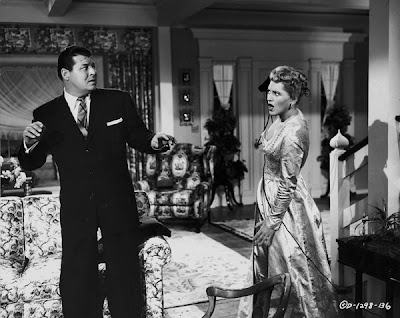
And soon enough the two realize their efforts are actually bringing them closer together as witnessed in one of the movie's standouts when they're surprised to discover they've both taken dancing lessons and proceed to show off with their respective partners only for their "dance off" to find them literally sweeping each other off their feet. However-- and true to romantic comedy form in addition to increasing our own amusement-- they fight their obvious attraction the entire way right until an ending that seems to have possibly influenced Pillow Talk.
Despite the age of the film which suffers as the weakest digital transfer in the set by making you strain for the remote to emphasize the volume-- and possibly if your television is able, get rid of excess noise from the dated print-- it's a great deal of fun.
And although it won't be mistaken for the second time around romantic comedy divorce hits (or "comedies of remarriage" as scholars have labeled them) like Cary Grant's efforts The Awful Truth and The Philadelphia Story-- it makes a terrific companion to It Should Happen to You and once again celebrates the deft physical timing of the two leads that they're able to punctuate with some truly classic Axelrod lines (yet dialogue-wise, Carson gets the best material).
Also on the DVD, you'll want to be sure to check out the hidden twenty-two minute television gem Marriageable Male which shows an impossibly young Jack Lemmon pretending he's a male model (and perhaps foreshadowing his great passion for golf, striking a pose with a club) in order to try and drive a wedge between advertising artist Ida Lupino and her brainy fiance she's currently supporting.
A true blast and one that has a great deal of potential as a comedic work-- making my writer brain work overtime in figuring out how we could write something like that that's feature length today-- in many ways, despite being one fourth of the length, Marriageable Male is just as impressive as Phffft!
Operation Mad Ball
(1957)
Director: Richard Quine
Writers: Arthur Carter (based on his play), Blake Edwards & Jed Harris
(1957)
Director: Richard Quine
Writers: Arthur Carter (based on his play), Blake Edwards & Jed Harris
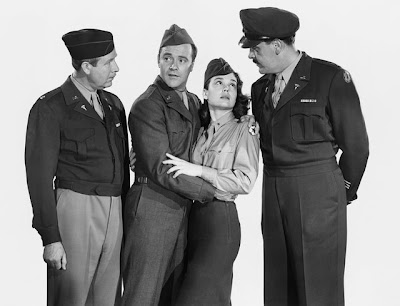
Two years after Jack Lemmon won the Best Supporting Actor Academy Award for John Ford and Mervyn LeRoy's military comedy-drama Mister Roberts, he returned to familiar and audience favored territory via Arthur Carter's comedic stage-play about servicemen trying to throw a big party despite their overbearing Captain Lock as co-written for director Richard Quine by Blake Edwards and Jed Harris.
While the result was a lighthearted romp that an interviewee in the box set's documentary likens the movie as a possible precursor to the hit film and spin-off TV series M*A*S*H-- in my eyes Operation Mad Ball plays like a 105 minute episode of The Phil Silvers Show a.k.a Bilko or Sergeant Bilko which ruled the CBS airwaves as a three-time Emmy award-winning Best Comedy Series for 143 episodes from 1955-1959.
Despite the familiarity of the admittedly minor plot and the fact that the film never fully manages to shake its theatrical roots as what-- at times-- essentially feels like a filmed version of the play, it's bolstered considerably by Jack Lemmon's tremendously mischievous charm and fast-talking, good-hearted yet downright conman World War II vet, Private Hogan.
Set post-war in September of '45 in an unclassified area of France, director Quine (who would work with Lemmon six times) and co-writer Blake Edwards' work is elevated immensely given Lemmon's energetic performance as he tries to wheel and deal his way out of Lock's insistent wish to court-martial him. And Lock's desire to rid Hogan from sight we soon ascertain derived mainly because Hogan is smarter than the man as well as having the distinction of being the most decorated private in the war, but one who tarnished the Captain's good will by deciding to run crap games as part of occupational therapy.
When he gets caught telling a nurse how beautiful she looks in the moonlight and-- given her position as an officer whereas enlisted men don't have that opportunity and therefore are forbidden from becoming romantically involved with an officer-- Lock goes ballistic and after Hogan manages to evoke the Geneva Convention in his defense, Lock re-assigns Hogan to the mortuary.
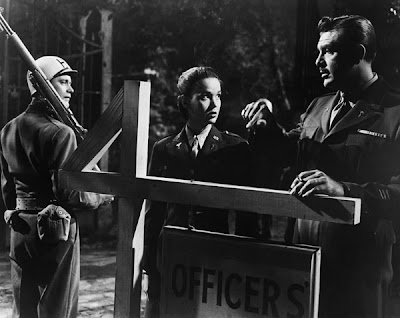
The bulk of the film-- in addition to the cliched subplot of Lemmon trying to woo the beautiful nurse-- consists of him leading the other soldiers in the planning and execution of a celebratory ball in honor of a young man who's shipping off for the pacific and away from his own female lieutenant sweetheart.
Although overall, it's the weakest disc in the set-- the cast and dialogue manage to make it work very well. With a great foil for Lemmon in Ernie Kovacs and nice supporting work by Mickey Rooney, the ensemble comedy makes a nice Saturday afternoon time-waster as we delight in seeing Lemmon play a part that one decade later would've no doubt have been given to his buddy Walter Matthau.
The Notorious Landlady
(1962)
Director: Richard Quine
Writers: Blake Edwards & Larry Gelbart
(Based on a story by Margery Sharp)
(1962)
Director: Richard Quine
Writers: Blake Edwards & Larry Gelbart
(Based on a story by Margery Sharp)
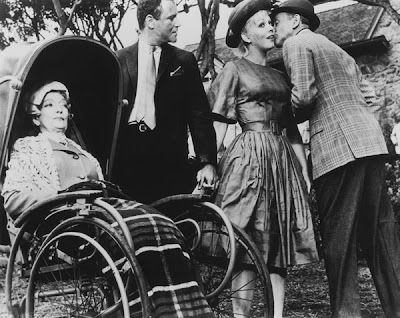
Although he acknowledges that his father would've been thrilled that all of these titles are finally being made available to the public, when I interviewed Chris Lemmon recently, he noted that if he had to choose one, he believed that his father Jack would've been particularly pleased with the debut of The Notorious Landlady.

It's a tremendous achievement by all involved including his great friends Richard Quine (who directed Lemmon for the fifth time in this ingeniously plotted work), Kim Novak (in yet another pairing of the two), and screenwriter Blake Edwards who in the exact same year had directed Lemmon in the wildly different and deeply moving film Days of Wine and Roses.
With a crackerjack script by Edwards who partnered with future M*A*S*H and Tootsie writer Larry Gelbart providing a solid foundation for the cast and crew alike, the movie manages to blend together as many genres as possible as it weaves a tapestry which starts with a seemingly simplistic plot that grows increasingly complicated with every twist and turn.
Notorious Landlady begins quite notoriously indeed as a wicked comedy crossed with gothic tinged noir as Novak's beautiful London resident Carly Hardwicke is suspected of murdering her husband whose body hasn't been found. Unable to rent out a room in her flat because she's under the suspicion of all of Scotland Yard and her nosy neighbors-- and likewise in desperate need of money-- Carly has all but given up on the idea that someone will arrive without knowledge of the possible crime.
However, as an American diplomat just arriving in the country from being stationed in Saudi Arabia, Jack Lemmon's smooth talking Bill Gridley proves to be the ideal candidate for her new tenant. For after catching even the briefest glimpse of Novak's radiant beauty (which can't even be hidden with a scarf or in the black and white photography), he flirts with shameless abandon and tells Carly he'd sign a one hundred year lease.
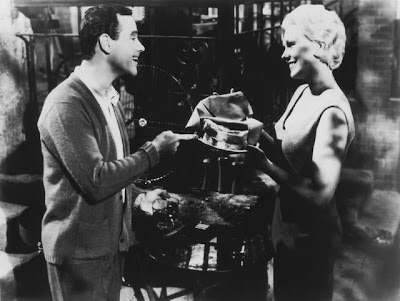
With the two sending off tangible sparks just in their opening moments together onscreen (no doubt augmented by the fact that they'd worked together previously in various projects for Columbia and Novak's serious off-screen romantic relationship with Quine helped solidify their friendship all the more), Gelbart and Edwards' innuendo filled conversational teases and romantic wordplay make it even funnier when Gridley inevitably discovers the truth about Carly's past from his superior Fred Astaire.
Persuaded by Astaire and forced by Scotland Yard not to cause an international incident given Lemmon's pleas that she's so angelic she has to be innocent, they encourage him to get even closer to Carly and report back on all of his findings. Shocked that they're asking him "to be a male Mata Hari," Lemmon initially refuses but is too smitten to stay away and far more worried when Astaire lays down the law that under no circumstances is Novak to realize he's been informed of her past.
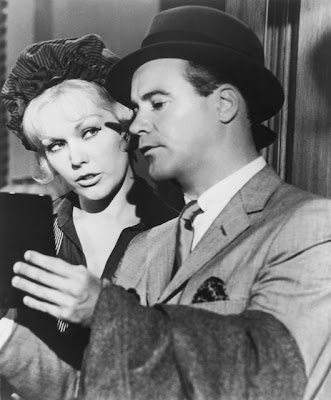
"If she knows I know, I go?" Lemmon's Gridley asks and with the threat that he'll be sent either back to Saudi Arabia or somewhere even more remote if he fails, makes a spectacle out of international diplomacy or America's foreign relations in England, Lemmon grudgingly agrees to Astaire's terms.
And while this alone is the ideal So I Married an Axe Murderer style impetus for a great dark romantic comedy, the filmmakers constantly change genres when a real genuine mystery is revealed including foul play and a courtroom drama (dragged out a bit too long), a blackmail situation with danger, intrigue and more.
Although given its 123 minute running time and especially in a post-crime incident, a lull in the pacing that screeches the fast-paced plot to a grinding halt thereafter, making the second half a bit uneven-- all is forgiven and the entire film is saved by one wondrously choreographed homage to the silent comedies of Harold Lloyd, Charlie Chaplin, and Buster Keaton.
With Novak and Lemmon showing off their natural skills at pratfalls, wordless physical humor, and energy as they run around a Concert By the Sea, chase a wheelchair down a hill and more all in sync with the music-- it's a moment of sheer cinematic joy and among some of Lemmon's best onscreen sequences-- not to mention one that no doubt helped propel Edwards' affinity for silly physical humor he'd use again with Lemmon in The Great Race as well as with Peter Sellers in The Party and The Pink Panther series.
Under the Yum Yum Tree
(1963)
Writer/Director: David Swift
(Based on the play by Lawrence Roman)
(1963)
Writer/Director: David Swift
(Based on the play by Lawrence Roman)
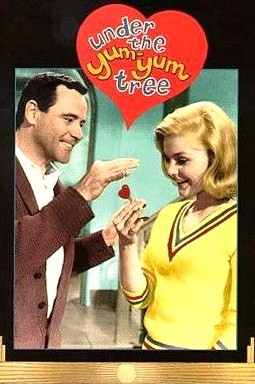
Earlier I mentioned that-- had it been made later-- Lemmon's role in Operation Mad Ball may indeed have been given to Walter Matthau. And in the case of former Pollyanna and The Parent Trap Walt Disney Studios writer/director David Swift's first foray into '60s "sexless" sex comedies with the box office smash Under the Yum Yum Tree-- had playwright Lawrence Roman not originally written it for Jack Lemmon, I think it's safe to say that Lemmon's Some Like it Hot and The Great Race costar Tony Sex and the Single Girl Curtis would've been tapped to play the lecherous landlord in this two-time Golden Globe nominated work.
I mean, when you imagine a kinky peeping tom who only rents apartments to young women whom he plies with stuffed animals and heart shaped keys, the last person you'd imagine going for the role is our beloved "Everyman" Jack Lemmon a.k.a. the individual Chris Lemmon joked in both his book and the set's documentary called himself both "modest" and "America's Sweetheart." However, Jack Lemmon has marvelous fun trying to seduce sweet young things and break up two happy college sweethearts in this dated but entertaining work.
As the Sony Picture Home Entertainment box set's documentary notes, a scheduling conflict prevented Lemmon from taking part in Lawrence Roman's play when it made its run on the stage but he definitely made it up to the playwright by tackling it for the big screen in a film that would become one of the top-grossing pictures of 1963. And likewise it ended up garnering Lemmon one of his record-setting twenty-two Golden Globe nominations he would accumulate over the course of his amazing career.
Essentially you can think of Yum Yum as a male-centric version of a Doris Day or Sandra Dee film but one that goes much further than Pillow Talk, Send Me No Flowers, If a Man Answers, or That Funny Feeling.
In doing so, Swift's film casts the adorable Carol Lynley as the object of Lemmon's latest lust-filled obsession in one of two virginal roles which finds Lynley's Robin and her boyfriend Dave (Dean Jones as the other virgin in a nice gender switch) deciding not to give into holy matrimony just as an excuse or legal permission to have sex. Instead Lynley's Robin makes the choice that they will test their compatibility sans literally sleeping together by ironically "sleeping together" albeit in separate beds in the same apartment as a trial run at cohabitation.
And to this end with a daring idea of two kids shacking up without a certificate from city hall, Swift makes the era's other sexless sex comedies of Day and Dee look downright Disney by comparison. And this is especially the case given Swift's bold choice to move the similarly themed plot-lines of those stars' comical mistaken identity or misunderstanding narratives of loopy l'amour sabotage into the same terrain that Lemmon's other frequent collaborator Billy Wilder mined with his Hot co-star Marilyn Monroe in The Seven Year Itch (in which incidentally Wilder had hoped to cast Lemmon's later on-screen soul mate Walter Matthau).
Now finding Lemmon inside that (Wilder again) Apartment he stood outside of in the Oscar winning classic-- he dons a Hugh Hefner style wardrobe and makes it his mission to try and shag Robin by cleverly getting Dave out of the picture, wearing out the young man by urging him to take out his raging hormones with an endless regime of exercise.
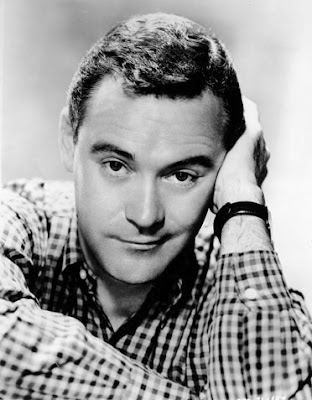
And continuing his lascivious quest Lemmon's described "sneaking, crawling, dirty man" enters the young lovebirds' apartment on any whim with the repeated excuse that he needs to water the (plastic!) plants as well as taking to listening outside their door, trying to peep through windows to further insinuate himself in his hopeful disintegration of their relationship.
While of course there's no question that pure romance will conquer all in the end-- I confess at first the "ick" factor of seeing Lemmon as a sleaze took a little while to adjust to cinematically. Nonetheless the politically incorrect and eerily stalker-esque Yum Yum still remains quite a riot-- if only to catch Lemmon in a truly against-type role as a morally bankrupt leering playboy-- especially in moments wherein you feel like you've broken through that fourth wall and can truly see him visibly loving every minute of playing such a crazy part.
Good Neighbor Sam
(1964)
Director: David Swift
Writers: David Swift, Everett Greenbaum & James Fritzell
(Based on the book by Jack Finney)
(1964)
Director: David Swift
Writers: David Swift, Everett Greenbaum & James Fritzell
(Based on the book by Jack Finney)
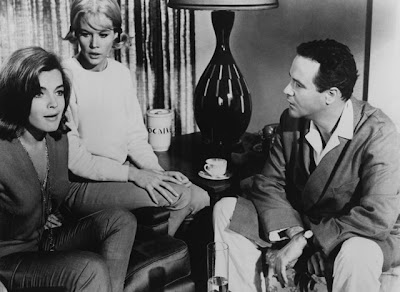
While there's no doubt that the only way that Yum Yum could be made today would be as an eerie thriller, during David Swift's follow-up "sexless" sex comedy with Jack Lemmon the next year in the infinitely lovable Good Neighbor Sam, I couldn't help but wish someone would try and play with this piece again since it's a work of purely comedic Lemmon gold.
Not since I caught director Frank Oz's 2007 gem Death at a Funeral have I been so thoroughly convinced that this work would make one incredible stage production in the same spirit of British bedroom farces including the one utilized to brilliant effect by Peter Bogdanovich in Noises Off.
The set-up alone is priceless as Lemmon's all-American people pleasing suburban husband, father, and routinely overlooked advertising employee (one of the many men in gray flannel suits of the era so to speak) finds himself in two unbelievably strange situations all in the course of twenty-four hours.
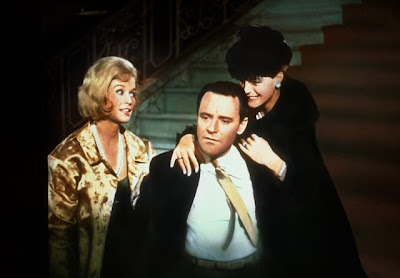
Things start going Sam's way when his company's big time client-- the prudish and pious owner of Nurdlinger's Eggs (a game Edward G. Robinson)-- threatens to leave the firm when he runs background checks on all of the unwholesome men assigned to his account living Mad Men style Don Draper like lives of extramarital sin and pleasure. And much to his surprise, the previously ignored Sam Bissell is suddenly the company's MVP since his life is as clean as his vacuum-like name.
Having been given a major promotion to run the account, Sam rushes home to celebrate with the wife he adores (Lemmon's Great Race co-star Dorothy Provine) only to end up walking in on her best friend Janet (Romy Schneider) taking a shower. Incredibly embarrassed, Sam realizes he'd forgotten that his wife Minerva was picking up the divorced Janet from the airport where she's newly arrived from France to organize her grandfather's estate. Luckily, the trio laugh off the confusion and go out celebrating, only to realize that Sam and Janet are going to have to get a whole lot closer in the future so that Minerva's friend can inherit fifteen million dollars.
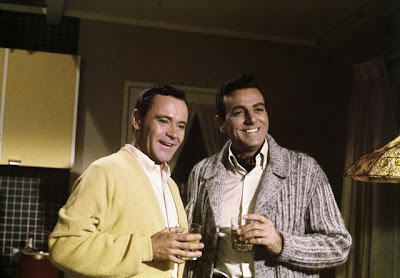
Upon learning that her grandfather left everything to his favorite relative, Janet's thrilled but her happiness dampens considerably when it's revealed that there's a clause attached to the will stating that she has to be married in order to receive it. However, due to a difference in California law, Janet ascertains that she's legally still married yet before she can collect on the money, her unscrupulous and greedy cousins arrive-- mistake Sam for her "husband" and then hire a 'round the clock detective to make sure she's blissfully wed.
Although Sam continually sneaks back and forth between the two houses (as conveniently Janet has rented the newly vacant place next door), further complications arise when Janet is also mistaken for Mrs. Bissell when she drives him to work to ward off the detectives and also when Janet's ex arrives out of the blue and decides that he'll keep up appearances too by staying with Minerva for the time being.
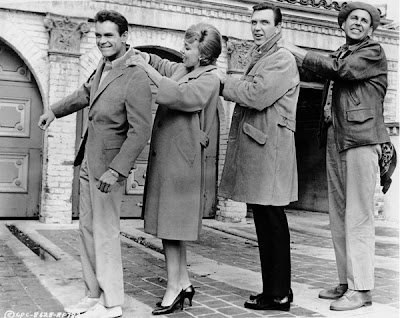
With all the on-the-surface, unintentional swinging happening, Swift's comedy grows incredibly funny as the two real couples and two fake couples get irrationally jealous as well as irrationally close--much to the delight of viewers. Of course, in an era of romantic comedies where deal-making and "pretend you're my fiance" or gimmicky paradigms are commonplace, it may not seem like (to those who have yet to check it out) that Good Neighbor Sam offers anything other than what we're usually presented with at the multiplex. However, it's in the constant raising of the stakes, the delightful twists and admittedly silly yet refreshingly likable quartet of characters who never feel like one of today's interchangeable rom-com "types" that make it well worth your while.
Although like The Notorious Landlady, the whopping 130 minute running time seems a bit excessive for a comedy (even one as complicated as this one) but it's the marriage of great innuendo again with slapstick, sight gags, and terrific supporting players that keep you from growing bored with what could've been a rather incredulous plot.
And in the end it's a pure delight and like Landlady and the TV short Marriageable Male one of the creative and jubilant titles in the collection that makes me recommend picking up The Jack Lemmon Film Collection without hesitation.