Showing posts with label David Morse. Show all posts

4/29/2021

Movie Review: The Virtuoso (2021)


Now Available


As we watch him execute his target at the beginning of the largely lifeless “The Virtuoso,” Anson Mount's unnamed hitman regales us with tongue-twister levels of alliteration. In his clunky voice-over narration, Mount describes the tricks of his trade. This means that for professional killers hoping for pristine, precise hits, it’s of paramount procedure to follow the protocols of planning and position in order to persevere. I'm paraphrasing, of course, but as Mount punches those alliterative words with purpose – undoubtedly trying to make sense of it all – it's hard not to feel like you're getting hit in the face by the “P” key of an old-fashioned typewriter for how often they're used.

Following up one surgically precise assassination with a rushed hit that goes wrong almost as soon as it starts, writer James C. Wolf's “Virtuoso” screenplay loosens up after that. Abandoning the emphasis on “P,” as though one consequence of the botched job was to cause the pages of Wolf's thesaurus to become unstuck, we watch as our virtuoso killer is lured away from his rustic, self-imposed isolation in the woods by his trusted employer (a game yet wasted Anthony Hopkins).

Making a horrifying meal out of a matter-of-fact monologue about the time his character was ordered to slaughter men, women, and children in Vietnam, Hopkins proves why he and he alone is the film's true virtuoso. Dropping in like a veritable hired gun for a few scenes before he presumably goes off to work on grander fare like “The Father,” Hopkins is easily the best thing in this self-important mess of a B-movie.


Sending Mount on a cryptic assignment where the quarry is given a code name like he's The Riddler in a Batman movie, our virtuoso ventures to a country town in the middle of nowhere. After a chance run-in with a few suspicious strangers at a gas station, he suddenly finds himself in a diner full of shady figures he's supposed to covertly assess as potential targets. Forgetting his lofty voice-over protocols of planning and precision, illogically, Mount just starts running the code name past people, quickly becoming the most conspicuous man in town.

One of those films with classic or neo-noir ambitions that at times you think might've been attempting to strive for “Key Largo” or even “Identity” like atmosphere and tension with its ensemble cast of characters in a small setting, the most surprising thing about director Nick Stagliano's muted, muddied “Virtuoso” is just how unsurprising it is from start to finish.

Almost as soon as one particular stranger is introduced, genre conventions tell you precisely where this thing is headed and like its hitman (well, in the first hit anyway) it doesn't deviate from its plan. Saddled with wooden dialogue and zero chemistry between the leads, “The Virtuoso” spends the rest of its 110 minute running time trying to make you believe another twist is coming. Sadly, it doesn't take long to realize that, despite the film's allusions to the contrary, Mount's visibly bored main character is many things but a virtuoso is not one of them.


Hoping to stack the deck, the movie is loaded with terrific character actors like the aforementioned Hopkins as well as Abbie Cornish, Eddie Marsan, and David Morse, some of whom appear for only the briefest of scenes to hopefully follow Hopkins' lead to show up, do the work, collect the paycheck, and get the hell out.

Still, whether it's with its talented cast, the film's few bursts of violence, or its near-bookended, gratuitously clinical depictions of nudity/sex which only call attention to themselves, no matter how hard “The Virtuoso” tries to command our attention, it's impossible to camouflage just how dull it is overall.

Bowing into theaters in some markets (including Phoenix) only five days after Hopkins garnered his second Oscar and four days before it bows onto DVD and Blu-ray, since curiosity over Hopkins' involvement is sure to drive some people to see this on the big screen, the timing of the film couldn't be better. Reinforcing Mount's words about the importance of his many professional “P”'s, what “The Virtuoso” lacks in pristine precision, its marketing team more than makes up for with their plan to persevere with a little help from gold.
 

Text ©2021, Film Intuition, LLC; All Rights Reserved. https://www.filmintuition.com  Unauthorized Reproduction or Publication Elsewhere is Strictly Prohibited and in violation of the Digital Millennium Copyright Act.  Also, as an Amazon Associate, I earn from qualifying purchases made off my site through ad links. FTC Disclosure: Per standard professional practice, I may have received a review copy or screener link of this title to voluntarily decide to evaluate it for my readers, which had no impact whatsoever on whether or not it received a favorable or unfavorable critique. Cookies Notice: This site incorporates tools (including advertiser partners and widgets) that use cookies and may collect some personal information to display ads tailored to you etc. Please be advised that neither Film Intuition nor its site owner has any access to this data beyond general site statistics (geographical region etc.) as your privacy is our main concern.

2/09/2021

A David Morse Reappraisal: Down in the Valley (2005)


Introduction: 

For my latest DVD Netflix actor's spotlight article, I chose five outstanding performances by character actor David Morse. One of the films I analyzed for the piece was this 2005 sleeper but unfortunately, the independent film studio went bust and the DVD is no longer in production or available to rent from Netflix. However, as of this post, "Down in the Valley" is available to stream from a variety of services (check the site/app Just Watch for current details) so I wanted to share this reevaluation of the film here for you today. 


"Down in the Valley"

Writer-director David Jacobson's “Down in the Valley” is as eerily dark yet disarmingly gentle as the potentially dangerous modern-day drifter cowboy Harlan Fairfax Curruthers that Edward Norton plays in the flawed yet fascinating film. A psychologically compelling character-driven contemporary western that plays on the genre archetypes of good and evil, the film focuses on the aimless wanderings of two kids coming-of-age in the San Fernando Valley. 

As a restless teenager on the cusp of womanhood, Tobe (Evan Rachel Wood) spends most of her days with friends or being followed around by her equally bored brother Lonnie (Rory Culkin). A maternal figure standing in for their mother who's out of the picture, in the way that Lonnie gravitates to Tobe, we begin to realize that – although Jacobson barely fills in the details for most of these characters – Wood's Tobe is a girl who has grown up much too quickly. 

 And just like we see in Norton both darkness and light, casting the precocious Wood (who'd first made a splash playing characters thrust into adulthood early), ensures that Jacobson brilliantly uses people as iconography in “Down in the Valley.” 

Ogled by Norton's handsome, much older Harlan as he fills her friend's car with gas, Tobe boldly eyes the stranger back and impulsively invites him to accompany them to the beach. Quitting his job on the spot, he jumps feet first into the ocean and headfirst into a relationship with Tobe. 

Guileless and relatively innocent (at least initially), although it's Harlan who has several years on his new girlfriend, after their first afternoon together quickly escalates into sex, it's surprisingly Harlan who wants to pump the brakes a bit and court her '50s style. Asking her younger brother if it's okay that he dates Tobe, in that moment we sense the “aw, shucks” Jimmy Stewart style nervousness that attracted Tobe to Harlan in the first place. Unfortunately for the kids, however, it takes a man closer to Harlan's age to see right through it. 


An overprotective stepfather to the two children who once again (with his natural “cop's face”) is cast as a man of the law, when Morse's Wade comes home and sees his stepdaughter wearing a dress that the man she's about to leave home with bought her, alarm bells start to go off in his head. Sizing him up but soon backing down, he lets the two go out, which indicates to us that Tobe must be of age (or else he's just that trusting). Things quickly change, however, first when she begins staying out all hours and again when she gets arrested for stealing a horse after former ranch hand Harlan lets himself onto another man's property to “borrow” a white horse and bring Tobe for a joy ride. 

In medieval romantic literature and movie westerns, the chivalrous heroes of the genres are the ones on white horses donning white hats. But even before Jacobson lets us see how white-hatted Harlan spends his days playacting gunfights (with real guns) when Tobe's not around, we start understanding why Wade instinctively knew that when it comes to this cowboy, something is definitely off. Pulled into the melee after the horse's owner (Bruce Dern) calls the cops and tells them that despite Harlan's insistence to the contrary, he's never seen him before in his life, Wade lays down the law that she needs to stop seeing this strange man. 

Soon a standoff develops between the two in the meandering third act when Morse – donning a black hat, clothes, and riding a dark horse as well – forms a posse with others to locate and arrest Harlan for a shocking crime. And the film's genre symbolism truly comes full circle when they wander onto a western movie set. 


Refusing to give us any answers about the drifter's background or mental state as the character of Harlan takes on some De Niro in “Taxi Driver” like properties when he aspires to “rescue” the kids from their domineering stepfather, the film finds its one true moral center in the complex heart of Wade. A cautionary tale about the dangers of fantasy, which – despite offering a sense of escape – can be taken much too far, Morse's Wade is the prickly voice of reason when the kids are charmed and seduced by Harlan. 

Knowing he's too strict with Tobe and frighteningly pushes her away, there's a sense of heartbreak and unease in Wade's behavior throughout the movie. We sense this both when he tells Lonnie not to sleep in his sister's room so much because he wants to toughen the sheltered boy up and also when he struggles to discipline a young woman at her most emotionally and hormonally confusing time. He's ill-equipped for his role as their guardian or single father and he knows it. 

Raising questions about masculinity, which admittedly need additional fleshing out to give Morse more to work with and the audience a better sense of their home life, Jacobson's script weaves in a few key lines of dialogue about Wade that are uttered by the other characters. Wanting to impress and bond with his new friend and sudden role model Harlan, Lonnie describes Wade's background in the service as a war veteran. Showing Harlan Wade's collection of vintage guns that he won't let Lonnie touch until he's at least sixteen, Wade's concern over their deadly intent – even when he draws down on Harlan midway into the movie to scare him off – admirably contradicts the casual, frightening way that Norton's character plays with weapons like they're mere extensions of his hand. 


Like his work in “Dancer in the Dark,” Morse's role in “Down in the Valley” is a relatively small one compared to co-stars Edward Norton and Evan Rachel Wood (whose portrayal of a young woman under the spell of a dangerous older man at a time that she actually was makes it quite harrowing). Still, via Morse, Wade's new stateside war between wanting to protect his stepchildren from potential harm but not drive them away in the process becomes one of the film's most underdeveloped yet subtly moving plotlines. So caught up in Tobe's relationship was I the first two times I saw the film, this reading of Wade only came to me recently in a rewatch. Intriguingly, although he has a fraction of the screen time, Morse's Wade is the one you'll find yourself contemplating much more after it ends, even though he's far less mysterious than Harlan. 

And while the film's insistence to put a bow on the ending as two characters reflect on Norton's troubled cowboy takes something away from “Down in the Valley”'s overall ambiguity, it's a curious film that's elevated by its talented quartet of stars. Likewise, it's one where the innate goodness of Norton and Morse's screen personas in other movies make their work here even richer and more subversive than it is on the page.

Read About 4 More David Morse Films & Performances on DVD Netflix here.


Text ©2021, Film Intuition, LLC; All Rights Reserved. https://www.filmintuition.com  Unauthorized Reproduction or Publication Elsewhere is Strictly Prohibited and in violation of the Digital Millennium Copyright Act.  Also, as an Amazon Associate, I earn from qualifying purchases made off my site through ad links. FTC Disclosure: Per standard professional practice, I may have received a review copy or screener link of this title to voluntarily decide to evaluate it for my readers, which had no impact whatsoever on whether or not it received a favorable or unfavorable critique. Cookies Notice: This site incorporates tools (including advertiser partners and widgets) that use cookies and may collect some personal information to display ads tailored to you etc. Please be advised that neither Film Intuition nor its site owner has any access to this data beyond general site statistics (geographical region etc.) as your privacy is our main concern.

7/10/2009

Movie Review: The Hurt Locker (2009)


Read Film Intuition's Interview With Jeremy Renner


Movie Still Slideshow


Now Available to Own


Delicious
Bookmark this on Delicious
submit to reddit
Print Page

Digg!

MovieBlips: vote it up!


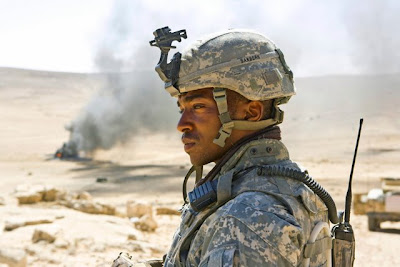
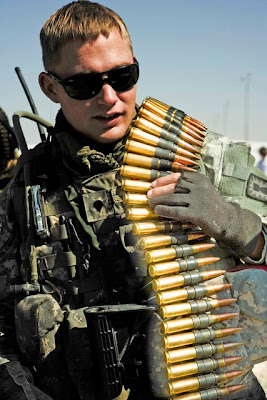
The way that Anthony Mackie describes his character Sergeant J.T. Sanborn in the film The Hurt Locker is that-- given his “seven years in intelligence before joining EOD [Explosive Ordinance Disposal a.k.a. the Bomb Squad]-- he’s a smart, capable, reliable, [and] charismatic guy.” But nonetheless as the “film’s Everyman,” he is likewise one, “who has never encountered a whirlwind like [actor Jeremy Renner’s character] James before.”


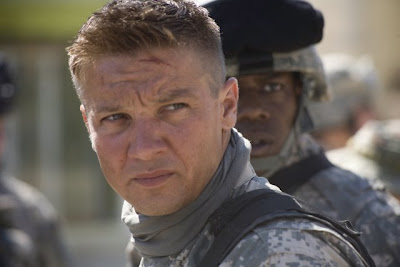
Of course, neither has the audience and it’s likely that both the character of Renner’s Sergeant William James and the actor playing him is one we won’t soon forget. James is an individual-- as I had the sheer pleasure to personally tell Renner-- that's not just a role but one of those great and unspeakably rare Cool Hand Luke parts blended along with what I can only call the mischievous “Kubrick face” of madness and joy.


And he is brought into the film after its harrowing roughly eight minute opener that finds a major movie star and the leader of the EOD’s three man unit dead in a chilling sequence that puts the viewers on the ground with the soldiers. Following the introduction where dialogue is necessarily minimal given the danger of the Iraqi “kill zone," Renner’s Sergeant William James is given a perfunctory introduction when he tells Sanborn that he won’t try to fill the deceased’s shoes but just do the best he can.
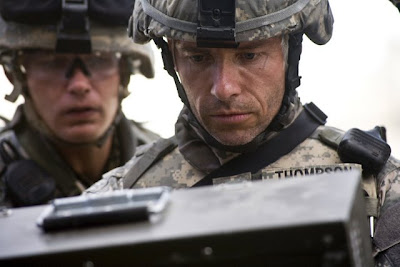


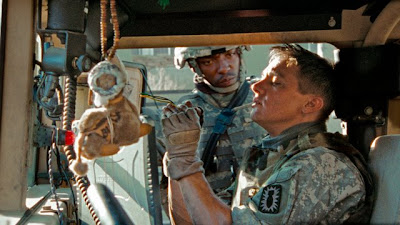
However, his “big moment,” comes when the trio (also consisting of the film’s “heart” in the form of Brian Geraghty’s Eldridge whom director Kathryn Bigelow described as “every mother’s son”) go out on their first routine op. More specifically it occurs when Sanborn and Eldridge test his mettle in the hummer on the way there, noting that “pretty much the bottom line is if you’re in Iraq, you’re dead.” Of course, this is before we discover that James had not only been previously in Afghanistan but has also dismantled 873 bombs before he joined their team.
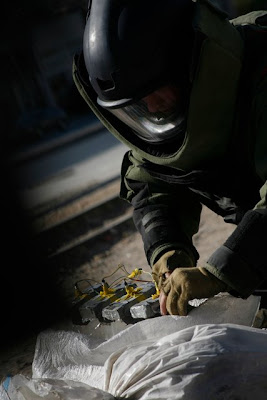


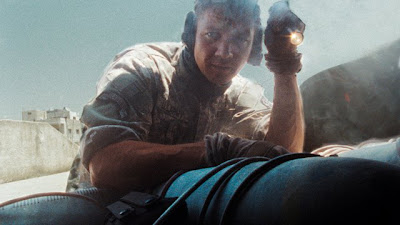
Instead of allowing his second-in-command Sanborn to talk him into sending a “bot” or remote control wagon down to investigate the possible danger, James just goes right down at it like a Wild West cowboy, breaking protocol the first of many times throughout when he uses a smoke canister to create a diversion. Additionally, as opposed to just taking cover, he stands calmly in the middle of the street when an Iraqi cabbie drives full speed past the screaming soldiers, stopping just short of plowing down James.

Drawing out his pistol, firing warning shots first near the car and then through the windshield until he rests the gun solely on the man’s forehead—again without backup until the guy finally does back up, James coolly deadpans into his mic, “well, if he wasn’t an insurgent, he sure the hell is now.”

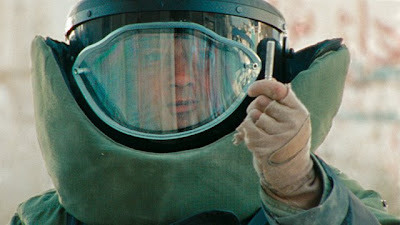
This is all foreplay of course, before he proceeds to just get right down on the ground like a kid playing in a sandbox, stroking the bombs with fetishistic pleasure, appreciating the artistry so much that he keeps the parts of some of the things that almost kill him (along with his wedding ring and a photo of his son) under his bed.

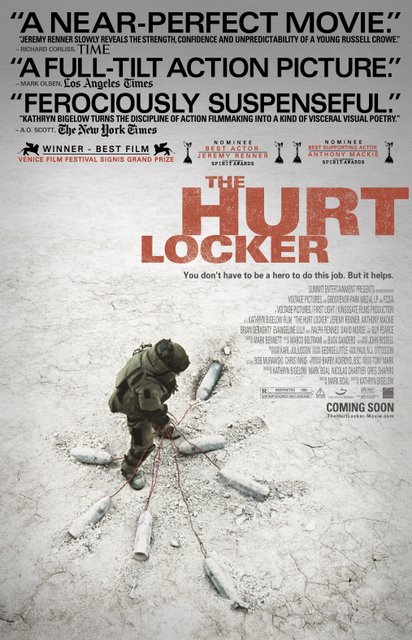
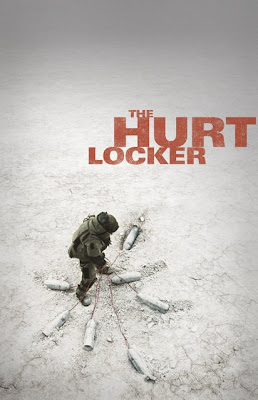
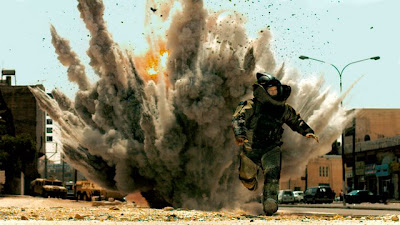
Taking care of the threat and informing Sanborn that “we’re good to go”—soon, just like the way the opening of the film suddenly changed in an instant with the previously unseen bystander who evolved into “dude’s got a phone,” James finds another wire that leads him to an endless string of IEDs that became the film’s incredibly eerie poster image.


While he handles that threat, sure enough we do see another “dude with a phone” make a break for it out of his eye-line. And in what is easily the best film of the year so far and the best war film I’ve seen in several years—this is just one of countless obstacles, explosions, gunfire, and complications that the trio’s Bravo company experiences in Bigelow’s fittingly “experiential” film during the 38 days they have left in rotation before they can finally return home.

Still, the fact that remains—although nothing detonated that day (and in fact the title comes from the soldiers’ own description of Mark Boal’s time spent with a special bomb unit who described the impact of explosions as putting yourself “in the hurt locker” as the production notes reveal), Sergeant James’s handling of the situation is anything but by-the-book and it becomes a bone of contention between him and Sanborn.


Essentially the personification of the quote that opens the film that “war is a drug"-- James is one of the most psychologically fascinating characters to be found in a war film since Platoon, Full Metal Jacket, and Apocalypse Now (incidentally three films Bigelow cites throughout Nick Dawson’s must-read article in Filmmaker Magazine’s Spring 2009 issue).


And this is all the more confounding because you can’t write him off as a simple thrill junkie, nor as Mackie angrily charges after a dangerous display of swaggering bravado “a redneck piece of trailer trash,” since he does what very few people in the world would be able to do. Yet he dismisses it to a falling-all-over-himself complimentary superior (David Morse) as attempting to do so “the way you don’t die, sir.”
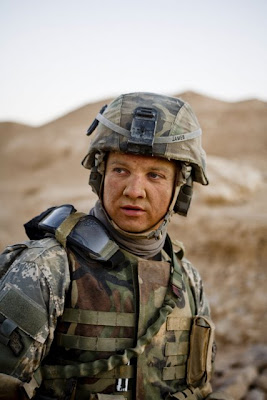


As a former Ranger with such an impressive record of doing it “the way you don’t die," James also in another dynamite sequence throws not only his 100 pound suit off but his headset and link to Sanborn in order to concentrate on a highly elaborate bomb wired into a car at a UN building—having decided that if he’s going to die, he’ll at least "die comfortably" and without the excess gear. And in moments such as these, you’re able to understand the psyche the job requires. For because the soldiers have developed split second, flip a switch, left or right, yes or no decisions--when they’re away from the kill zone, they’re never fully at ease or able to feel that desperately alive at-- say-- the grocery store.


Yet it's all part of the daily routine working in a field that originated in World War II which found US and British soldiers collaborating in tandem to make pencil diagrams of time-delayed explosive devices which they tried to dismantle with commonplace tools. And in Locker, Bigelow and the journalist turned screenwriter Mark Boal-- who also turned his experiences into another psychological exploration of after-effects with the Tommy Lee Jones' Oscar nominated effort In the Valley of Elah-- educate us about what it takes to walk towards bombs when everyone else walks away.


As I discovered in the thorough and informative notes provided by Summit Entertainment—EOD soldiers are so rare, specialized, and in such a dangerous field that the technicians were not only “five times more likely to die than all other soldiers” and relationship difficulties are so mainstream that an in-joke is that EOD also means “every one divorced” but “the insurgency reportedly placed a $25,000 bounty on the heads of EOD techs.”


Of course, while stateside citizens dial 911 to report suspicious activity—whenever military personnel is both unfortunate enough to find an insurgent-made IED yet fortunate enough not to be one of the casualties from the opposition’s deadliest weapon of choice, EOD takes the call. And as Mark Boal notes, “sometimes [this occurs up to] 10 or 20 times a day… and the bomb squad has to deal with it while everyone else in the military pulls back.”


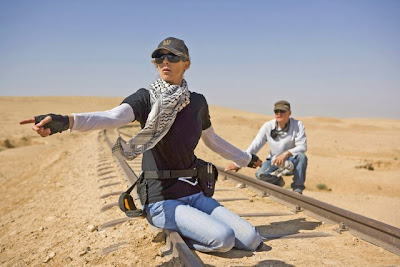
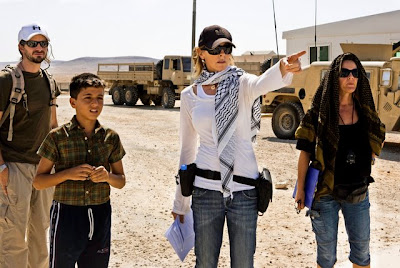
“The fact that these men live in mortal danger every day make their lives inherently tense, iconic and cinematic and on a metaphorical level, they seemed to suggest both the heroism and the futility of the war,” as Bigelow explains. And by using her trademark multiple camera set-up and visual arts background (Point Break, Strange Days) to keep the actors on their toes in long takes with 4 cameras constantly moving and out of sight-- like the ninjas that Renner likened them to since he never knew where they were during the 44 day shoot in Jordan-- Bigelow brings the audience into the EOD unit.


Easily described as a docudrama but also one that Boal likened to naturalism or “true fiction,” by avoiding trendy rapid video-game style cuts or abrupt changes in orientation since Bigelow proves her belief from the powerful beginning that “it’s really important to never let the audience lose a sense of geography,” she takes great pains to “draw them further and further into this vortex of information,” (Filmmaker, pg. 37).


And this is precisely why the film was honored with the SIGNIS and Human Rights Film Award at the Venice Film Festival since as they noted it “avoids dry ideology” and offers “an uncompromising approach to the Iraq war and its consequences seen through the experience [of the EOD]…for whom war is an addiction rather than a cause." And by doing so, “Kathryn Bigelow challenges the audiences view of war in general and the current war in particular [by] demonstrating the struggle between violence to the body and psychological alienation.”


So instead of an overt message movie, Bigelow was more fascinated by telling a simple and engrossing story about the war from the point-of-view of a handful of soldiers we come to know much better than in traditional war pictures where we can only tell them apart because of the names on their helmets or the high profile actors playing them because this time we’re in it completely along with them.


For, as she told Filmmaker’s Nick Dawson, “literature can be reflective, but film can be experiential,” and she loves it when both the mediums of photography (which was given a powerful boost by the amazingly gifted Bourne Supremacy, Bourne Ultimatum, and United 93 cinematographer Barry Ackroyd) and cinema can do just that as, “the gift of traveling you from [here] to… wherever” is what drives her (37).


Although The Hurt Locker had the misfortune of following the box office disasters of countless Iraq-themed pictures which made funding and distribution an incredible uphill climb for Bigelow and those involved, additionally it gave her unprecedented creative freedom of not being tied to “yes men” or studio execs. And the film, which marks the director’s return to feature filmmaking for the first time since 2002's K-19: The Widowmaker is the best example of her own unique brand of experiential moviemaking and moreover, her strongest work so far.


Yet throughout the process of planning the film out so precisely that “the directing, script, camera work, music, editing—was conceived from the beginning with the single goal of creating that heightened sense of realism that underscores the tension,” she’s completely correct in stating that ultimately the film doesn’t allow itself to be too “cinematic” so that it takes away from the complexities of the characters.


I, for one have not been able to stop thinking about the soldiers of Locker for weeks. Moreover I believe that not only will it stay ingrained in your memory long after the movie ends but it will haunt you the way that excellent cinema should by going off the screen and into your life, filling the air of your conversations with others as you realize that similar to Mackie’s warning-- nothing has ever prepared you “for a whirlwind like” Renner’s James or The Hurt Locker style of genre-busting war film before.


Text ©2009, Film Intuition, LLC; All Rights Reserved. http://www.filmintuition.com
Unauthorized Reproduction or Publication Elsewhere is Strictly Prohibited.

2/04/2007

Down in the Valley

Note: Read a new in-depth reappraisal of the film, written in 2021 here.


Director: David Jacobson

Drawing from his own youth spent with his sister in California’s lonely San Fernando Valley in the 60’s and 70’s, writer/director David Jacobson takes a twisted and fantastical approach to the classic western genre by infusing his screenplay with the overwhelming psychological air of modern isolation and subsequent quest for escapism in contemporary society. Evan Rachel Wood, the startlingly talented young actress from Thirteen, is excellent and understated as Tobe, a seventeen year old girl who lives with her equally lost thirteen year old brother (Rory Culkin) and surrogate father David Morse, their police officer guardian. When faced with the boredom of Spring Break, Tobe impulsively sets her sights on the peculiarly charming cowboy drifter Harlan Fairfax Carruthers, played by the film’s co-producer Edward Norton in one of his best roles since Fight Club and American History X. While initially Harlan provides a fun diversion and adventurous escape for Tobe and her brother, soon they realize that his out-of-time persona and possibly delusional fantasies have crossed the line from amusing to dangerous as he gets more obsessive and frightening. Norton channels this remarkably beginning the film as a sort of innocently polite Jimmy Stewart-like cowboy who, as the film continues, morphs subtly into Taxi Driver’s Travis Bickle or even Robert Mitchum in Night of the Hunter. This beautifully photographed, fully realized character piece is moody, atmospheric and true, cutting right to the bone. Down in the Valley is a riveting depiction of the angst and isolation of growing up and while it does get overly long in the rambling last forty-five minutes, the film feels like a product of the 70’s era that inspired Jacobson in that character and psychological motivation are what keeps us in our seats instead of flashy computer generated effects. In the words of Edward Norton, who appears in a fascinating interview with Jacobson on the film’s DVD, the only reason to evoke the mythical genre of the western once again is if you as an audience member can relate to the story and in Down in the Valley, they’ve definitely succeeded.