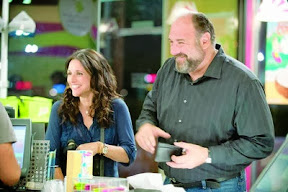
As true in 2014 as it was when when Flannery O’Connor warned us more than sixty years ago in her Southern Gothic short-story shocker turned single woman battle cry that “A Good Man Is Hard to Find,” if O’Connor were still around today, she might just as well write a sequel noting that in the social media age, a good friend is equally hard to find.
With this truism lurking somewhere in the background of the mind of the divorced Eva (Julia Louis-Dreyfus) as she once again tags along to a party as the third amigo to her married friends Sarah (Toni Collette) and Will (Ben Falcone), the beautiful masseuse is stunned to find two potential new strangers who each might fill the aforementioned roles in the exact same night.
While initially hired by the impressive poet Marianne (Catherine Keener) to massage her aching neck, the two form an easy friendship, bonding over stories of their exes which the neat-freak Marianne is all too eager to share in the form of a laundry list of complaints about her disappointing, overweight ex-husband.
Yet as Marianne’s complaints about her past escalate, Eva’s future romantic prospects change for the better when she begins to date the charming, likeminded TV cultural librarian Albert (the late, amazingly great James Gandolfini).
Though initially uncertain if she feels any attraction towards a man who may not match up with her ideal vision of a mate, Eva is understandably drawn to Albert’s laid-back conversational ease, gentle flirtation and quick sense of humor.
Experiencing that enviable feeling on their first date “like we were old friends already,” Eva grows more attracted to Albert, only to find her initial impressions of the man second-guessed by the alarming realization that he is precisely the “clumsy in bed… sloppy” ex-husband that Marianne is always ranting about.
Caught between her own respect for the new, accomplished friend whose taste and lifestyle she’s completely in awe of and her budding feelings of what might very well be love with Albert, Eva retreats into her own mind, encouraging Marianne to share more with each passing day and then evaluating the information during her time with Albert.
Trapped in a cruel science experiment, while in anyone else’s hands Eva would be considered unconscionably selfish or twisted, in the deft portrayal of Louis-Dreyfus whose inexperience as a dramatic actor is augmented by writer/director Nicole Holofcener’s incredibly articulate, sensitive script, we understand her dilemma from both sides even when we don’t understand why she just doesn’t trust her heart right from the start.
Yet at the same time, we appreciate the complexity of the situation from the point-of-view of a woman who is in an emotionally vulnerable place – not only due to a past divorce but also because her daughter/best friend will soon be leaving her for college and she’s bracing herself for how much heartbreak she can handle.
And even though we hold our breath and hope for the best, we know that there won’t be any shortcuts in her future as whatever way the relationships play out, eventually someone is going to learn the truth and get hurt. Likewise, we respect Holofcener’s ability to let events unfold naturally, without big pop-song fueled emotional breakthroughs that occur during a montage sequence or a lot of unnecessary speechmaking.
In what is easily one of the filmmaker’s strongest works (and that’s saying something as it comes directly off the heels of her previous masterwork Please Give), we’re treated to one of the year’s best and most mature treatments of grown up romantic love that can stand right alongside Richard Linklater’s Before Midnight and Joe Swanberg’s Drinking Buddies.
While admittedly it is a bittersweet success as James Gandolfini finally got the chance to show a sensitive, sweet, sexy side of himself that was always shut away during his typecast Sopranos era, for one of his final works Enough Said is a fitting way for him to be remembered. Additionally, his portrayal of Albert in Holofcener's film makes for a great last half of a Gandolfini Double Feature to go along with his recent turn in David Chase's Not Fade Away as well.
And although his absence is certainly felt in some of the special featurettes included on Fox’s gorgeously transferred Blu-ray disc, thankfully now that this work has been released complete with an Ultraviolet High Definition digital copy of the film, he won’t fade away from memory in this – one of his most watchable performances.
A nice change of pace for Keener as well, who has starred in every single one of Holofcener’s films and usually plays the filmmaker’s alter-ego, Enough Said lets her use her intimidating beauty and confidence to brilliant effect, illuminating the complexities of co-dependency, peer pressure and power struggles that occur in female relationships of all ages.
Nominated for multiple honors this award season, while Enough may not stand a chance opposite some of Hollywood’s biggest studio-backed heavy hitters in snagging an Oscar, it’s a shoo-in to steal your heart. Just be sure to seek it out as Enough Said proves that good films – just like good men and good friends – certainly do exist and even though they’re hard to find, when you do, they’re well worth your time.
With American Beauty, Road to Perdition, Jarhead, Revolutionary Road and now Away We Go, British director Sam Mendes has repeatedly proven his knack and keen desire to explore life for those living in these United States regardless of the decade, genre or if in fact a majority of it is even set within its boundaries (Jarhead).
And it's often been said that part of Mendes' success with American work is in his ability to approach things as an outsider which was precisely the same hook that finally enticed fellow British director Joe Wright (Atonement, Pride and Prejudice) to journey to La La Land for his American debut, The Soloist.
Hesitant to film in a country wherein he curiously notes on this Blu-ray release that he feels he has less of an understanding of it the more time he spends in the United States-- finally he realized that much like Mendes' sense of being an outsider in this enviornment, he could instantly relate to the fellow outsiders he'd be filming in the form of characters Steve Lopez and Nathaniel Ayers.
And his passion for the project extended to the filmmaking process as he further revealed the fact that Wright would only make the film on the condition that he would be working with the homeless citizens of Los Angeles who reside in and around Lamp and Skid Row as he shares in one of the many extras included on the disc.
Obviously, since this was an unprecedented experiment since real lives would be affected in a biopic that was now teetering on the verge of a docudrama, this proved to be a challenge not just to both DreamWorks and Universal but the organizations located in the area as well since the results of such an experience would be uncertain.
However, eventually everyone agreed and Joe Wright embarked on a filmmaking experience that couldn't have had less in common with Atonement, despite the fact that themes of Pride and Prejudice seem to emanate throughout. Since I was fortunate enough to have reviewed the film in time for its theatrical release, I'll republish my original review below and go into the Blu-ray analysis and technical details in Part III.
Similar to the old adage that there’s no “I” in team—most reporters will tell you that there should be no “I” when it comes to covering the news. However, this rule is immediately overlooked for those not working via the inverted pyramid style lead-heavy cover stories of the A & B sections. For, as once we venture into the realm of columnists and feature writing-- part of the charm of a solid article is a writer’s ability to interject their own personality into a piece to add a unique flavor to slice-of-life vignettes.
It’s when the writer has to negotiate the balance of understanding that on a cynical level you may be exploiting another to sell papers and earn a heavily read byline and where your responsibility lies to a fellow human being that makes this an ethical gray area for journalists. And of course, this dichotomy is made doubly complex when one’s subject is physically and/or mentally disabled and one isn’t quite sure whether or not they actually have “permission” to begin writing about a person who seems lost in his own world.
Such is the case of British filmmaker Joe Wright’s first American film, The Soloist, which finds the award-winning Pride and Prejudice and Atonement director leaving his homeland to-- as he explained-- blend “Hollywood and British realism together,” for a piece “that might benefit from his distinctly outsider’s point of view.”
The film, which centers on two very different outsiders in its unique approach of a male friendship love story benefits from the dedication shown for the material via Erin Brockovich screenwriter Susannah Grant’s adaptation of Los Angeles Times columnist Steve Lopez’s feature articles that began in the spring of 2005 about a homeless, schizophrenic, exceedingly talented Julliard trained musician.
The Soloist-- which stars Robert Downey Jr. fresh off his 2008 blockbuster run as Iron Man and the all-time method actor in Ben Stiller’s Tropic Thunder as Lopez-- manages to engage us in an action oriented beginning wherein he’s injured in a bike accident and told he is going to be disoriented for four to six weeks.
However, Grant (or perhaps the film’s editor) inexplicably drops the thread of this great set-up and lead-in to Lopez’s first encounter with Jamie Foxx’s Nathaniel Anthony Ayers that-- handled a bit more directly-- may have helped give us a better sense of who these two men truly are and why they connect.
Instead of implying that perhaps they may have bonded precisely because they may have shared a similar sense of being a bit out-of-sync with the Los Angeles surroundings-- as depicted, Lopez’s character simply appears as though he’s just fishing for a story idea by any means necessary.
Thus, essentially starting the film twice with two introductions to our lead character and still a bit confused about his true personality-- the compelling “initial opening” feels like a first draft that gets discarded when the “new one” takes over. This kicks off as Lopez finds himself drawn to the charismatic but rambling, manic, mile-a-minute soloist currently spending his time on the streets of Skid Row, passionately serenading the environment and the wondrous statue of his idol, Ludwig Van Beethoven with his badly worn two-stringed violin.
When Lopez discovers that Ayers’ story checks out and he did indeed study at Julliard—the reporter in him takes over and as the positive reader response pours in with endless e-mails, Lopez continues to seek out Ayers learning that he’s moved locations to now performing in a busy Los Angeles tunnel as cars fly by.
With the gift of a cello sent in by a caring reader, Lopez takes it upon himself to at least attempt to get Ayers back onto his feet—as much as he can anyway—by encouraging him to stay at the Lamp Community, which is an “advocacy group that offers nearly 200 private apartments for the homeless.”
Frustrated by the potential of the undeniably gifted musician and the possibility that all it could take to set him back on the path to life as a professional musician is the right psychiatric medication, Lopez tries to morally and ethically rationalize just how involved he should get with the man who begins as simply his subject but becomes a true friend as the story continues.
It's a rare glimpse into a community that Wright cites as the reason he made the film—namely Los Angeles’ Skid Row. Describing them as a group of “people [who] are the most disenfranchised people in American society and don’t generally have a voice,” Wright takes great pains to take a movie he initially envisioned as one that was stylistically influenced by John Schlesinger’s Midnight Cowboy in its gritty depiction of honest male friendship into something that later he ended up blending with the social reality of Italian neorealism and docudrama.
All in all, it's an intense work that boasts predictably excellent turns by its leads especially Jamie Foxx. Still, more often than not, the well-intentioned and big-hearted film falters throughout with some scenes that feel as though they are figuratively hitting you over the head as “message” moments as opposed to the more seemingly natural situations utilized in Mike Binder’s fictitious yet far more authentic work Reign Over Me starring Don Cheadle and Adam Sandler.
And while these failures of over-wrought sequences in The Soloist are possibly again the fault of the editing process as it ultimately abandons subtlety in favor of driving its very valid but extremely repetitive and—ironically-- exploitative points home, an unhealthy portion seems far too forced. For in certain instances, even an enormous talent such as the one possessed by Downey appears as though he’s just hitting his marks a few times by angrily shouting or kicking something to try and emphasize just how much he cares.
Despite this—the cinematography by Wright’s Oscar nominated Atonement lensman Seamus McGarvey which was painstakingly storyboarded and captured via 35mm anamorphic format to give The Soloist as McGarvey explains “an even stronger sense of veracity,” is a standout as we’re swept away by the dazzling bird’s eye view shots of the city of isolated Los Angeles residents.
While aside from one Disney Hall sequence ruined by setting Beethoven’s third symphony to a near parade of colorful flashing lights straight out of Kubrick’s 2001: A Space Odyssey—it’s the visuals that leave us breathless as well as the strong sense of music that fills every scene from not only the classical sources but also from the Oscar winning Atonement composer Dario Marianelli.
Last week, the film was listed as one of the four most recent recipients of Heartland’s Truly Moving Picture Awards. And while the uneven Soloist is filled with the positive message of the importance of human connection, compassion and friendship, it’s also one in which thankfully Grant—taking a cue from Lopez’s writing from both the column and his subsequent book—attributes the relationship as having benefits for both the journalist and the musician.
And although it’s hard to fault Joe Wright’s admirable intention to bring the devastating problem of homelessness in Los Angeles to attention—more often than not, the Skid Row sequences overpower the plight of Lopez and Ayers. Thereby, it throws the narrative off balance and indicates that Wright was really trying to squeeze two different films into one and the humanistic tale of two unlikely friends is the one that ultimately suffers, which may have been why this film’s release date was continually pushed back from the fall of 2008 until its eventual debut in spring of 2009.
However, one benefit is—considering a few of the artistic liberties taken with the facts and the reminder given the film’s flawed structure that the columns were all jumbled together for dramatic effect—in the end Wright and Grant do manage to call much needed attention to the dying newspaper industry.
Therefore, despite the fact that contrary to the true art-form of feature writing, the “I” and the “reporting” get jumbled together in this big screen version of Lopez’s articles—the filmmakers of The Soloist succeed mightily in making those of us still left with unanswered questions want to read Lopez’s original columns either through the L.A. Times or captured in book form.
III. Blu-ray Review
While I've struggled with the sound balance on a few previous DreamWorks releases despite their unparalleled clarity, this release from not just DreamWorks but Universal, StudioCanal and Participant manages to excel in both technical areas, no doubt realizing that since music is such an integral part of the work, it would be under the closest scrutiny for those pursuing the film on Blu-ray.
As he cited that Midnight Cowboy was an influence, some of Seamus McGarvey's cinematography is purposely filmed grainy and docu-style in the Lamp and Skid Row scenes but the sweeping crane shots still soar even on the small screen. Their usage is not just for beauty's sake however but purposely illustrating as those involved note-- the not-too-far divide between the haves and the have-nots since Disney Hall is that close to a place where people are residing for whom wishes upon stars haven't managed to come true.
It's evident that almost like a community organization or volunteer experience, it was Wright's purpose all along to train and work with the residents in the area and collaborate with local leaders of centers for rehabilitation by having them as involved in the creation of the film as possible.
Providing them with skills and training to contribute as extras and help the process, they created what is overall an admirable message movie but one that again sometimes teeters over the brink from exposing the issue to exploiting it both in the feature and in a few comments made in the extras.
And unfortunately, there's yet another cringe-worthy politically incorrect slip-of-the-tongue when Downey Jr. praises his co-star. Although you can initially write it off as an extension of his Tropic Thunder character who lectured Ben Stiller for trying to play a disabled character to win an Oscar, when Downey raves about Foxx and says that he won't name names but he's "seen crazy done wrong" and shares that you don't want to mess with "crazy" since it means as an actor "you suck" you want to reach into frame and remind him he's not on Tropic Thunder anymore and may want to stay on script about the term schizophrenia. Still, as a Downey fan and realizing he worked on so many movies last year that I know he probably didn't mean it in the bullying sense of those who'd tormented the real Ayers, it's easily forgiven but it does stand out on a disc filled with acceptance and open-armed support of the mentally ill and homeless.
One of the strongest extras included on the disc was a featurette interview with the real Steve Lopez and Nathaniel Ayers whom we're thrilled to discover are still not only good friends but both fondly recall their experiences together. Additionally, it offers commentary from the director, deleted scenes and two important extras regarding the issue of homelessness including the short film "Beth's Story."
Yet the sole Blu-ray exclusive is a worthwhile albeit extremely brief salute to Julliard and the importance of arts institutions to continue to exist which can no doubt double as a great political ad and call to help raise funds for the schools that provide an outlet for those like Ayers who would never have managed to flourish or function nearly as well without creativity or music.
Similar to the old adage that there’s no “I” in team—most reporters will tell you that there should be no “I” when it comes to covering the news. However, this rule is immediately overlooked for those not working via the inverted pyramid style lead-heavy cover stories of the A & B sections. For, as once we venture into the realm of columnists and feature writing-- part of the charm of a solid article is a writer’s ability to interject their own personality into a piece to add a unique flavor to slice-of-life vignettes.
It’s when the writer has to negotiate the balance of understanding that on a cynical level you may be exploiting another to sell papers and earn a heavily read byline and where your responsibility lies to a fellow human being that makes this an ethical gray area for journalists. And of course, this dichotomy is made doubly complex when one’s subject is physically and/or mentally disabled and one isn’t quite sure whether or not they actually have “permission” to begin writing about a person who seems lost in his own world.
Such is the case of British filmmaker Joe Wright’s first American film, The Soloist, which finds the award-winning Pride and Prejudice and Atonement director leaving his homeland to-- as he explained-- blend “Hollywood and British realism together,” for a piece “that might benefit from his distinctly outsider’s point of view.”
The film, which centers on two very different outsiders in its unique approach of a male friendship love story benefits from the dedication shown for the material via Erin Brockovich screenwriter Susannah Grant’s adaptation of Los Angeles Times columnist Steve Lopez’s feature articles that began in the spring of 2005 about a homeless, schizophrenic, exceedingly talented Julliard trained musician.
The Soloist-- which stars Robert Downey Jr. fresh off his 2008 blockbuster run as Iron Man and the all-time method actor in Ben Stiller’s Tropic Thunder as Lopez-- manages to engage us in an action oriented beginning wherein he’s injured in a bike accident and told he is going to be disoriented for four to six weeks.
However, Grant (or perhaps the film’s editor) inexplicably drops the thread of this great set-up and lead-in to Lopez’s first encounter with Jamie Foxx’s Nathaniel Anthony Ayers that-- handled a bit more directly-- may have helped give us a better sense of who these two men truly are. Instead of implying that perhaps they may have bonded precisely because they may have shared a similar sense of being a bit out-of-sync with the Los Angeles surroundings-- as depicted, Lopez’s character simply appears as though he’s just fishing for a story idea by any means necessary.
Thus, essentially starting the film twice with two introductions to our lead character and still a bit confused about his true personality-- the compelling “initial opening” feels like a first draft that gets discarded when the “new one” takes over. This kicks off as Lopez finds himself drawn to the charismatic but rambling, manic, mile-a-minute soloist currently spending his time on the streets of Skid Row, passionately serenading the environment and the wondrous statue of his idol, Ludwig Van Beethoven with his badly worn two-stringed violin.
When Lopez discovers that Ayers’ story checks out and he did indeed study at Julliard—the reporter in him takes over and as the positive reader response pours in with endless e-mails, Lopez continues to seek out Ayers learning that he’s moved locations to now performing in a busy Los Angeles tunnel as cars fly by.
With the gift of a cello sent in by a caring reader, Lopez takes it upon himself to at least attempt to get Ayers back onto his feet—as much as he can anyway—by encouraging him to stay at the Lamp Community, which is an “advocacy group that offers nearly 200 private apartments for the homeless.”
Frustrated by the potential of the undeniably gifted musician and the possibility that all it could take to set him back on the path to life as a professional musician is the right psychiatric medication, Lopez tries to morally and ethically rationalize just how involved he should get with the man who begins as simply his subject but becomes a true friend as the story continues.
A rare glimpse into a community that Wright cites as the reason he made the film—namely Los Angeles’ Skid Row—which he describes as a group of “people [who] are the most disenfranchised people in American society and don’t generally have a voice,” Wright takes great pains to take a movie he initially envisioned as one that was stylistically influenced by John Schlesinger’s Midnight Cowboy in its gritty depiction of honest male friendship into something that later he ended up blending with the social reality of Italian neorealism and docudrama.
All in all, it's an intense work that boasts predictably excellent turns by its leads especially Jamie Foxx. Still, more often than not, the well-intentioned and big-hearted film falters throughout with some scenes that feel as though they are figuratively hitting you over the head as “message” moments as opposed to the more seemingly natural situations utilized in Mike Binder’s fictitious yet far more authentic work Reign Over Me starring Don Cheadle and Adam Sandler.
And while these failures of over-wrought sequences in The Soloist are possibly again the fault of the editing process as it ultimately abandons subtlety in favor of driving its very valid but extremely repetitive and—ironically-- exploitative points home, an unhealthy portion seems far too forced. For in certain instances, even a talent such as Downey appears as though he’s just hitting his marks a few times by angrily shouting or kicking something to show just how much he cares.
Despite this—the cinematography by Wright’s Oscar nominated Atonement lensman Seamus McGarvey which was painstakingly storyboarded and captured via 35mm anamorphic format to give The Soloist as McGarvey explains “an even stronger sense of veracity,” is a standout as we’re swept away by the dazzling bird’s eye view shots of the city of isolated Los Angeles residents.
While aside from one Disney Hall sequence ruined by setting Beethoven’s third symphony to a near parade of colorful flashing lights straight out of Kubrick’s 2001: A Space Odyssey—it’s the visuals that leave us breathless as well as the strong sense of music that fills every scene from not only the classical sources but also from the Oscar winning Atonement composer Dario Marianelli.
Last week, it was listed as one of the four most recent recipients of Heartland’s Truly Moving Picture Awards, while the uneven Soloist is filled with the positive message of the importance of human connection, compassion and friendship, it’s also one in which thankfully Grant—taking a cue from Lopez’s writing from both the column and his subsequent book—attributes the relationship as having benefits for both the journalist and the musician.
And although it’s hard to fault Joe Wright’s admirable intention to bring the devastating problem of homelessness in Los Angeles to attention—more often than not, the Skid Row sequences overpower the plight of Lopez and Ayers, throwing the narrative off balance and indicating that Wright was really trying to squeeze two different films into one and the humanistic tale of two unlikely friends is the one that ultimately suffers, which may have been why this film’s release date was continually pushed back from the fall of 2008.
However, one benefit is—considering a few of the artistic liberties taken with the facts and the reminder given the film’s flawed structure that the columns were all jumbled together for dramatic effect—in the end Wright and Grant do manage to call much needed attention to the dying newspaper industry.
Therefore, despite the fact that contrary to the true art-form of feature writing, the “I” and the “reporting” get jumbled together in this big screen version of Lopez’s articles—the filmmakers of The Soloist succeed mightily in making those of us still left with unanswered questions want to read Lopez’s original columns either through the L.A. Times or captured in book form.
Admittedly, the shooting of a dog in No Country for Old Men may have added to the brutal ambiance needed for the Coen Brother's allegorical depiction of a country that's "hard on people," in earning it the Academy Award for Best Picture. However, when it comes to mainstream cinema, putting two in the chest of a beloved family pet is hardly the way to win people over at a test screening. Hollywood producer Ben (Robert De Niro) learns this lesson the hard way in fake Technicolor blood as he watches his latest edgy film Fiercely-- directed by a British nail-polish wearing ticking temper-tantrum time bomb Jeremy (Michael Wincott) -- send audience members either fleeing for the exits or leaving scathing notes on his comment cards ranging from "my wife is still crying" to the one-worded question, "why?"
While Jeremy is just one of several characters in director Barry Levinson's hilarious adaptation of screewnwriter Art Linson's fictionalized and far more satirical version of his bestselling 2002 insider memoir who pleads "artistic integrity" the way most mobsters take the fifth in court, the bottom line is changes need to be made or the film will not only lose millions, further jeopardize Ben's dwindling "power credentials" but possibly end careers as well. Putting it bluntly, Catherine Keener's two-faced cutthroat studio executive Lou (another one of her fascinating creations reminiscent of her ball-breaking turn in Being John Malkovich), demands that either both Jeremy and Ben makes the changes or she'll take away the film and cut it herself. Although Jeremy is sent into hysterics and Ben's wise, young assistant is kicked out of the room when she suggests that the film's edge could've been the reason its star Sean Penn (appearing in the film as himself) signed on, Ben knows it is all part of the game. And it's the same game he plays twenty times a day at a breathlessly breakneck pace over fourteen hellish days that take him from La La Land to Cannes.
And throughout Levinson's film, Ben juggles his responsibilities as a devoted dad driving his children (from two marriages) to school, endlessly chatting away on his cell phone earpiece, trying to come to terms with his feelings for his soon to be ex-wife Kelly (Robin Wright Penn), massaging egos and holding the hands of his temperamental colleagues, hearing pitches at school drop-offs, listening to Morricone while stuck in traffic, or trying to figure out how to persuade Bruce Willis (also playing himself) to shave a beard for his role to maximize leading man sex appeal.
While it’s nowhere near the same league as Altman’s masterful film The Player-- as the latest in a long line of insider comedy/dramas, refreshingly What Just Happened is much more successful than this year's other Hollywood insider-comedy Tropic Thunder. And this is precisely because in making it a human story first and foremost, it also makes the situations both accessible and believable, without solely playing to only those well-versed in film industry knowledge.
Additionally, De Niro's quiet, contemplative and fascinatingly restrained character that always seems to be spreading himself far too thin marks one of the actor's best performances in years. Getting the chance to be both funny and endearing and never slipping into the caricature that helped propel the success of the Meet the Parents films, it's a wonderful change of pace for De Niro devotees such as myself (for proof click here) to see Bobby D playing the most level-headed one in the room when Bruce Willis pleads "artistic integrity" and trashes a room filled with costumes before stomping off to his trailer. As Linson noted in the press release, De Niro "instinctively knew that a man hanging over a ledge in Hollywood is desperately funny and true. He ferociously inhaled that idea and the rest of us followed," as his character tries to "hold his family together while navigating through," as Levin called it--- the Hollywood "battlefield."
Shot in just thirty-three days, the artistry of the film's look is quite impressive with fast-cuts, intriguing sound and visual cues, and the stunning photography of lensman Stephane Fontaine. Likewise it’s one of those films that seems as though it must've been as enjoyable to make as it is to watch as it's filled with what feel like spontaneous little touches by scene-stealing players like Wincott (truly one of the most hilarious people in the film), John Turturro, Stanley Tucci, and Bruce Willis (courageously playing the worst version of himself). Although initially, I feared it would feel like most indulgent Hollywood industry comedies where we're all showing up as extra guests at a party to which we really shouldn't have been invited (and film buffs instinctively get the impression of "who called who" when realizing the overlapping credits of those involved), upon the first viewing, it's an overwhelming whirlwind as we try to keep up with Ben's chaotic lifestyle.
However, during the second time around, I realized that despite its ridiculously jaded setting where a man's facial hair can put hundreds of people out of work, it's a great, artistic glimpse of a life lived at full-speed, under too much pressure like a bulb ready to burn out from overuse which is something to which most Americans multitasking during their waking hours can definitely relate --that is before our inevitable crash of however long we sleep before doing the exact same thing again. And while the great thing is that, unlike Ben's life, ours isn't spent under the microscope, it's nice to be able to laugh at the problems of the little things times ten magnified Hollywood style, whether it's in the over-the-top bravura performance of Jeremy or in some truly great, organic humor between Robin Wright Penn and Robert De Niro as they attend a couple's therapy where the ultimate goal is to keep them apart as opposed to bringing them together. While What Just Happened is used as both a question by Wright Penn in the film in a throwaway line near the end (and honestly makes for a lackluster title destined to be forgotten once the film ends), it also seems to be the name of Ben's game in explaining to everyone what just happened regarding any given situation, no matter how unbelievable it is. And as the film careens into an overly long yet terrifically unpredictable windup, it will most likely have you going over what exactly happened during your drive home. Just don’t forget to pack the Morricone but maybe—unless you want to end up in soon to be ex-couple’s therapy-- leave your Bluetooth earpiece at home.
Read the Book that Started it All & More from Art Linson
It almost seems like it’s a prerequisite for becoming an adult but most people I’ve talked with have had a similar feeling of restlessness following graduation when, after years of raising one’s hand and waiting for a hall pass to leave the room, there’s the unmistakable urge to break free, to wander, to explore, to see beauty in nature, and to stop worrying about the clock on the wall. For me it followed high school when my friend Shelley introduced me to Jack Kerouac and Bob Dylan and I felt a sense of wonder I hadn’t encountered since I’d first read Steinbeck and Fitzgerald—a hopeful sense of idealism, an unquestioning love for the idea of the American dream, and an overwhelming sense of wanting to get out and see the gorgeous landscapes and talk to people just as people and not as clips on the news categorized into whatever stereotype the network has decided to spin that day.
While my destination of Arizona ended up becoming my new home after a traditional visit, I admit that, as bizarre and illogical as it is, there is something undeniably intoxicating about the journey that Christopher McCandless took following his graduation from Emory University in 1990. Even though, those familiar with the resulting novel by Jon Krakauer or from the media coverage, knew that his story ended tragically inside that Magic Bus in the Alaskan wilderness, there’s a haunting indescribable joy mixed with dread and sadness that comes from watching his tale realized on the big screen by a compassionate filmmaker in actor turned writer/director Sean Penn.
Penn, who’d wanted to make the film for more than ten years and originally had envisioned Leonardo DiCaprio in the role, waited for official permission and approval from the McCandless family according to IMDb and I think that the film benefits not only from the space in time from the day that Christopher fled Atlanta in his Datsun but also from Penn’s maturity and growth as an artist in his own right as I recall the multitude of characters, performances, directorial efforts and choices he’s made over the last ten years as well.
After only a few moments of watching actor Emile Hirsch disappear into the role of Christopher in a career making effort, it seems to be an absolute crime that he was denied a Best Actor nomination from the 2007 Oscar season. A gifted student with the promise of an even brighter future at Harvard Law School, Christopher makes a choice that seems to shock everyone but his loving sister Carine (Jena Malone) when he donates his professional school fund of $24,000 to Oxfam, uses a scissors to cut up his credit cards and identification and burns his social security card in an act of defiance before taking to the road. Inspired by his beloved books by Thoreau and London, Chris heads west until his car fails him in the unforgiving Arizona desert and begins to "hoof it," now as what hippies would later dub him in his role as a “leather-tramp.” Fitting to his newly dubbed name of Alexander Supertramp, the film, divided into chapters that illustrate his new life from birth, to adolescence, manhood etc. follows Chris/Alex as he meets some people who would become like a second family to him on the road including a terrific Catherine Keener and Brian Dierker as hippies Jan and Rainey, a memorable Vince Vaughn as his farming boss in South Dakota whom he writes postcards to regularly throughout the film and countless others while his sister and parents (William Hurt and Marcia Gay Harden) must contend with his absence without any explanation, save for the flashbacks showing a rather tumultuous upbringing with some abuse, rage and lies. In a truly heartbreaking and Oscar nominated role, Hal Holbrook plays a retired military veteran with a tragic past who grandfatherly looks after Chris before he ultimately heads north for his true destination of Alaska.
Soon the film, which has intercut his past travels for two years before making it to the bus which would be his final destination, meets up in the same timeline and it careens towards its chilling and desperate finale—yet there’s a beauty and a quiet to these moments that recall the wonder and innocent joy of the earlier work that keeps things bearable, despite viewers' underlying sense of dread.
Gorgeously photographed on the exact locations from the life of Chris McCandless with an unrecognizable Hirsch who, in his brave role lost not only forty pounds but also used no doubles or stuntmen in even the most dangerous of situations, it’s Penn’s greatest directorial achievement so far and manages to hook us completely after its stylistically uneven start with too many scrawled journal entries and notes moving across the canvas of the frame. With an undeniable nod to the road pictures of the 60’s and 70’s such as Easy Rider and Bound for Glory, Penn’s film is admirable and unique in the sense of it seeming like an actual document of a life and one that, unlike some of the more polished works of 2007, will not become dated with each passing year, kind of like the life of McCandless that will no doubt continue to fascinate and inspire for decades to come.
Walking Movie Encyclopedia at Film Intuition; 3-Time National Award Winning Scribe; Film Reviewer; "Watch With Jen" Podcast Host; Screenwriter; Movie Discussion Host; BA in Film Studies & Communication.