Showing posts with label Audrey Tautou. Show all posts

11/22/2013

DVD Review: Therese (2012)


Now Available to Own   


  Photo Slideshow


Alternate Title: Therese Desqueyroux

Life didn’t offer many options for young women in the 1920s. And a future as a housewife was particularly less than thrilling for the eponymous character in Claude Miller’s final film Therese, which centers on a young woman (played by Audrey Tautou) growing up in the southwest of France with all of her power and potential wrapped up in pine-tree laden property and a head that she admits is too full of ideas.


Though she’d hoped the marriage would finally bring her some peace of mind, sure enough, it’s precisely this wandering mind filled with longing and ideas that brings about her downfall. In Therese’s case in fact, things are set into a downward spiral shortly after she’s said “I do” to Bernard (Gilles Lellouche), the older brother of Anne (Anais Demoustier), her best friend and young neighbor.


Upon discovering that the joining of property and life engaging in polite small talk about the weather with a man whom in all reality she has very little in common does not equal the same type of all-encompassing Anne herself has just experienced and eagerly written her about, Therese begins to feel an impending sense of doom as early as her honeymoon.


Tasked with the role of breaking up Anne and her true love by Bernard’s family who are appalled at the match of their daughter with a Jewish man of Portuguese descent, Therese finds herself not only envious of the romantic passion experienced by her childhood friend but also jealous of the liberated mind and spirit of freedom embodied by her handsome love (Stanley Weber).


Unfortunately, we’re left to infer most of this by Tautou’s anguished, unsmiling face, the long stretches of silence that pass on the film’s soundtrack and the sparse dialogue that goes from awkward to downright rude (usually on Therese’s end) shared by Lellouche and Tautou.

For although Tautou is a remarkable actress, there’s little for us to empathize with during the film as she mostly comes off as a cold, calculating bitch. Whereas perhaps unintentionally Lellouche’s Bernard becomes the character we’re in turn most fascinated by as he stands by his wife, putting family above all else even after her behavior has gone so off the rails that she’s threatened everything.


Based on the 1927 novel by the Nobel Prize winning author Francois Mauriac, Therese suffers in translation by leaving far too much on the page, failing to keep us interested – let alone riveted – without giving us more to connect to whether in terms of our leading lady or by building up the other characters to make the adaptation succeed as a film in its own right.

A veritable museum piece with some exquisitely beautiful images, while it would undoubtedly have benefited from a narrator or intimate knowledge of the source material, unfortunately as it stands, there’s nothing in this portrait of a miserable lady that we haven’t seen executed much better before in a Henry James or Edith Wharton adaptation.


Text ©2013, Film Intuition, LLC; All Rights Reserved. http://www.filmintuition.com Unauthorized Reproduction or Publication Elsewhere is Strictly Prohibited and in violation of the Digital Millennium Copyright Act.  FTC Disclosure: Per standard professional practice, I may have received a review copy of this title in order to evaluate it for my readers, which had no impact whatsoever on whether or not it received a favorable or unfavorable critique.

3/08/2010

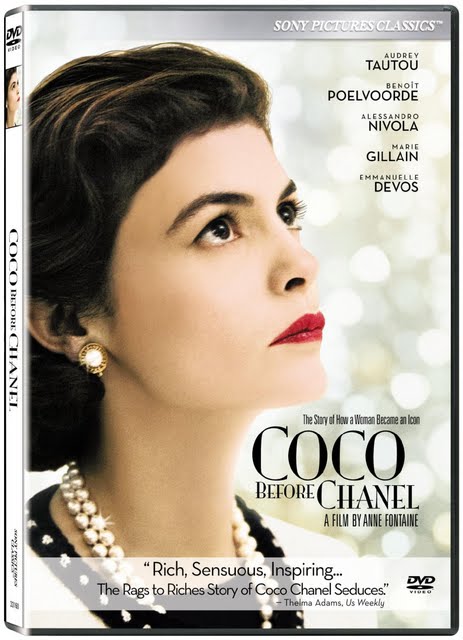
DVD Review: Coco Before Chanel (2009)


Now Available to Own


AKA Coco Avant Chanel

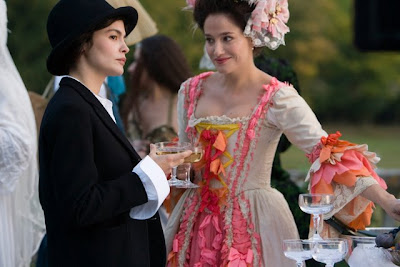
Perhaps since her nickname of Coco came from a flirtatious little cabaret number she sang to collect coins from drunken men, Gabrielle Chanel (Audrey Tautou) was acutely aware of the way that men had a tendency to look at the opposite sex as desserts ready to be devoured.


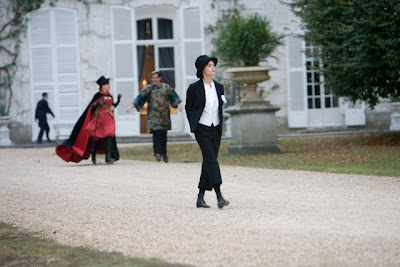
Instead of giving into the ridiculous trends, the orphan whose first taste of male disappointment came from being abandoned by her father whom she loyally waited in vain for every single Sunday, used the comfort, cut and look of her lovers' and male friends' clothes. Instinctively Coco knew that it was always sexier to stand out in a black ensemble than give in to the sea of pastry inspired fashions.


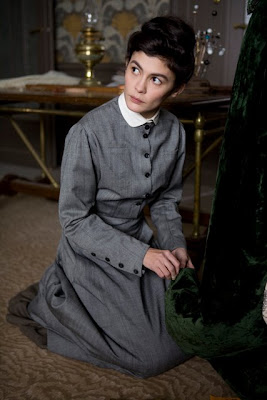
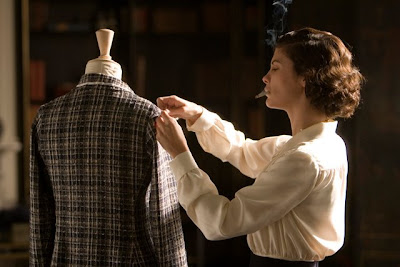
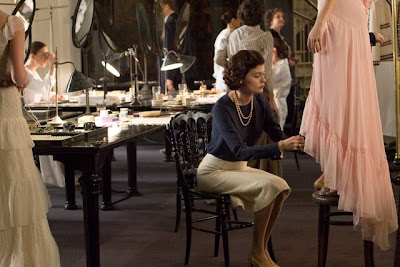
Initially famous for her stylish hats, she tapped right into the time and what she rightly believed as a woman of good sense and former seamstress that others would want to wear as opposed to her pet peeves of heavy “silverware” style jewelry around the neck, painful corsets, or meringues on their heads.


And in director Anne Fontaine's passionately sensuous Coco Before Chanel, the filmmaker takes a cue from the film's subject by rebelling against traditional biopic format to give us a more impressionistic visually imaginative overview of the way that Chanel was inspired by everything around her from the time Gabrielle was ditched by a man to the time that another dubbed her Coco.

Although the production notes reveal that F. Scott Fitzgerald's quintessential American novel, The Great Gatsby was used by design departments as a reference point in the back of their minds, I felt it was distinctly French and all the better for it.


Easily Audrey Tautou's strongest performance since her post-Amelie reunion with Jeunet in A Very Long Engagement-- as the anchor of the film, Coco could've easily gone from runway to runaway based on her turn alone but it's thrilling to see an entirely new and far more mature side of the actress than she's ever been allowed to play before.


Likewise, those familiar with Chanel's life either through the more than forty biographies written about the icon or the recent TV movie Coco Chanel with Shirley MacLaine are aware that she suffered her fair share of heartbreak as an essential courtesan by a man who used her like a geisha but still cared about her in his own way. However, it takes a talented actress and female mindset in the screenwriting and direction to empower Chanel during these tough times when she didn't have the upper hand in any other way than through work.


Furthermore, even if the film-- at a respectable 110 minutes-- does feel overly long, it takes a new “through suffering comes art” approach by ensuring that Coco never realized that is what was happening as the filmmakers illustrate how even the most heartbreaking of experiences defined the style she would share with the world.

Although it isn't quite as magnifique as Anne Fontaine's other 2009 offering, The Girl From Monaco because we're left wanting more of Chanel once Coco comes into her own, it's as delicately crafted yet universally appealing as one of Chanel's designs such as her classic, little black dress.


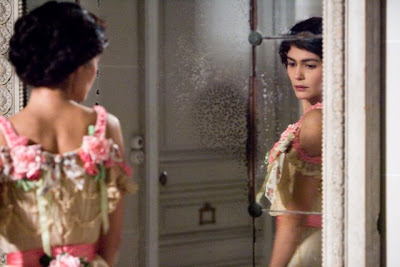
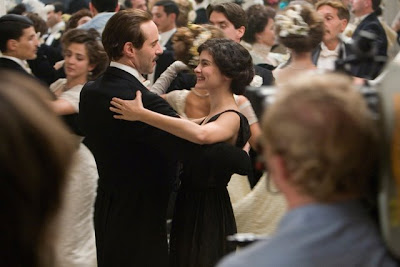
Elegantly photographed by lensman Christophe Beaucarne with Olivier Radot's production design, the film moves seamlessly from what appears to be Renoir inspired seaside paintings to images that one would believe could've been found in the Chanel archives of Mademoiselle's photographs.

While the pacing falls a bit behind at times as your mind races ahead further than the slower moving film, it's nonetheless a technically impressive and emotionally potent film that invites viewers to experience the world through Coco's selective eyes and ears, thanks to the lush compositions of Alexandre Desplat.


Oscar nominated for Catherine Leterrier's Cesar Award winning authentic and entirely original costume designs, which no doubt was helped immensely by the Fashion House of Chanel's cooperation and featuring what is quite possibly Audrey Tautou's best work to date, Sony's transfer of the film looks more than couture ready even on DVD.

Text ©2010, Film Intuition, LLC; All Rights Reserved. http://www.filmintuition.com
Unauthorized Reproduction or Publication Elsewhere is Strictly Prohibited and in violation of the Digital Millennium Copyright Act.

FTC Disclosure:
Per standard professional practice, I received a review copy of this title in order to evaluate it for my readers, which had no impact whatsoever on whether or not it received a favorable or unfavorable critique.
5/04/2008

Priceless


Now Available to Own


A habitual check-splitter, I get embarrassed if an insistent but well-meaning man spends too much on me on dinner let alone trying to procure gifts of diamonds, hotel suites and Chanel from my date. Then again, I’m a regular woman living in the real world and not the gorgeous Audrey Hepburn like Audrey Tautou whose gold digging beauty Irene lives in the world of frothy, sun-drenched France in director Pierre Salvadori’s latest infectious hit Priceless.

With his adorable romantic comedy Apres Vous (After You), Salvadori and his co-writer Benoit Graffin gave legendary comedic director Francis Veber (The Closet, The Dinner Game) a run for his money. For Priceless, they even recruited the charming star Gad Elmaleh of Veber’s most recent film The Valet.

As Jean, Elmaleh plays a role similar to the one in The Valet, as the kind, diligent but largely unappreciated employee at a high class hotel with an inability to say “no,” who routinely fills in for others as the seaside resort’s jack of all trades, walking dogs for the ridiculous, wealthy and ridiculously wealthy and serving as the bartender.

While Jean’s life is all about hard work, Irene (Tautou) covets all things luxurious and expensive as the sexy siren hoping to marry her latest sugar daddy but in a predictable and Veber like twist of fate, ends up mistaking Jean for a high roller, tumbling into bed with him until her meal ticket finds out and kicks her to the curb.

One year later and still smitten with Irene, Jean tries to fill the gentleman’s Prada shoes by digging deep into his savings account, pension and then some to keep her in the lifestyle to which she’s accustomed. Unwilling to change her ways, Irene cleans the man out in one painfully memorable scene that finds Jean awakening to the sound of Irene ripping tags off couture each with a price that makes our economic stimulus package seem like earnings from a child’s lemonade stand. Soon, Jean himself finds he’s the target of a wealthy, older female “cougar” and becomes both Irene’s friend and rival as they try to extract as many gifts as possible from their… ahem, benefactors.

Although we all know just who will end up with whom before the final credits roll, watching the two charismatic leads and their millionaire lovers volley back and forth like pairs in doubles tennis is pure bliss. More importantly, Priceless serves as further proof of not only Salvadori’s directorial skill in the genre but more so in the wake of too many by-the-numbers American rom-coms, that much like Chanel perfume, nobody does sophisticated, irresistible romance like the French.

1/19/2007

He Loves Me, He Loves Me Not (2002)

Director: Laetitia Colombani


Now Available to Own


 It's hard to imagine Amelie's adorable waif, Audrey Tautou going all Glenn Close Fatal Attraction but she manages to try-- not too terribly convinvingly-- for at least half of this creepy little import. The film works well on a purely film student level illustrating the subjectiveness and depection that can arise from clever editing, camera trickery and the medium of cinema. For the first portion of the film, Tautou's lovesick art student chases and satisfies every impulse in her affair with a happily married heart surgeon. In the second half of the film, the tables are turned from “she said” to “he said” and we see things from the doctor's perspective with the viewer quickly realizing Tautou is a dangerous coed cutie with an erotomaniac disorder and frightening crush on a perfect stranger. An unsettling film to be certain but it seems a bit cheap and manipulative at times and Tautou wouldn’t be my top choice to play the stalker.